Project 9: Database ORM Integration
Build a data layer using SQLModel (Pydantic + SQLAlchemy) that shares models between API validation and database operations, with migrations and relationship handling.
Learning Objectives
By completing this project, you will:
- Understand SQLModel’s unified architecture - How it combines Pydantic and SQLAlchemy into a single model
- Master table=True vs table=False patterns - When to create database tables vs validation-only models
- Handle relationships correctly - Foreign keys, one-to-many, many-to-many with proper loading strategies
- Implement the repository pattern - Clean separation between domain logic and data access
- Manage database migrations with Alembic - Schema evolution without data loss
- Use async database operations - Non-blocking database access for high-performance APIs
Deep Theoretical Foundation
Why SQLModel? The Unification Story
Before SQLModel, developers faced a frustrating duplication problem:
WITHOUT SQLModel (The Pain):
┌────────────────────────────────────────────────────────────────────────────┐
│                                                                             │
│  # Pydantic model for API validation                                       │
│  class UserCreate(BaseModel):                                              │
│      email: str                                                            │
│      name: str                                                             │
│      password: str                                                         │
│                                                                             │
│  # SQLAlchemy model for database                                           │
│  class User(Base):                                                         │
│      __tablename__ = "users"                                               │
│      id = Column(Integer, primary_key=True)                                │
│      email = Column(String, unique=True)       ◄── Duplicated!            │
│      name = Column(String)                      ◄── Duplicated!            │
│      hashed_password = Column(String)                                      │
│                                                                             │
│  # You need ANOTHER model for responses                                    │
│  class UserResponse(BaseModel):                                            │
│      id: int                                                               │
│      email: str                                  ◄── Duplicated again!     │
│      name: str                                   ◄── Duplicated again!     │
│                                                                             │
└────────────────────────────────────────────────────────────────────────────┘

WITH SQLModel (The Solution):
┌────────────────────────────────────────────────────────────────────────────┐
│                                                                             │
│  class UserBase(SQLModel):                                                 │
│      email: EmailStr                             # Shared fields           │
│      name: str                                                             │
│                                                                             │
│  class User(UserBase, table=True):               # Database table          │
│      id: Optional[int] = Field(primary_key=True)                          │
│      hashed_password: str                                                  │
│                                                                             │
│  class UserCreate(UserBase):                     # API input               │
│      password: str                                                         │
│                                                                             │
│  class UserRead(UserBase):                       # API output              │
│      id: int                                                               │
│                                                                             │
│  # Same field definitions, different purposes!                             │
│                                                                             │
└────────────────────────────────────────────────────────────────────────────┘
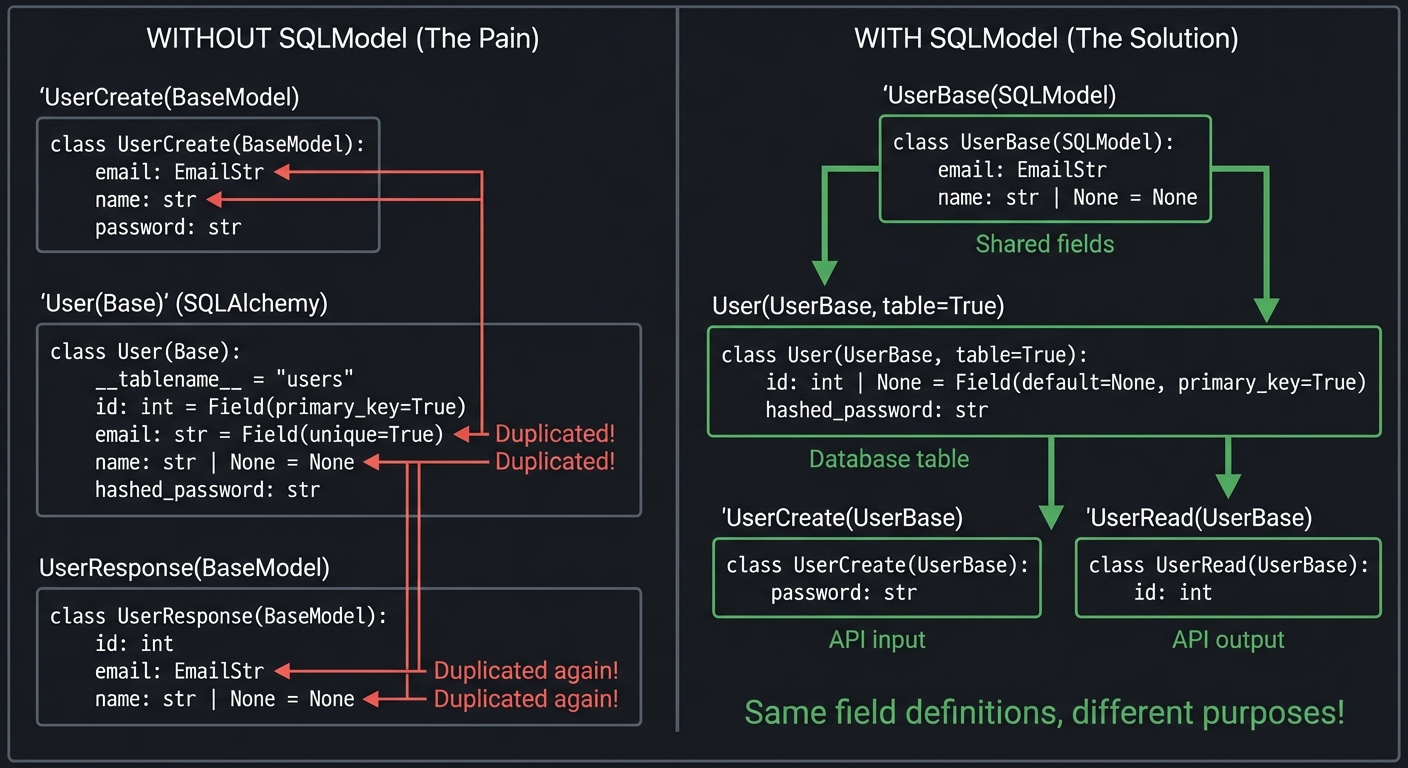
SQLModel was created by Sebastián Ramírez (creator of FastAPI) to solve this exact problem. It inherits from both Pydantic’s BaseModel and SQLAlchemy’s declarative base.
Understanding table=True vs table=False
The table parameter is the key that determines whether a SQLModel class creates a database table:
from sqlmodel import SQLModel, Field
from typing import Optional

# table=False (default): Pure Pydantic validation model
class UserBase(SQLModel):
    """No database table created. Used for validation only."""
    email: str
    name: str
    # This class is essentially a Pydantic BaseModel

# table=True: Creates a database table
class User(UserBase, table=True):
    """Database table 'user' is created with these columns."""
    id: Optional[int] = Field(default=None, primary_key=True)
    hashed_password: str
    # This class maps to a real database table
What happens internally:
When table=False (default):
┌─────────────────────────────────────────────────────────┐
│  class UserBase(SQLModel):                               │
│                                                          │
│  Pydantic Features:                                      │
│    ✓ Type validation                                    │
│    ✓ JSON serialization                                 │
│    ✓ Schema generation                                  │
│                                                          │
│  SQLAlchemy Features:                                    │
│    ✗ No __tablename__                                   │
│    ✗ No Column() mappings                               │
│    ✗ No relationship() support                          │
│    ✗ Not registered with MetaData                       │
└─────────────────────────────────────────────────────────┘

When table=True:
┌─────────────────────────────────────────────────────────┐
│  class User(SQLModel, table=True):                       │
│                                                          │
│  Pydantic Features:                                      │
│    ✓ Type validation                                    │
│    ✓ JSON serialization                                 │
│    ✓ Schema generation                                  │
│                                                          │
│  SQLAlchemy Features:                                    │
│    ✓ __tablename__ = "user" (auto-generated)           │
│    ✓ id → Column(Integer, primary_key=True)            │
│    ✓ email → Column(String)                            │
│    ✓ Registered with MetaData                          │
│    ✓ Can use Relationship()                            │
└─────────────────────────────────────────────────────────┘
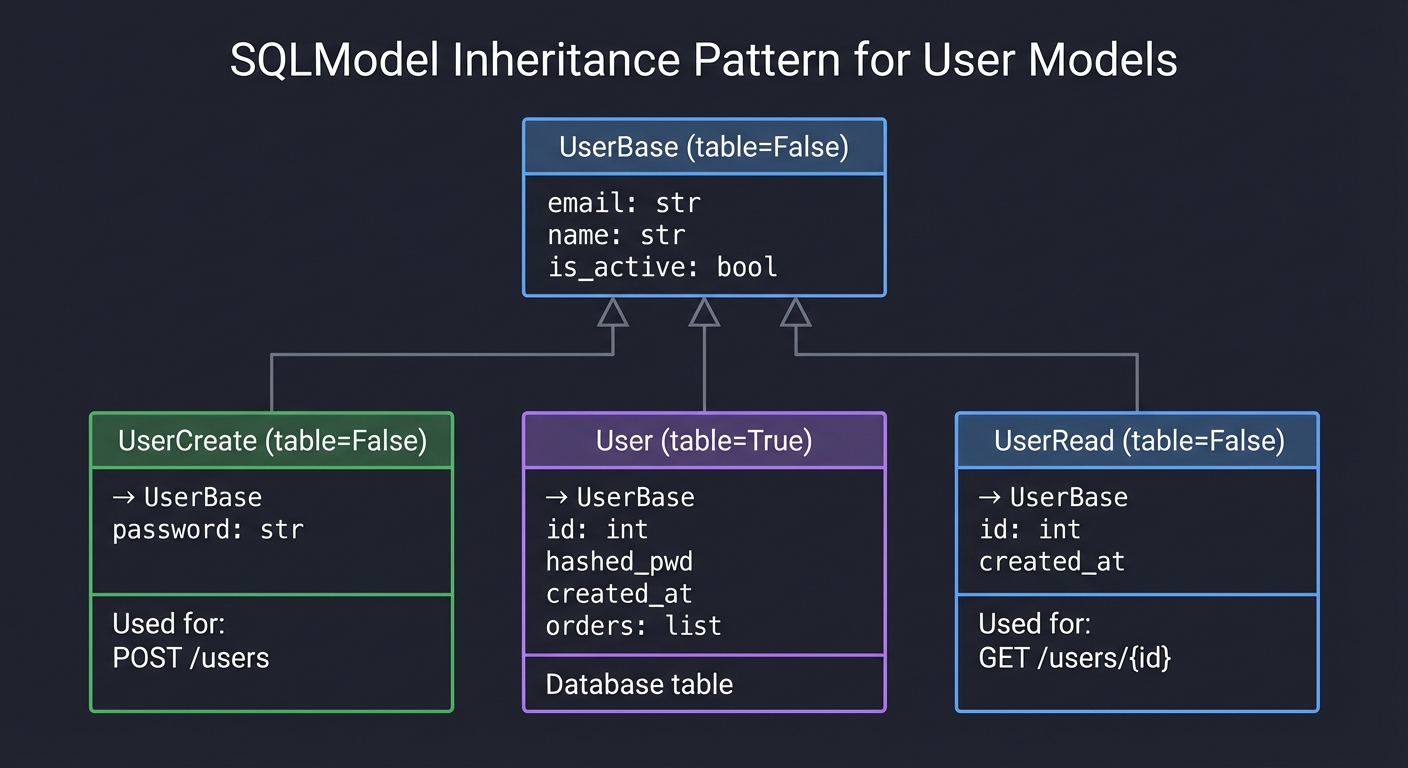
The Model Inheritance Pattern
The recommended pattern for SQLModel projects:
                    ┌─────────────────────┐
                    │      UserBase       │
                    │   (table=False)     │
                    │                     │
                    │  - email: str       │
                    │  - name: str        │
                    │  - is_active: bool  │
                    └──────────┬──────────┘
                               │
           ┌───────────────────┼───────────────────┐
           │                   │                   │
           ▼                   ▼                   ▼
┌─────────────────┐  ┌─────────────────┐  ┌─────────────────┐
│   UserCreate    │  │      User       │  │    UserRead     │
│ (table=False)   │  │  (table=True)   │  │ (table=False)   │
│                 │  │                 │  │                 │
│ Inherits base + │  │ Inherits base + │  │ Inherits base + │
│ + password: str │  │ + id: int       │  │ + id: int       │
│                 │  │ + hashed_pwd    │  │ + created_at    │
│                 │  │ + created_at    │  │                 │
│ Used for:       │  │ + orders: list  │  │ Used for:       │
│ POST /users     │  │                 │  │ GET /users/{id} │
└─────────────────┘  │ Database table  │  └─────────────────┘
                     └─────────────────┘
Relationship Handling and Foreign Keys
SQLModel supports SQLAlchemy-style relationships:
from sqlmodel import SQLModel, Field, Relationship
from typing import Optional, List

class Team(SQLModel, table=True):
    id: Optional[int] = Field(default=None, primary_key=True)
    name: str

    # One-to-many: A team has many heroes
    heroes: List["Hero"] = Relationship(back_populates="team")

class Hero(SQLModel, table=True):
    id: Optional[int] = Field(default=None, primary_key=True)
    name: str

    # Foreign key column
    team_id: Optional[int] = Field(default=None, foreign_key="team.id")

    # Relationship back to Team
    team: Optional[Team] = Relationship(back_populates="heroes")
Relationship types:
ONE-TO-MANY (User has many Orders):
┌─────────────┐         ┌─────────────┐
│    User     │ 1     N │    Order    │
│─────────────│◄────────│─────────────│
│ id (PK)     │         │ id (PK)     │
│ name        │         │ user_id (FK)│
│             │         │ total       │
└─────────────┘         └─────────────┘

class User(SQLModel, table=True):
    id: Optional[int] = Field(primary_key=True)
    orders: List["Order"] = Relationship(back_populates="user")

class Order(SQLModel, table=True):
    id: Optional[int] = Field(primary_key=True)
    user_id: int = Field(foreign_key="user.id")
    user: Optional[User] = Relationship(back_populates="orders")


MANY-TO-MANY (Users have many Roles, Roles have many Users):
┌─────────────┐         ┌─────────────┐         ┌─────────────┐
│    User     │ N     M │  UserRole   │ M     N │    Role     │
│─────────────│◄────────│─────────────│────────►│─────────────│
│ id (PK)     │         │ user_id (FK)│         │ id (PK)     │
│ name        │         │ role_id (FK)│         │ name        │
└─────────────┘         └─────────────┘         └─────────────┘

class UserRoleLink(SQLModel, table=True):
    user_id: int = Field(foreign_key="user.id", primary_key=True)
    role_id: int = Field(foreign_key="role.id", primary_key=True)

class User(SQLModel, table=True):
    id: Optional[int] = Field(primary_key=True)
    roles: List["Role"] = Relationship(
        back_populates="users",
        link_model=UserRoleLink
    )

class Role(SQLModel, table=True):
    id: Optional[int] = Field(primary_key=True)
    users: List["User"] = Relationship(
        back_populates="roles",
        link_model=UserRoleLink
    )
The Repository Pattern
The repository pattern abstracts database operations behind a clean interface:
┌─────────────────────────────────────────────────────────────────────────┐
│                            API Layer                                     │
│                                                                          │
│  @app.post("/users")                                                    │
│  async def create_user(user: UserCreate):                               │
│      return user_repo.create(user)                                      │
│                                                                          │
└─────────────────────────────────────┬───────────────────────────────────┘
                                      │
                                      ▼
┌─────────────────────────────────────────────────────────────────────────┐
│                        Repository Layer                                  │
│                                                                          │
│  class UserRepository:                                                   │
│      def create(self, data: UserCreate) -> User: ...                    │
│      def get_by_id(self, id: int) -> Optional[User]: ...               │
│      def list(self, skip: int, limit: int) -> List[User]: ...          │
│      def update(self, id: int, data: UserUpdate) -> User: ...          │
│      def delete(self, id: int) -> bool: ...                            │
│                                                                          │
│  Benefits:                                                               │
│    - Testable (can mock the repository)                                 │
│    - Swappable (can change database without changing API)               │
│    - Clean (business logic doesn't know about SQL)                      │
│                                                                          │
└─────────────────────────────────────┬───────────────────────────────────┘
                                      │
                                      ▼
┌─────────────────────────────────────────────────────────────────────────┐
│                         Database Layer                                   │
│                                                                          │
│  SQLModel Session                                                        │
│    - session.add(user)                                                  │
│    - session.commit()                                                   │
│    - session.exec(select(User).where(...))                             │
│                                                                          │
└─────────────────────────────────────────────────────────────────────────┘
Database Migrations with Alembic
Alembic manages schema changes over time:
Initial State:                    After Migration:
┌─────────────────────┐           ┌─────────────────────┐
│       users         │           │       users         │
│─────────────────────│   ──►     │─────────────────────│
│ id: INTEGER (PK)    │           │ id: INTEGER (PK)    │
│ email: VARCHAR      │           │ email: VARCHAR      │
│ name: VARCHAR       │           │ name: VARCHAR       │
│                     │           │ created_at: DATETIME│ ◄── NEW!
│                     │           │ is_active: BOOLEAN  │ ◄── NEW!
└─────────────────────┘           └─────────────────────┘

Migration file (versions/001_add_user_fields.py):

def upgrade():
    op.add_column('users', sa.Column('created_at', sa.DateTime()))
    op.add_column('users', sa.Column('is_active', sa.Boolean(), default=True))

def downgrade():
    op.drop_column('users', 'created_at')
    op.drop_column('users', 'is_active')
Alembic workflow:
# Initialize Alembic
alembic init alembic

# Generate migration from model changes
alembic revision --autogenerate -m "Add user fields"

# Apply migrations
alembic upgrade head

# Rollback
alembic downgrade -1

# View migration history
alembic history
Async Database Operations
For high-performance APIs, use async database operations:
from sqlmodel import SQLModel
from sqlmodel.ext.asyncio.session import AsyncSession
from sqlalchemy.ext.asyncio import create_async_engine, async_sessionmaker

# Async engine
DATABASE_URL = "postgresql+asyncpg://user:pass@localhost/db"
engine = create_async_engine(DATABASE_URL, echo=True)

# Async session factory
async_session = async_sessionmaker(
    engine,
    class_=AsyncSession,
    expire_on_commit=False
)

# Usage in FastAPI
async def get_session() -> AsyncSession:
    async with async_session() as session:
        yield session

@app.get("/users/{user_id}")
async def get_user(
    user_id: int,
    session: AsyncSession = Depends(get_session)
):
    result = await session.exec(
        select(User).where(User.id == user_id)
    )
    user = result.first()
    if not user:
        raise HTTPException(404)
    return user
Sync vs Async comparison:
SYNCHRONOUS (Blocking):
┌─────────────────────────────────────────────────────────────┐
│  Request 1   ████████████████████████░░░░░░░░░░░░░░░░░░░░░ │
│  Request 2   ░░░░░░░░░░░░░░░░░░░░░░░░████████████████████░░ │
│  Request 3   ░░░░░░░░░░░░░░░░░░░░░░░░░░░░░░░░░░░░░░░░░████ │
│                                                              │
│  Each request blocks until database responds                │
└─────────────────────────────────────────────────────────────┘

ASYNCHRONOUS (Non-blocking):
┌─────────────────────────────────────────────────────────────┐
│  Request 1   ████░░░░░░░░░░████░░░░░░░░░░████               │
│  Request 2   ░░░░████░░░░░░░░░░████░░░░░░░░░░████           │
│  Request 3   ░░░░░░░░████░░░░░░░░░░████░░░░░░░░░░████       │
│                                                              │
│  Requests interleave during I/O waits                       │
│  Same time, more throughput!                                │
└─────────────────────────────────────────────────────────────┘
from_attributes for ORM Compatibility
When returning ORM objects from FastAPI, you need from_attributes:
from pydantic import ConfigDict
from sqlmodel import SQLModel, Field
from typing import Optional

class UserRead(SQLModel):
    """Response model that can read from ORM objects."""
    id: int
    email: str
    name: str

    # This allows Pydantic to read from SQLAlchemy objects
    model_config = ConfigDict(from_attributes=True)

# Now this works:
@app.get("/users/{user_id}", response_model=UserRead)
async def get_user(user_id: int, session: Session = Depends(get_session)):
    user = session.get(User, user_id)  # Returns SQLModel table instance
    return user  # Automatically converted to UserRead
How from_attributes works:
Without from_attributes=True:
┌─────────────────────────────────────────────────────────────┐
│                                                              │
│  User(table=True) instance                                  │
│  ├── id = 1                                                 │
│  ├── email = "john@example.com"                            │
│  └── name = "John"                                         │
│                                                              │
│           ▼ Try to create UserRead                          │
│                                                              │
│  ERROR: Input should be a valid dictionary                  │
│         (Pydantic expects dict, not ORM object)             │
│                                                              │
└─────────────────────────────────────────────────────────────┘

With from_attributes=True:
┌─────────────────────────────────────────────────────────────┐
│                                                              │
│  User(table=True) instance                                  │
│  ├── id = 1                                                 │
│  ├── email = "john@example.com"                            │
│  └── name = "John"                                         │
│                                                              │
│           ▼ Pydantic reads attributes                       │
│                                                              │
│  UserRead(                                                  │
│      id=getattr(user, 'id'),                               │
│      email=getattr(user, 'email'),                         │
│      name=getattr(user, 'name')                            │
│  )                                                          │
│                                                              │
│  SUCCESS: UserRead(id=1, email="john@example.com", ...)    │
│                                                              │
└─────────────────────────────────────────────────────────────┘
Project Specification
Functional Requirements
Build a complete e-commerce data layer that demonstrates:
- User management with authentication fields
- Product catalog with categories and inventory
- Order processing with line items and status tracking
- Full CRUD through a repository pattern
- Database migrations with Alembic
- Both sync and async database operations
Data Model
┌─────────────────────────────────────────────────────────────────────────────┐
│                                                                              │
│  ┌───────────────┐       ┌────────────────┐       ┌───────────────┐        │
│  │    Category   │ 1   N │    Product     │       │     User      │        │
│  │───────────────│◄──────│────────────────│       │───────────────│        │
│  │ id (PK)       │       │ id (PK)        │       │ id (PK)       │        │
│  │ name          │       │ name           │       │ email (unique)│        │
│  │ description   │       │ description    │       │ name          │        │
│  │ created_at    │       │ price          │       │ hashed_pwd    │        │
│  │               │       │ stock_quantity │       │ is_active     │        │
│  │               │       │ category_id(FK)│       │ created_at    │        │
│  │               │       │ created_at     │       │               │        │
│  └───────────────┘       └───────┬────────┘       └───────┬───────┘        │
│                                  │                        │                 │
│                                  │ N                      │ 1               │
│                                  │                        │                 │
│                                  ▼                        ▼                 │
│                         ┌────────────────┐       ┌───────────────┐         │
│                         │   OrderItem    │ N   1 │     Order     │         │
│                         │────────────────│──────►│───────────────│         │
│                         │ id (PK)        │       │ id (PK)       │         │
│                         │ order_id (FK)  │       │ user_id (FK)  │         │
│                         │ product_id(FK) │       │ status        │         │
│                         │ quantity       │       │ total_amount  │         │
│                         │ unit_price     │       │ created_at    │         │
│                         │                │       │ updated_at    │         │
│                         └────────────────┘       └───────────────┘         │
│                                                                              │
└─────────────────────────────────────────────────────────────────────────────┘
API Endpoints
Categories:
  POST   /categories                     Create category
  GET    /categories                     List categories
  GET    /categories/{id}                Get category with products
  PATCH  /categories/{id}                Update category
  DELETE /categories/{id}                Delete category

Products:
  POST   /products                       Create product
  GET    /products                       List products (with filters)
  GET    /products/{id}                  Get product details
  PATCH  /products/{id}                  Update product
  DELETE /products/{id}                  Delete product
  POST   /products/{id}/stock            Adjust stock

Users:
  POST   /users                          Register user
  GET    /users/{id}                     Get user profile
  PATCH  /users/{id}                     Update user
  DELETE /users/{id}                     Deactivate user

Orders:
  POST   /orders                         Create order
  GET    /orders                         List orders (with filters)
  GET    /orders/{id}                    Get order with items
  PATCH  /orders/{id}/status             Update order status
  DELETE /orders/{id}                    Cancel order
Solution Architecture
Project Structure
ecommerce-sqlmodel/
├── app/
│   ├── __init__.py
│   ├── main.py                   # FastAPI application
│   ├── config.py                 # Settings with pydantic-settings
│   │
│   ├── models/                   # SQLModel models
│   │   ├── __init__.py
│   │   ├── base.py               # Base classes and common fields
│   │   ├── user.py               # User models (table + schemas)
│   │   ├── category.py           # Category models
│   │   ├── product.py            # Product models
│   │   └── order.py              # Order and OrderItem models
│   │
│   ├── repositories/             # Data access layer
│   │   ├── __init__.py
│   │   ├── base.py               # Generic repository base
│   │   ├── user_repository.py
│   │   ├── category_repository.py
│   │   ├── product_repository.py
│   │   └── order_repository.py
│   │
│   ├── routes/                   # API routes
│   │   ├── __init__.py
│   │   ├── users.py
│   │   ├── categories.py
│   │   ├── products.py
│   │   └── orders.py
│   │
│   ├── services/                 # Business logic
│   │   ├── __init__.py
│   │   ├── user_service.py
│   │   ├── product_service.py
│   │   └── order_service.py
│   │
│   └── db/                       # Database configuration
│       ├── __init__.py
│       ├── engine.py             # Engine and session
│       └── init_db.py            # Database initialization
│
├── alembic/                      # Migrations
│   ├── versions/
│   ├── env.py
│   └── alembic.ini
│
├── tests/
│   ├── __init__.py
│   ├── conftest.py               # Fixtures
│   ├── test_models.py
│   ├── test_repositories.py
│   └── test_api.py
│
├── pyproject.toml
└── README.md
Component Diagram
┌─────────────────────────────────────────────────────────────────────────────┐
│                                  main.py                                     │
│  - FastAPI app                                                               │
│  - Exception handlers                                                        │
│  - Lifespan events (DB init)                                                │
└─────────────────────────────────────┬───────────────────────────────────────┘
                                      │
              ┌───────────────────────┼───────────────────────┐
              ▼                       ▼                       ▼
┌───────────────────────┐ ┌───────────────────────┐ ┌───────────────────────┐
│    routes/users.py    │ │  routes/products.py   │ │   routes/orders.py    │
│  - Input validation   │ │  - Input validation   │ │  - Input validation   │
│  - HTTP handling      │ │  - Query params       │ │  - Status transitions │
└───────────┬───────────┘ └───────────┬───────────┘ └───────────┬───────────┘
            │                         │                         │
            ▼                         ▼                         ▼
┌───────────────────────┐ ┌───────────────────────┐ ┌───────────────────────┐
│  services/user_svc.py │ │ services/product_svc  │ │  services/order_svc   │
│  - Business rules     │ │ - Stock management    │ │  - Order creation     │
│  - Password hashing   │ │ - Price calculation   │ │  - Total calculation  │
└───────────┬───────────┘ └───────────┬───────────┘ └───────────┬───────────┘
            │                         │                         │
            ▼                         ▼                         ▼
┌─────────────────────────────────────────────────────────────────────────────┐
│                           repositories/                                       │
│  - UserRepository      - ProductRepository      - OrderRepository            │
│  - Generic CRUD        - Stock queries          - Order with items           │
│  - SQL abstraction     - Category filters       - Status updates             │
└─────────────────────────────────────┬───────────────────────────────────────┘
                                      │
                                      ▼
┌─────────────────────────────────────────────────────────────────────────────┐
│                              db/engine.py                                    │
│  - SQLModel engine          - Session factory          - Async support      │
└─────────────────────────────────────┬───────────────────────────────────────┘
                                      │
                                      ▼
                             ┌─────────────────┐
                             │   PostgreSQL    │
                             │    Database     │
                             └─────────────────┘
Data Flow for Order Creation
POST /orders
{
  "user_id": 1,
  "items": [
    {"product_id": 101, "quantity": 2},
    {"product_id": 102, "quantity": 1}
  ]
}
         │
         ▼
┌─────────────────────────────────────────────────────────────────────────────┐
│  Route: create_order(order_create: OrderCreate)                              │
│  - Validate input with Pydantic                                             │
│  - Call OrderService                                                         │
└─────────────────────────────────────┬───────────────────────────────────────┘
                                      │
                                      ▼
┌─────────────────────────────────────────────────────────────────────────────┐
│  OrderService.create_order()                                                 │
│  1. Verify user exists                                                       │
│  2. Verify products exist and have stock                                    │
│  3. Calculate total from product prices × quantities                        │
│  4. Create Order and OrderItems in transaction                              │
│  5. Deduct stock from products                                              │
└─────────────────────────────────────┬───────────────────────────────────────┘
                                      │
                                      ▼
┌─────────────────────────────────────────────────────────────────────────────┐
│  OrderRepository.create_with_items(order, items)                             │
│  session.begin()                                                             │
│  session.add(order)                                                          │
│  session.add_all(order_items)                                               │
│  session.commit()                                                            │
│  session.refresh(order)                                                      │
└─────────────────────────────────────┬───────────────────────────────────────┘
                                      │
                                      ▼
┌─────────────────────────────────────────────────────────────────────────────┐
│  Response: OrderRead                                                         │
│  {                                                                           │
│    "id": 1,                                                                  │
│    "user_id": 1,                                                            │
│    "status": "pending",                                                      │
│    "total_amount": 149.97,                                                  │
│    "items": [                                                                │
│      {"product_id": 101, "quantity": 2, "unit_price": 49.99},              │
│      {"product_id": 102, "quantity": 1, "unit_price": 49.99}               │
│    ]                                                                         │
│  }                                                                           │
└─────────────────────────────────────────────────────────────────────────────┘
Phased Implementation Guide
Phase 1: Project Setup and Base Models (1-2 hours)
Goal: Set up the project structure with database connection.
Step 1: Create project and install dependencies:
mkdir ecommerce-sqlmodel && cd ecommerce-sqlmodel
python -m venv venv
source venv/bin/activate

pip install fastapi uvicorn sqlmodel alembic asyncpg psycopg2-binary pydantic-settings python-dotenv
Step 2: Create database configuration:
# app/config.py
from pydantic_settings import BaseSettings

class Settings(BaseSettings):
    database_url: str = "postgresql://user:pass@localhost/ecommerce"
    database_echo: bool = False

    class Config:
        env_file = ".env"

settings = Settings()
Step 3: Create database engine:
# app/db/engine.py
from sqlmodel import SQLModel, create_engine, Session
from app.config import settings

engine = create_engine(settings.database_url, echo=settings.database_echo)

def get_session():
    with Session(engine) as session:
        yield session

def create_db_and_tables():
    SQLModel.metadata.create_all(engine)
Step 4: Create base model:
# app/models/base.py
from sqlmodel import SQLModel, Field
from datetime import datetime
from typing import Optional

class TimestampMixin(SQLModel):
    """Mixin for created_at and updated_at fields."""
    created_at: datetime = Field(default_factory=datetime.utcnow)
    updated_at: Optional[datetime] = Field(default=None)
Checkpoint: Can connect to database and create tables.
Phase 2: User Models and Repository (2 hours)
Goal: Implement complete user management with the repository pattern.
Step 1: Create user models:
# app/models/user.py
from sqlmodel import SQLModel, Field, Relationship
from pydantic import EmailStr, ConfigDict
from typing import Optional, List, TYPE_CHECKING
from datetime import datetime

if TYPE_CHECKING:
    from .order import Order

# Base fields shared across models
class UserBase(SQLModel):
    email: EmailStr = Field(unique=True, index=True)
    name: str = Field(min_length=1, max_length=100)
    is_active: bool = Field(default=True)

# Database table
class User(UserBase, table=True):
    id: Optional[int] = Field(default=None, primary_key=True)
    hashed_password: str
    created_at: datetime = Field(default_factory=datetime.utcnow)

    # Relationships
    orders: List["Order"] = Relationship(back_populates="user")

# API Input: Create
class UserCreate(UserBase):
    password: str = Field(min_length=8, max_length=100)

# API Input: Update
class UserUpdate(SQLModel):
    email: Optional[EmailStr] = None
    name: Optional[str] = Field(None, min_length=1, max_length=100)
    password: Optional[str] = Field(None, min_length=8, max_length=100)
    is_active: Optional[bool] = None

# API Output
class UserRead(UserBase):
    id: int
    created_at: datetime

    model_config = ConfigDict(from_attributes=True)
Step 2: Create user repository:
# app/repositories/user_repository.py
from sqlmodel import Session, select
from typing import Optional, List
from app.models.user import User, UserCreate, UserUpdate
import hashlib

def hash_password(password: str) -> str:
    """Simple hash for demo. Use bcrypt in production!"""
    return hashlib.sha256(password.encode()).hexdigest()

class UserRepository:
    def __init__(self, session: Session):
        self.session = session

    def create(self, user_create: UserCreate) -> User:
        user = User(
            email=user_create.email,
            name=user_create.name,
            hashed_password=hash_password(user_create.password)
        )
        self.session.add(user)
        self.session.commit()
        self.session.refresh(user)
        return user

    def get_by_id(self, user_id: int) -> Optional[User]:
        return self.session.get(User, user_id)

    def get_by_email(self, email: str) -> Optional[User]:
        statement = select(User).where(User.email == email)
        return self.session.exec(statement).first()

    def list(self, skip: int = 0, limit: int = 100) -> List[User]:
        statement = select(User).offset(skip).limit(limit)
        return self.session.exec(statement).all()

    def update(self, user_id: int, user_update: UserUpdate) -> Optional[User]:
        user = self.get_by_id(user_id)
        if not user:
            return None

        update_data = user_update.model_dump(exclude_unset=True)
        if "password" in update_data:
            update_data["hashed_password"] = hash_password(update_data.pop("password"))

        for key, value in update_data.items():
            setattr(user, key, value)

        self.session.add(user)
        self.session.commit()
        self.session.refresh(user)
        return user

    def delete(self, user_id: int) -> bool:
        user = self.get_by_id(user_id)
        if not user:
            return False
        self.session.delete(user)
        self.session.commit()
        return True
Checkpoint: Can create, read, update, delete users through repository.
Phase 3: Product and Category Models (2 hours)
Goal: Implement product catalog with category relationships.
Step 1: Create category model:
# app/models/category.py
from sqlmodel import SQLModel, Field, Relationship
from typing import Optional, List, TYPE_CHECKING
from datetime import datetime
from pydantic import ConfigDict

if TYPE_CHECKING:
    from .product import Product

class CategoryBase(SQLModel):
    name: str = Field(min_length=1, max_length=100)
    description: Optional[str] = Field(None, max_length=500)

class Category(CategoryBase, table=True):
    id: Optional[int] = Field(default=None, primary_key=True)
    created_at: datetime = Field(default_factory=datetime.utcnow)

    products: List["Product"] = Relationship(back_populates="category")

class CategoryCreate(CategoryBase):
    pass

class CategoryRead(CategoryBase):
    id: int
    created_at: datetime
    product_count: int = 0

    model_config = ConfigDict(from_attributes=True)

class CategoryReadWithProducts(CategoryRead):
    products: List["ProductRead"] = []
Step 2: Create product model:
# app/models/product.py
from sqlmodel import SQLModel, Field, Relationship
from typing import Optional, TYPE_CHECKING
from datetime import datetime
from decimal import Decimal
from pydantic import ConfigDict

if TYPE_CHECKING:
    from .category import Category

class ProductBase(SQLModel):
    name: str = Field(min_length=1, max_length=200)
    description: Optional[str] = Field(None, max_length=2000)
    price: Decimal = Field(ge=0, decimal_places=2)
    stock_quantity: int = Field(ge=0, default=0)

class Product(ProductBase, table=True):
    id: Optional[int] = Field(default=None, primary_key=True)
    category_id: Optional[int] = Field(default=None, foreign_key="category.id")
    created_at: datetime = Field(default_factory=datetime.utcnow)
    updated_at: Optional[datetime] = None

    category: Optional["Category"] = Relationship(back_populates="products")

class ProductCreate(ProductBase):
    category_id: Optional[int] = None

class ProductUpdate(SQLModel):
    name: Optional[str] = Field(None, min_length=1, max_length=200)
    description: Optional[str] = None
    price: Optional[Decimal] = Field(None, ge=0)
    stock_quantity: Optional[int] = Field(None, ge=0)
    category_id: Optional[int] = None

class ProductRead(ProductBase):
    id: int
    category_id: Optional[int]
    created_at: datetime

    model_config = ConfigDict(from_attributes=True)

class ProductReadWithCategory(ProductRead):
    category: Optional["CategoryRead"] = None
Checkpoint: Can manage products and categories with relationships.
Phase 4: Order Models with Transactions (2-3 hours)
Goal: Implement order processing with proper transaction handling.
Step 1: Create order models:
# app/models/order.py
from sqlmodel import SQLModel, Field, Relationship
from typing import Optional, List, TYPE_CHECKING
from datetime import datetime
from decimal import Decimal
from enum import Enum
from pydantic import ConfigDict

if TYPE_CHECKING:
    from .user import User
    from .product import Product

class OrderStatus(str, Enum):
    pending = "pending"
    confirmed = "confirmed"
    processing = "processing"
    shipped = "shipped"
    delivered = "delivered"
    cancelled = "cancelled"

class OrderItemBase(SQLModel):
    quantity: int = Field(ge=1)
    unit_price: Decimal = Field(ge=0, decimal_places=2)

class OrderItem(OrderItemBase, table=True):
    id: Optional[int] = Field(default=None, primary_key=True)
    order_id: int = Field(foreign_key="order.id")
    product_id: int = Field(foreign_key="product.id")

    order: Optional["Order"] = Relationship(back_populates="items")
    product: Optional["Product"] = Relationship()

class OrderBase(SQLModel):
    status: OrderStatus = Field(default=OrderStatus.pending)
    total_amount: Decimal = Field(ge=0, decimal_places=2, default=0)

class Order(OrderBase, table=True):
    id: Optional[int] = Field(default=None, primary_key=True)
    user_id: int = Field(foreign_key="user.id")
    created_at: datetime = Field(default_factory=datetime.utcnow)
    updated_at: Optional[datetime] = None

    user: Optional["User"] = Relationship(back_populates="orders")
    items: List["OrderItem"] = Relationship(back_populates="order")

# API Input
class OrderItemCreate(SQLModel):
    product_id: int
    quantity: int = Field(ge=1)

class OrderCreate(SQLModel):
    user_id: int
    items: List[OrderItemCreate]

# API Output
class OrderItemRead(OrderItemBase):
    id: int
    product_id: int

    model_config = ConfigDict(from_attributes=True)

class OrderRead(OrderBase):
    id: int
    user_id: int
    created_at: datetime
    items: List[OrderItemRead] = []

    model_config = ConfigDict(from_attributes=True)
Step 2: Create order service with transaction:
# app/services/order_service.py
from sqlmodel import Session, select
from typing import Optional
from decimal import Decimal
from app.models.order import Order, OrderItem, OrderCreate, OrderStatus
from app.models.product import Product
from app.models.user import User

class InsufficientStockError(Exception):
    def __init__(self, product_id: int, requested: int, available: int):
        self.product_id = product_id
        self.requested = requested
        self.available = available
        super().__init__(f"Product {product_id}: requested {requested}, available {available}")

class OrderService:
    def __init__(self, session: Session):
        self.session = session

    def create_order(self, order_create: OrderCreate) -> Order:
        # Verify user exists
        user = self.session.get(User, order_create.user_id)
        if not user:
            raise ValueError(f"User {order_create.user_id} not found")

        # Verify products and calculate total
        total = Decimal("0.00")
        order_items = []

        for item in order_create.items:
            product = self.session.get(Product, item.product_id)
            if not product:
                raise ValueError(f"Product {item.product_id} not found")

            if product.stock_quantity < item.quantity:
                raise InsufficientStockError(
                    item.product_id,
                    item.quantity,
                    product.stock_quantity
                )

            item_total = product.price * item.quantity
            total += item_total

            order_items.append({
                "product": product,
                "quantity": item.quantity,
                "unit_price": product.price
            })

        # Create order
        order = Order(
            user_id=order_create.user_id,
            total_amount=total,
            status=OrderStatus.pending
        )
        self.session.add(order)
        self.session.flush()  # Get order.id without committing

        # Create order items and deduct stock
        for item_data in order_items:
            order_item = OrderItem(
                order_id=order.id,
                product_id=item_data["product"].id,
                quantity=item_data["quantity"],
                unit_price=item_data["unit_price"]
            )
            self.session.add(order_item)

            # Deduct stock
            item_data["product"].stock_quantity -= item_data["quantity"]
            self.session.add(item_data["product"])

        self.session.commit()
        self.session.refresh(order)
        return order

    def update_status(self, order_id: int, new_status: OrderStatus) -> Optional[Order]:
        order = self.session.get(Order, order_id)
        if not order:
            return None

        # Status transition validation
        valid_transitions = {
            OrderStatus.pending: [OrderStatus.confirmed, OrderStatus.cancelled],
            OrderStatus.confirmed: [OrderStatus.processing, OrderStatus.cancelled],
            OrderStatus.processing: [OrderStatus.shipped, OrderStatus.cancelled],
            OrderStatus.shipped: [OrderStatus.delivered],
            OrderStatus.delivered: [],
            OrderStatus.cancelled: []
        }

        if new_status not in valid_transitions.get(order.status, []):
            raise ValueError(f"Cannot transition from {order.status} to {new_status}")

        order.status = new_status
        self.session.add(order)
        self.session.commit()
        self.session.refresh(order)
        return order
Checkpoint: Can create orders with stock validation and transactions.
Phase 5: Alembic Migrations (1-2 hours)
Goal: Set up and use Alembic for schema migrations.
Step 1: Initialize Alembic:
alembic init alembic
Step 2: Configure Alembic to use SQLModel:
# alembic/env.py
from logging.config import fileConfig
from sqlalchemy import engine_from_config, pool
from alembic import context
from sqlmodel import SQLModel

# Import all models so they're registered with SQLModel.metadata
from app.models.user import User
from app.models.category import Category
from app.models.product import Product
from app.models.order import Order, OrderItem

# This is the Alembic Config object
config = context.config

# Interpret the config file for Python logging
if config.config_file_name is not None:
    fileConfig(config.config_file_name)

# Use SQLModel metadata
target_metadata = SQLModel.metadata

def run_migrations_offline() -> None:
    """Run migrations in 'offline' mode."""
    url = config.get_main_option("sqlalchemy.url")
    context.configure(
        url=url,
        target_metadata=target_metadata,
        literal_binds=True,
        dialect_opts={"paramstyle": "named"},
    )

    with context.begin_transaction():
        context.run_migrations()

def run_migrations_online() -> None:
    """Run migrations in 'online' mode."""
    connectable = engine_from_config(
        config.get_section(config.config_ini_section, {}),
        prefix="sqlalchemy.",
        poolclass=pool.NullPool,
    )

    with connectable.connect() as connection:
        context.configure(
            connection=connection,
            target_metadata=target_metadata
        )

        with context.begin_transaction():
            context.run_migrations()

if context.is_offline_mode():
    run_migrations_offline()
else:
    run_migrations_online()
Step 3: Generate initial migration:
alembic revision --autogenerate -m "Initial schema"
alembic upgrade head
Checkpoint: Can generate and apply database migrations.
Phase 6: FastAPI Integration and Testing (2-3 hours)
Goal: Wire everything together with FastAPI routes and tests.
Step 1: Create the main application:
# app/main.py
from fastapi import FastAPI, Depends, HTTPException
from sqlmodel import Session
from contextlib import asynccontextmanager

from app.db.engine import create_db_and_tables, get_session
from app.routes import users, products, categories, orders

@asynccontextmanager
async def lifespan(app: FastAPI):
    create_db_and_tables()
    yield

app = FastAPI(
    title="E-Commerce API",
    description="SQLModel-powered e-commerce backend",
    version="1.0.0",
    lifespan=lifespan
)

app.include_router(users.router, prefix="/users", tags=["users"])
app.include_router(categories.router, prefix="/categories", tags=["categories"])
app.include_router(products.router, prefix="/products", tags=["products"])
app.include_router(orders.router, prefix="/orders", tags=["orders"])

@app.get("/health")
async def health():
    return {"status": "healthy"}
Step 2: Create routes:
# app/routes/users.py
from fastapi import APIRouter, Depends, HTTPException
from sqlmodel import Session
from typing import List

from app.db.engine import get_session
from app.models.user import UserCreate, UserRead, UserUpdate
from app.repositories.user_repository import UserRepository

router = APIRouter()

@router.post("", response_model=UserRead, status_code=201)
def create_user(
    user: UserCreate,
    session: Session = Depends(get_session)
):
    repo = UserRepository(session)
    if repo.get_by_email(user.email):
        raise HTTPException(409, "Email already registered")
    return repo.create(user)

@router.get("", response_model=List[UserRead])
def list_users(
    skip: int = 0,
    limit: int = 100,
    session: Session = Depends(get_session)
):
    repo = UserRepository(session)
    return repo.list(skip, limit)

@router.get("/{user_id}", response_model=UserRead)
def get_user(user_id: int, session: Session = Depends(get_session)):
    repo = UserRepository(session)
    user = repo.get_by_id(user_id)
    if not user:
        raise HTTPException(404, "User not found")
    return user

@router.patch("/{user_id}", response_model=UserRead)
def update_user(
    user_id: int,
    user_update: UserUpdate,
    session: Session = Depends(get_session)
):
    repo = UserRepository(session)
    user = repo.update(user_id, user_update)
    if not user:
        raise HTTPException(404, "User not found")
    return user

@router.delete("/{user_id}", status_code=204)
def delete_user(user_id: int, session: Session = Depends(get_session)):
    repo = UserRepository(session)
    if not repo.delete(user_id):
        raise HTTPException(404, "User not found")
Checkpoint: Full API working with all CRUD operations.
Testing Strategy
Unit Tests for Models
# tests/test_models.py
import pytest
from pydantic import ValidationError
from app.models.user import UserCreate, UserUpdate, UserRead
from app.models.order import OrderStatus

def test_user_create_valid():
    user = UserCreate(
        email="test@example.com",
        name="Test User",
        password="securepassword123"
    )
    assert user.email == "test@example.com"
    assert user.name == "Test User"

def test_user_create_invalid_email():
    with pytest.raises(ValidationError) as exc:
        UserCreate(
            email="not-an-email",
            name="Test",
            password="password123"
        )
    errors = exc.value.errors()
    assert any(e["loc"] == ("email",) for e in errors)

def test_user_create_short_password():
    with pytest.raises(ValidationError) as exc:
        UserCreate(
            email="test@example.com",
            name="Test",
            password="short"
        )
    errors = exc.value.errors()
    assert any(e["loc"] == ("password",) for e in errors)

def test_user_update_partial():
    update = UserUpdate(name="New Name")
    assert update.name == "New Name"
    assert update.email is None
    assert update.password is None

def test_order_status_enum():
    assert OrderStatus.pending.value == "pending"
    assert OrderStatus.cancelled.value == "cancelled"
Repository Tests
# tests/test_repositories.py
import pytest
from sqlmodel import Session, SQLModel, create_engine
from sqlmodel.pool import StaticPool
from app.models.user import UserCreate, UserUpdate
from app.repositories.user_repository import UserRepository

@pytest.fixture
def session():
    engine = create_engine(
        "sqlite://",
        connect_args={"check_same_thread": False},
        poolclass=StaticPool
    )
    SQLModel.metadata.create_all(engine)
    with Session(engine) as session:
        yield session

def test_create_user(session):
    repo = UserRepository(session)
    user = repo.create(UserCreate(
        email="test@example.com",
        name="Test User",
        password="password123"
    ))

    assert user.id is not None
    assert user.email == "test@example.com"
    assert user.hashed_password != "password123"

def test_get_user_by_email(session):
    repo = UserRepository(session)
    repo.create(UserCreate(
        email="find@example.com",
        name="Find Me",
        password="password123"
    ))

    user = repo.get_by_email("find@example.com")
    assert user is not None
    assert user.name == "Find Me"

def test_update_user(session):
    repo = UserRepository(session)
    user = repo.create(UserCreate(
        email="update@example.com",
        name="Original",
        password="password123"
    ))

    updated = repo.update(user.id, UserUpdate(name="Updated"))
    assert updated.name == "Updated"
    assert updated.email == "update@example.com"

def test_delete_user(session):
    repo = UserRepository(session)
    user = repo.create(UserCreate(
        email="delete@example.com",
        name="Delete Me",
        password="password123"
    ))

    assert repo.delete(user.id) is True
    assert repo.get_by_id(user.id) is None
Integration Tests
# tests/test_api.py
import pytest
from fastapi.testclient import TestClient
from sqlmodel import Session, SQLModel, create_engine
from sqlmodel.pool import StaticPool
from app.main import app
from app.db.engine import get_session

@pytest.fixture
def client():
    engine = create_engine(
        "sqlite://",
        connect_args={"check_same_thread": False},
        poolclass=StaticPool
    )
    SQLModel.metadata.create_all(engine)

    def get_test_session():
        with Session(engine) as session:
            yield session

    app.dependency_overrides[get_session] = get_test_session

    with TestClient(app) as client:
        yield client

    app.dependency_overrides.clear()

def test_create_user_api(client):
    response = client.post("/users", json={
        "email": "api@example.com",
        "name": "API User",
        "password": "password123"
    })
    assert response.status_code == 201
    data = response.json()
    assert data["email"] == "api@example.com"
    assert "password" not in data
    assert "id" in data

def test_create_user_duplicate_email(client):
    client.post("/users", json={
        "email": "dupe@example.com",
        "name": "First",
        "password": "password123"
    })

    response = client.post("/users", json={
        "email": "dupe@example.com",
        "name": "Second",
        "password": "password123"
    })
    assert response.status_code == 409

def test_create_order_insufficient_stock(client):
    # Create user
    user_resp = client.post("/users", json={
        "email": "buyer@example.com",
        "name": "Buyer",
        "password": "password123"
    })
    user_id = user_resp.json()["id"]

    # Create product with limited stock
    cat_resp = client.post("/categories", json={"name": "Test"})
    prod_resp = client.post("/products", json={
        "name": "Limited Product",
        "price": 10.00,
        "stock_quantity": 5,
        "category_id": cat_resp.json()["id"]
    })
    product_id = prod_resp.json()["id"]

    # Try to order more than available
    response = client.post("/orders", json={
        "user_id": user_id,
        "items": [{"product_id": product_id, "quantity": 10}]
    })
    assert response.status_code == 400
    assert "insufficient" in response.json()["detail"].lower()
Common Pitfalls and Debugging
Pitfall 1: Forgetting table=True
Problem: Model doesn’t create database table.
# Wrong: Missing table=True
class User(SQLModel):
    id: int = Field(primary_key=True)
    name: str

# Correct
class User(SQLModel, table=True):
    id: Optional[int] = Field(default=None, primary_key=True)
    name: str
Symptom: sqlalchemy.exc.NoSuchTableError: user
Pitfall 2: Optional Primary Key
Problem: Primary key must be Optional for auto-generation.
# Wrong: Can't insert without id
class User(SQLModel, table=True):
    id: int = Field(primary_key=True)  # Required!

# Correct: Optional with default None
class User(SQLModel, table=True):
    id: Optional[int] = Field(default=None, primary_key=True)
Pitfall 3: Circular Import with Relationships
Problem: Models reference each other causing import errors.
# Wrong: Direct import causes circular dependency
from app.models.order import Order

class User(SQLModel, table=True):
    orders: List[Order]  # Error!

# Correct: Use TYPE_CHECKING and string annotations
from typing import TYPE_CHECKING
if TYPE_CHECKING:
    from app.models.order import Order

class User(SQLModel, table=True):
    orders: List["Order"] = Relationship(back_populates="user")
Pitfall 4: Missing from_attributes
Problem: Can’t return ORM objects as response models.
# Wrong: Missing from_attributes
class UserRead(SQLModel):
    id: int
    name: str

@app.get("/users/{id}", response_model=UserRead)
def get_user(id: int, session: Session = Depends(get_session)):
    return session.get(User, id)  # Error!

# Correct: Add from_attributes
class UserRead(SQLModel):
    id: int
    name: str

    model_config = ConfigDict(from_attributes=True)
Pitfall 5: N+1 Query Problem
Problem: Loading relationships causes too many queries.
# Wrong: N+1 queries when accessing order.items for each order
orders = session.exec(select(Order)).all()
for order in orders:
    print(order.items)  # Each access triggers a query!

# Correct: Use selectinload or joinedload
from sqlalchemy.orm import selectinload

statement = select(Order).options(selectinload(Order.items))
orders = session.exec(statement).all()
# All items loaded in 2 queries total
Pitfall 6: Session Not Refreshed
Problem: Object doesn’t have updated values after commit.
# Wrong: user.id is still None after commit
user = User(name="Test")
session.add(user)
session.commit()
print(user.id)  # None!

# Correct: Refresh to get database-generated values
session.add(user)
session.commit()
session.refresh(user)
print(user.id)  # 1
Pitfall 7: Alembic Not Detecting Changes
Problem: Autogenerate doesn’t see model changes.
Solution: Ensure all models are imported in alembic/env.py:
# alembic/env.py
# Import ALL models here
from app.models.user import User
from app.models.order import Order, OrderItem
from app.models.product import Product
from app.models.category import Category

target_metadata = SQLModel.metadata
Extensions and Challenges
Extension 1: Async Database Operations
Convert to async for better performance:
from sqlmodel.ext.asyncio.session import AsyncSession
from sqlalchemy.ext.asyncio import create_async_engine, async_sessionmaker

DATABASE_URL = "postgresql+asyncpg://user:pass@localhost/db"
engine = create_async_engine(DATABASE_URL)
async_session = async_sessionmaker(engine, class_=AsyncSession)

async def get_async_session() -> AsyncSession:
    async with async_session() as session:
        yield session

@app.get("/users/{user_id}")
async def get_user(
    user_id: int,
    session: AsyncSession = Depends(get_async_session)
):
    result = await session.exec(select(User).where(User.id == user_id))
    return result.first()
Extension 2: Soft Deletes
Implement soft delete pattern:
class SoftDeleteMixin(SQLModel):
    deleted_at: Optional[datetime] = None
    is_deleted: bool = Field(default=False)

class User(UserBase, SoftDeleteMixin, table=True):
    ...

# Repository method
def soft_delete(self, user_id: int) -> bool:
    user = self.get_by_id(user_id)
    if not user:
        return False
    user.is_deleted = True
    user.deleted_at = datetime.utcnow()
    self.session.add(user)
    self.session.commit()
    return True

# Query excludes soft-deleted
def list_active(self):
    statement = select(User).where(User.is_deleted == False)
    return self.session.exec(statement).all()
Extension 3: Query Builder Pattern
Build complex queries fluently:
class ProductQueryBuilder:
    def __init__(self, session: Session):
        self.session = session
        self.statement = select(Product)

    def in_category(self, category_id: int) -> "ProductQueryBuilder":
        self.statement = self.statement.where(
            Product.category_id == category_id
        )
        return self

    def in_stock(self) -> "ProductQueryBuilder":
        self.statement = self.statement.where(
            Product.stock_quantity > 0
        )
        return self

    def price_range(self, min_price: Decimal, max_price: Decimal):
        self.statement = self.statement.where(
            Product.price.between(min_price, max_price)
        )
        return self

    def execute(self) -> List[Product]:
        return self.session.exec(self.statement).all()

# Usage
products = (
    ProductQueryBuilder(session)
    .in_category(1)
    .in_stock()
    .price_range(10, 100)
    .execute()
)
Extension 4: Event Sourcing for Orders
Track all order state changes:
class OrderEvent(SQLModel, table=True):
    id: Optional[int] = Field(default=None, primary_key=True)
    order_id: int = Field(foreign_key="order.id")
    event_type: str  # "created", "confirmed", "shipped", etc.
    old_status: Optional[str]
    new_status: str
    metadata: dict = Field(default={}, sa_column=Column(JSON))
    created_at: datetime = Field(default_factory=datetime.utcnow)
    created_by: Optional[int] = None

def update_order_status(order_id: int, new_status: OrderStatus, user_id: int):
    order = session.get(Order, order_id)
    old_status = order.status

    # Create event
    event = OrderEvent(
        order_id=order_id,
        event_type="status_change",
        old_status=old_status,
        new_status=new_status,
        created_by=user_id
    )
    session.add(event)

    # Update order
    order.status = new_status
    session.add(order)
    session.commit()
Extension 5: Full-Text Search
Add search capability with PostgreSQL:
from sqlalchemy import func

class ProductRepository:
    def search(self, query: str) -> List[Product]:
        # PostgreSQL full-text search
        statement = select(Product).where(
            func.to_tsvector('english', Product.name + ' ' + Product.description)
            .match(query)
        )
        return self.session.exec(statement).all()
Real-World Connections
Where This Pattern Appears
- FastAPI + SQLModel - Official recommended stack
- Django ORM - Similar model-first approach
- ActiveRecord (Rails) - Models as tables pattern
- Entity Framework (.NET) - Code-first migrations
Industry Examples
- Stripe - Repository pattern for payment models
- GitHub - Event sourcing for repository events
- Shopify - Order and inventory management
- Netflix - Async database operations for streaming
Production Considerations
- Connection Pooling - Use SQLAlchemy pool settings
- Read Replicas - Route reads to replicas
- Migrations in CI/CD - Run migrations before deployment
- Backup Strategy - Regular database backups
- Monitoring - Query performance and connection metrics
Self-Assessment Checklist
Core Understanding
- Can I explain the difference between table=True and table=False?
- Can I describe how SQLModel combines Pydantic and SQLAlchemy?
- Can I explain why we separate input, output, and database models?
- Can I describe the repository pattern and its benefits?
Implementation Skills
- Can I create SQLModel tables with relationships?
- Can I implement a repository with full CRUD operations?
- Can I handle transactions for multi-step operations?
- Can I set up and run Alembic migrations?
Advanced Skills
- Can I implement async database operations?
- Can I prevent N+1 query problems?
- Can I handle circular imports between models?
- Can I write comprehensive tests for repositories?
Mastery Indicators
- Order creation properly validates and deducts stock
- Migrations generate correctly from model changes
- Tests cover both success and error cases
- API returns properly serialized responses
Resources
Documentation
Books
- “Architecture Patterns with Python” by Harry Percival & Bob Gregory
- “Cosmic Python” (free online) - Domain-driven design with Python
Related Projects
Videos
- Sebastián Ramírez’s SQLModel talks
- ArjanCodes - SQLModel tutorials