Project 2: Configuration Management System
Build a type-safe configuration system that loads settings from environment variables, .env files, config files, and CLI arguments with full validation and documentation.
Learning Objectives
By completing this project, you will:
- Master pydantic-settings - Understand how it extends Pydantic for configuration management
- Handle multiple configuration sources - Learn source precedence and how settings cascade
- Secure sensitive data - Use SecretStr to prevent accidental secret exposure
- Build nested configuration - Create hierarchical settings with sub-configurations
- Generate configuration documentation - Auto-document all available settings
- Implement environment-specific configs - Handle dev/staging/production configurations
Theoretical Foundation
The 12-Factor App Configuration Principle
The 12-Factor App methodology defines a best practice for handling configuration:
“Store config in the environment”
This means:
- No hardcoded values - Configuration should never be committed to code
- Environment variables - The primary mechanism for passing config
- Environment parity - Same code runs in dev, staging, production with different configs
- No code changes for config changes - Reconfigure by changing environment, not code
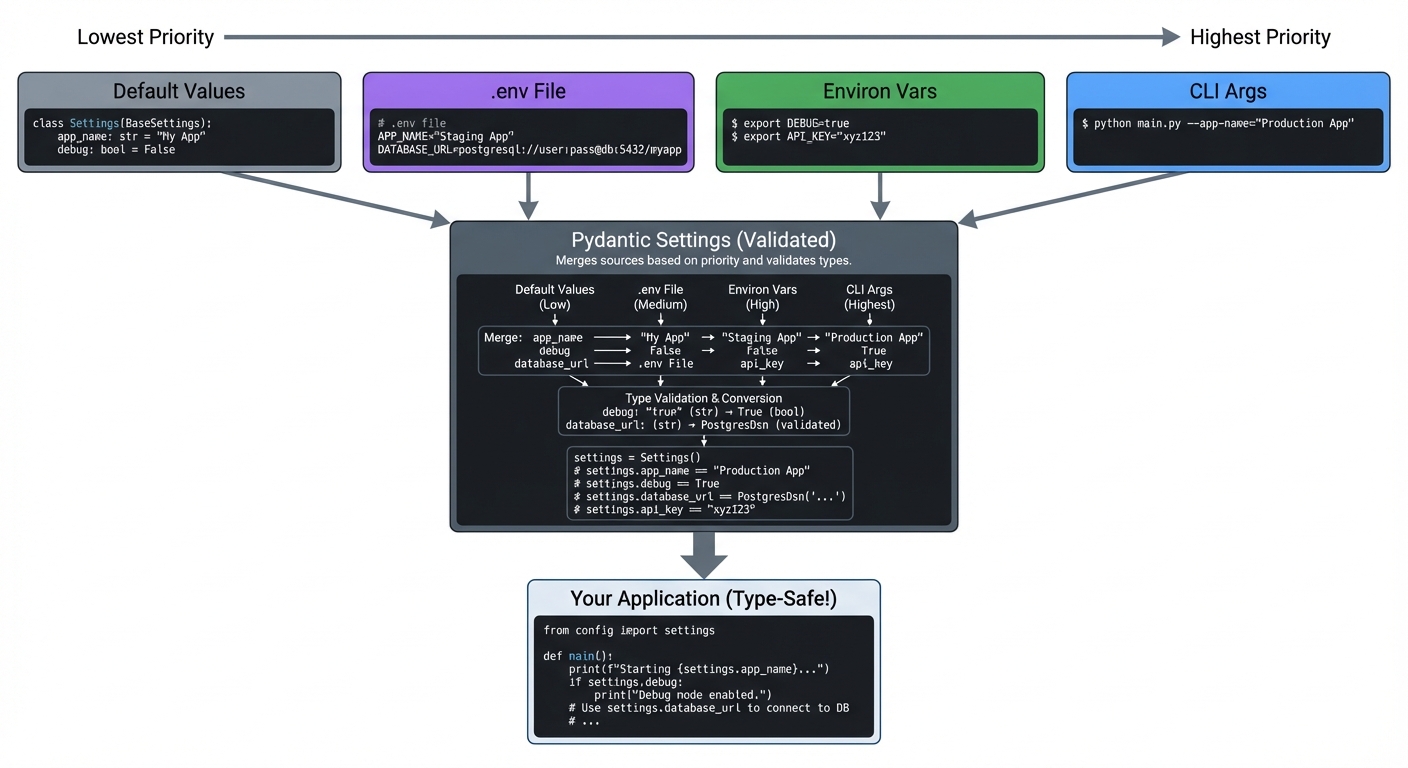
┌─────────────────────────────────────────────────────────────────┐
│                    Configuration Flow                            │
│                                                                  │
│   ┌──────────┐   ┌──────────┐   ┌──────────┐   ┌──────────┐    │
│   │ Default  │   │  .env    │   │ Environ  │   │   CLI    │    │
│   │ Values   │   │  File    │   │  Vars    │   │  Args    │    │
│   └────┬─────┘   └────┬─────┘   └────┬─────┘   └────┬─────┘    │
│        │              │              │              │           │
│        │   Lowest     │              │              │  Highest  │
│        │  Priority    │              │              │  Priority │
│        │              │              │              │           │
│        └──────────────┴──────────────┴──────────────┘           │
│                              │                                   │
│                              ▼                                   │
│                    ┌──────────────────┐                         │
│                    │ Pydantic Settings│                         │
│                    │   (Validated)    │                         │
│                    └──────────────────┘                         │
│                              │                                   │
│                              ▼                                   │
│                    ┌──────────────────┐                         │
│                    │  Your Application│                         │
│                    │  (Type-Safe!)    │                         │
│                    └──────────────────┘                         │
└─────────────────────────────────────────────────────────────────┘
Why Type-Safe Configuration?
Traditional configuration approaches are error-prone:
# Traditional approach - many problems!
import os

DATABASE_URL = os.getenv("DATABASE_URL")  # Could be None!
DEBUG = os.getenv("DEBUG")  # "true" or "True" or "1"? It's a string!
PORT = int(os.getenv("PORT", 8000))  # Crashes if PORT="abc"
MAX_CONNECTIONS = os.getenv("MAX_CONN")  # Typo goes unnoticed!
Problems with this approach:
- No validation - Invalid values aren’t caught until runtime
- Type confusion - Everything is a string
- Silent failures - Missing required values return None
- No documentation - What settings exist? What are valid values?
- Typos - Misspelled variable names silently fail
Pydantic Settings solves all of these:
from pydantic_settings import BaseSettings
from pydantic import Field, PostgresDsn

class Settings(BaseSettings):
    database_url: PostgresDsn  # Validated URL!
    debug: bool = False  # Automatically parsed from "true", "1", etc.
    port: int = Field(default=8000, ge=1, le=65535)  # Range validation!
    max_connections: int = Field(default=10, ge=1)  # Required name match!

settings = Settings()  # Validates on instantiation!
How pydantic-settings Works
pydantic-settings extends Pydantic’s BaseModel with environment variable loading:
from pydantic_settings import BaseSettings, SettingsConfigDict

class AppSettings(BaseSettings):
    app_name: str
    debug: bool = False

    model_config = SettingsConfigDict(
        env_file='.env',
        env_file_encoding='utf-8',
        case_sensitive=False,  # APP_NAME or app_name both work
    )
Loading Priority (lowest to highest):
- Default values in the class definition
- Environment file (.env)
- Environment variables (actual OS environment)
- Init arguments (when instantiating the class)
This means environment variables override .env file values, which override defaults.
Understanding Settings Sources
pydantic-settings uses “sources” to load values:
from pydantic_settings import (
    BaseSettings,
    SettingsConfigDict,
    PydanticBaseSettingsSource,
)

class Settings(BaseSettings):
    model_config = SettingsConfigDict(
        env_file='.env',
        env_nested_delimiter='__',  # For nested settings
    )

    @classmethod
    def settings_customise_sources(
        cls,
        settings_cls: type[BaseSettings],
        init_settings: PydanticBaseSettingsSource,
        env_settings: PydanticBaseSettingsSource,
        dotenv_settings: PydanticBaseSettingsSource,
        file_secret_settings: PydanticBaseSettingsSource,
    ) -> tuple[PydanticBaseSettingsSource, ...]:
        # Customize source order (priority)
        return (
            init_settings,      # Highest priority
            env_settings,       # Environment variables
            dotenv_settings,    # .env file
            file_secret_settings,  # Secret files (Docker secrets)
        )
SecretStr: Protecting Sensitive Data
One of the biggest configuration mistakes is accidentally logging secrets:
# DANGER: This logs your password!
print(f"Connecting to {settings.database_password}")
# Or in error messages, logs, etc.
SecretStr prevents this:
from pydantic import SecretStr

class Settings(BaseSettings):
    database_password: SecretStr

settings = Settings()

# Safe operations
print(settings.database_password)  # Output: **********
str(settings.database_password)    # Output: **********
repr(settings.database_password)   # Output: SecretStr('**********')

# Explicit reveal (when you actually need the value)
password = settings.database_password.get_secret_value()
SecretStr also works in:
- JSON serialization (excluded by default)
- Logging
- Error messages
- Debugger views
Nested Configuration
Real applications have hierarchical configuration:
from pydantic_settings import BaseSettings, SettingsConfigDict
from pydantic import Field

class DatabaseSettings(BaseSettings):
    host: str = "localhost"
    port: int = 5432
    name: str
    user: str
    password: SecretStr

    model_config = SettingsConfigDict(env_prefix='DB_')

class RedisSettings(BaseSettings):
    url: str = "redis://localhost:6379"
    password: SecretStr | None = None

    model_config = SettingsConfigDict(env_prefix='REDIS_')

class AppSettings(BaseSettings):
    debug: bool = False
    secret_key: SecretStr

    # Nested settings
    database: DatabaseSettings = Field(default_factory=DatabaseSettings)
    redis: RedisSettings = Field(default_factory=RedisSettings)

    model_config = SettingsConfigDict(
        env_file='.env',
        env_nested_delimiter='__',  # Enables DATABASE__HOST syntax
    )
Environment variables for nested settings:
# Using prefix (DatabaseSettings has env_prefix='DB_')
DB_HOST=postgres.example.com
DB_PORT=5432
DB_NAME=myapp
DB_USER=admin
DB_PASSWORD=secret

# OR using nested delimiter
DATABASE__HOST=postgres.example.com
DATABASE__PORT=5432
Complex Types in Settings
Pydantic Settings handles various types:
from pydantic_settings import BaseSettings
from pydantic import Field, HttpUrl, EmailStr
from typing import List, Dict
from datetime import timedelta

class Settings(BaseSettings):
    # URLs are validated
    api_url: HttpUrl

    # Email validation
    admin_email: EmailStr

    # Lists from JSON or comma-separated
    allowed_hosts: List[str] = Field(default=["localhost"])
    # As env: ALLOWED_HOSTS='["host1.com", "host2.com"]'
    # Or: ALLOWED_HOSTS=host1.com,host2.com (with custom validator)

    # Dicts from JSON
    feature_flags: Dict[str, bool] = Field(default_factory=dict)
    # As env: FEATURE_FLAGS='{"new_ui": true, "beta": false}'

    # Timedeltas
    cache_ttl: timedelta = timedelta(hours=1)
    # As env: CACHE_TTL=3600 (seconds)

    # Enums
    log_level: LogLevel = LogLevel.INFO
Project Specification
Functional Requirements
Build a configuration management system and CLI tool that:
- Manages application settings
- Define settings using Pydantic models
- Load from multiple sources with proper precedence
- Validate all settings on startup
- Provides a CLI interface
- Show current configuration (with masked secrets)
- Validate configuration without starting the app
- Export configuration to various formats
- Generate documentation
- Supports multiple environments
- Development, staging, production profiles
- Environment-specific .env files
- Override mechanism
- Handles secrets safely
- Never log or display secret values
- Support Docker secrets
- Warn about insecure configurations
CLI Interface
# Show current configuration
$ config-manager show
╭─────────────────────────────────────────────────────────────╮
│ Application Configuration                                   │
├─────────────────────────────────────────────────────────────┤
│ Environment: production                                     │
│                                                             │
│ app:                                                        │
│   name: MyApp                                              │
│   debug: false                                             │
│   secret_key: ******** (SecretStr)                         │
│                                                             │
│ database:                                                   │
│   host: postgres.example.com                               │
│   port: 5432                                               │
│   name: myapp_prod                                         │
│   user: app_user                                           │
│   password: ******** (SecretStr)                           │
│   pool_size: 20                                            │
│                                                             │
│ redis:                                                      │
│   url: redis://redis.example.com:6379                      │
│   password: ******** (SecretStr)                           │
│                                                             │
│ logging:                                                    │
│   level: INFO                                              │
│   format: json                                             │
╰─────────────────────────────────────────────────────────────╯

# Validate configuration
$ config-manager validate
✓ All required settings present
✓ Database URL is valid
✓ Redis connection successful
✓ Secret key has sufficient entropy
✓ Configuration is valid for production

# With missing required settings
$ config-manager validate
✗ Validation failed:
  ├── SECRET_KEY: Field required (no default)
  ├── DB_PASSWORD: Field required (no default)
  └── Suggestion: Create a .env file or set environment variables

# Export configuration
$ config-manager export --format=json --include-secrets=false > config.json
$ config-manager export --format=yaml
$ config-manager export --format=env > .env.example

# Generate documentation
$ config-manager docs
# Application Configuration

## Environment Variables

| Variable | Type | Required | Default | Description |
|----------|------|----------|---------|-------------|
| APP_NAME | str | No | "MyApp" | Application name |
| DEBUG | bool | No | false | Enable debug mode |
| SECRET_KEY | SecretStr | Yes | - | Application secret key |
| DB_HOST | str | No | "localhost" | Database host |
...

# Show specific section
$ config-manager show database
$ config-manager show --env=staging

# Diff between environments
$ config-manager diff development production
Settings Structure
# config/settings.py
from pydantic_settings import BaseSettings, SettingsConfigDict
from pydantic import Field, SecretStr, PostgresDsn, RedisDsn
from typing import Optional, List, Literal
from enum import Enum

class Environment(str, Enum):
    development = "development"
    staging = "staging"
    production = "production"

class LogLevel(str, Enum):
    DEBUG = "DEBUG"
    INFO = "INFO"
    WARNING = "WARNING"
    ERROR = "ERROR"

class DatabaseSettings(BaseSettings):
    """Database connection settings."""
    host: str = Field(
        default="localhost",
        description="Database server hostname"
    )
    port: int = Field(
        default=5432,
        ge=1,
        le=65535,
        description="Database server port"
    )
    name: str = Field(
        description="Database name"
    )
    user: str = Field(
        description="Database username"
    )
    password: SecretStr = Field(
        description="Database password"
    )
    pool_size: int = Field(
        default=5,
        ge=1,
        le=100,
        description="Connection pool size"
    )

    model_config = SettingsConfigDict(env_prefix='DB_')

    @property
    def url(self) -> str:
        """Construct database URL."""
        password = self.password.get_secret_value()
        return f"postgresql://{self.user}:{password}@{self.host}:{self.port}/{self.name}"

class RedisSettings(BaseSettings):
    """Redis connection settings."""
    url: RedisDsn = Field(
        default="redis://localhost:6379",
        description="Redis connection URL"
    )
    password: Optional[SecretStr] = Field(
        default=None,
        description="Redis password (if required)"
    )
    db: int = Field(
        default=0,
        ge=0,
        le=15,
        description="Redis database number"
    )

    model_config = SettingsConfigDict(env_prefix='REDIS_')

class LoggingSettings(BaseSettings):
    """Logging configuration."""
    level: LogLevel = Field(
        default=LogLevel.INFO,
        description="Log level"
    )
    format: Literal["json", "text"] = Field(
        default="text",
        description="Log output format"
    )
    file: Optional[str] = Field(
        default=None,
        description="Log file path (optional)"
    )

    model_config = SettingsConfigDict(env_prefix='LOG_')

class AppSettings(BaseSettings):
    """Main application settings."""
    name: str = Field(
        default="MyApp",
        description="Application name"
    )
    environment: Environment = Field(
        default=Environment.development,
        description="Deployment environment"
    )
    debug: bool = Field(
        default=False,
        description="Enable debug mode (never in production!)"
    )
    secret_key: SecretStr = Field(
        description="Secret key for cryptographic operations",
        min_length=32
    )
    allowed_hosts: List[str] = Field(
        default=["localhost", "127.0.0.1"],
        description="Allowed host headers"
    )

    # Nested settings
    database: DatabaseSettings = Field(default_factory=DatabaseSettings)
    redis: RedisSettings = Field(default_factory=RedisSettings)
    logging: LoggingSettings = Field(default_factory=LoggingSettings)

    model_config = SettingsConfigDict(
        env_file='.env',
        env_file_encoding='utf-8',
        env_nested_delimiter='__',
        extra='ignore',  # Ignore unknown env vars
    )

    def validate_for_production(self) -> List[str]:
        """Additional production-specific validation."""
        warnings = []

        if self.environment == Environment.production:
            if self.debug:
                warnings.append("DEBUG is enabled in production!")
            if "localhost" in self.allowed_hosts:
                warnings.append("localhost in ALLOWED_HOSTS for production")
            if len(self.secret_key.get_secret_value()) < 50:
                warnings.append("SECRET_KEY should be at least 50 characters")

        return warnings
Solution Architecture
Component Design
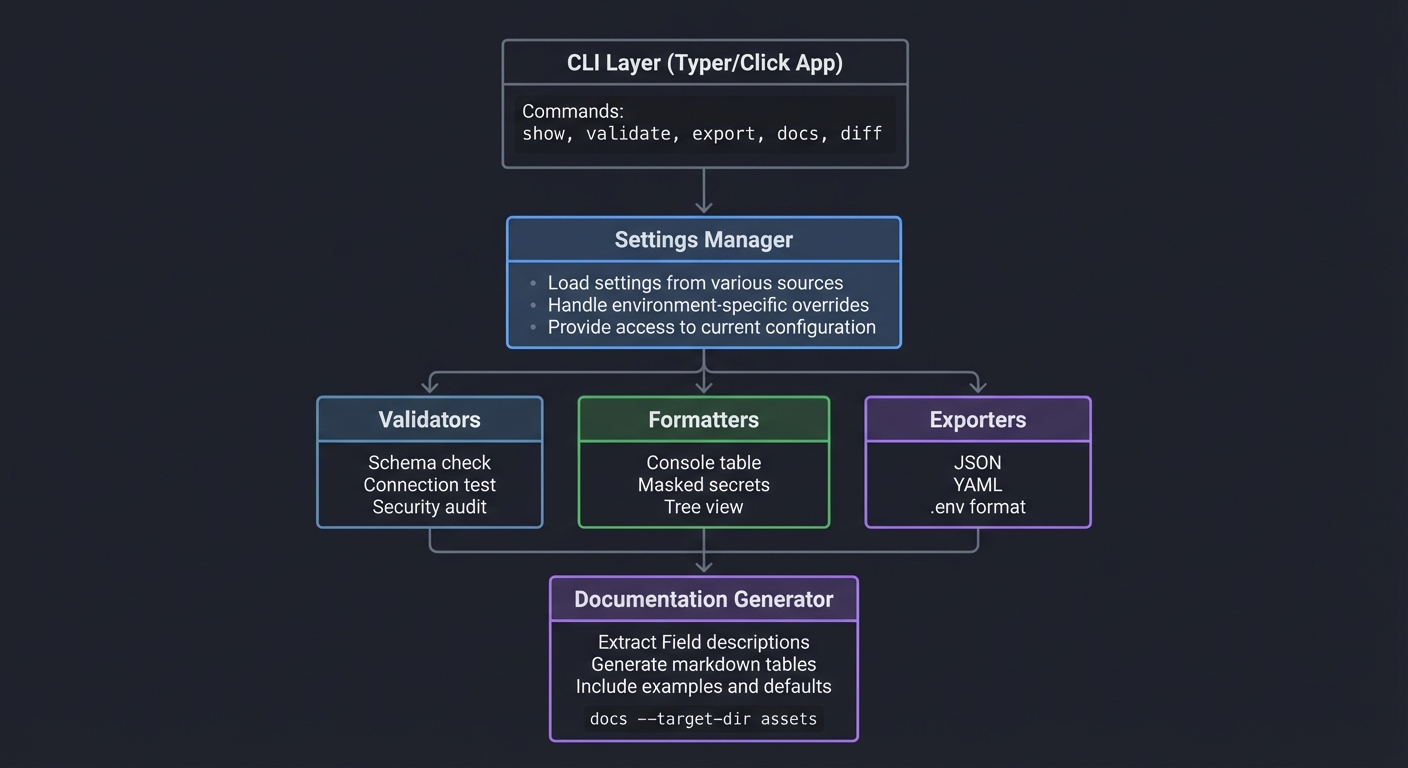
┌─────────────────────────────────────────────────────────────────┐
│                         CLI Layer                                │
│                     (Typer/Click App)                           │
│  Commands: show, validate, export, docs, diff                   │
└─────────────────────────────────────────────────────────────────┘
                              │
                              ▼
┌─────────────────────────────────────────────────────────────────┐
│                    Settings Manager                              │
│  - Load settings from various sources                           │
│  - Handle environment-specific overrides                         │
│  - Provide access to current configuration                       │
└─────────────────────────────────────────────────────────────────┘
                              │
            ┌─────────────────┼─────────────────┐
            ▼                 ▼                 ▼
┌───────────────────┐ ┌───────────────────┐ ┌───────────────────┐
│   Validators      │ │   Formatters      │ │   Exporters       │
│  - Schema check   │ │  - Console table  │ │  - JSON           │
│  - Connection test│ │  - Masked secrets │ │  - YAML           │
│  - Security audit │ │  - Tree view      │ │  - .env format    │
└───────────────────┘ └───────────────────┘ └───────────────────┘
                              │
                              ▼
┌─────────────────────────────────────────────────────────────────┐
│                    Documentation Generator                       │
│  - Extract Field descriptions                                    │
│  - Generate markdown tables                                      │
│  - Include examples and defaults                                 │
└─────────────────────────────────────────────────────────────────┘
Key Design Patterns
- Singleton Settings: Load configuration once, access globally
- Environment Overlay: Base config + environment-specific overrides
- Fail-Fast Validation: Catch config errors at startup
- Secret Masking: Never expose secrets in any output
Settings Loading Strategy
# config/loader.py
from functools import lru_cache
from pathlib import Path
from typing import Optional

@lru_cache
def get_settings(environment: Optional[str] = None) -> AppSettings:
    """
    Load and cache settings.

    Priority:
    1. .env.{environment}.local (ignored by git)
    2. .env.{environment}
    3. .env.local (ignored by git)
    4. .env
    5. Environment variables
    """
    env_files = []

    if environment:
        local_env = Path(f".env.{environment}.local")
        if local_env.exists():
            env_files.append(local_env)

        env_file = Path(f".env.{environment}")
        if env_file.exists():
            env_files.append(env_file)

    local_env = Path(".env.local")
    if local_env.exists():
        env_files.append(local_env)

    base_env = Path(".env")
    if base_env.exists():
        env_files.append(base_env)

    # Load with file priority
    return AppSettings(_env_file=env_files)
Phased Implementation Guide
Phase 1: Basic Settings Class (1-2 hours)
Goal: Create a working settings class with pydantic-settings.
- Install dependencies:
pip install pydantic pydantic-settings python-dotenv - Create basic settings:
from pydantic_settings import BaseSettings class Settings(BaseSettings): app_name: str = "MyApp" debug: bool = False - Test loading from environment:
DEBUG=true python -c "from settings import Settings; print(Settings().debug)"
Checkpoint: Settings load from environment variables.
Phase 2: Nested Settings (1-2 hours)
Goal: Implement hierarchical configuration.
- Create database and redis settings classes
- Add env_prefix to each
- Compose into main AppSettings
- Test with environment variables
Checkpoint: DB_HOST=x python -c "print(Settings().database.host)" works.
Phase 3: Secret Handling (1 hour)
Goal: Implement secure secret handling.
- Add SecretStr fields for passwords, keys
- Test that printing doesn’t reveal secrets
- Implement get_secret_value() for actual usage
Checkpoint: print(settings) shows ******** for secrets.
Phase 4: CLI Tool (2-3 hours)
Goal: Build the config-manager CLI.
- Set up Typer/Click application
- Implement
showcommand with Rich formatting - Implement
validatecommand - Add
--envoption for environment selection
Checkpoint: config-manager show displays formatted config.
Phase 5: Export and Documentation (2 hours)
Goal: Generate exports and docs.
- Implement JSON/YAML export (with secret exclusion)
- Implement .env.example generation
- Build documentation generator from Field metadata
Checkpoint: config-manager docs generates markdown.
Phase 6: Advanced Features (2-3 hours)
Goal: Add production-ready features.
- Implement environment-specific .env file loading
- Add production validation checks
- Implement config diff between environments
- Add connection testing for database/redis
Checkpoint: Full working configuration management system.
Testing Strategy
Unit Tests
# tests/test_settings.py
import os
import pytest
from config.settings import AppSettings, DatabaseSettings

def test_default_values():
    """Test that defaults are applied."""
    with pytest.MonkeyPatch.context() as mp:
        mp.setenv("SECRET_KEY", "a" * 32)
        mp.setenv("DB_NAME", "test")
        mp.setenv("DB_USER", "user")
        mp.setenv("DB_PASSWORD", "pass")

        settings = AppSettings()
        assert settings.debug is False
        assert settings.database.host == "localhost"

def test_env_override():
    """Test environment variable override."""
    with pytest.MonkeyPatch.context() as mp:
        mp.setenv("DEBUG", "true")
        mp.setenv("DB_HOST", "custom-host")
        # ... other required vars

        settings = AppSettings()
        assert settings.debug is True
        assert settings.database.host == "custom-host"

def test_secret_masking():
    """Test that secrets are masked in string output."""
    with pytest.MonkeyPatch.context() as mp:
        mp.setenv("SECRET_KEY", "super-secret-value")
        # ... other required vars

        settings = AppSettings()
        string_repr = str(settings)
        assert "super-secret-value" not in string_repr

def test_missing_required_field():
    """Test that missing required fields raise error."""
    with pytest.MonkeyPatch.context() as mp:
        mp.delenv("SECRET_KEY", raising=False)

        with pytest.raises(ValidationError) as exc:
            AppSettings()
        assert "SECRET_KEY" in str(exc.value)

def test_production_validation():
    """Test production-specific validation."""
    with pytest.MonkeyPatch.context() as mp:
        mp.setenv("ENVIRONMENT", "production")
        mp.setenv("DEBUG", "true")
        # ... other vars

        settings = AppSettings()
        warnings = settings.validate_for_production()
        assert "DEBUG is enabled in production" in warnings
Integration Tests
# tests/test_cli.py
from typer.testing import CliRunner
from config.cli import app

runner = CliRunner()

def test_show_command():
    result = runner.invoke(app, ["show"])
    assert result.exit_code == 0
    assert "Application Configuration" in result.output

def test_validate_success():
    result = runner.invoke(app, ["validate"])
    assert result.exit_code == 0
    assert "valid" in result.output.lower()

def test_export_json():
    result = runner.invoke(app, ["export", "--format", "json"])
    assert result.exit_code == 0
    import json
    data = json.loads(result.output)
    assert "database" in data

def test_export_excludes_secrets():
    result = runner.invoke(app, ["export", "--format", "json"])
    assert "password" not in result.output.lower()
Common Pitfalls and Debugging
Pitfall 1: Case Sensitivity
Problem: DB_HOST works but db_host doesn’t.
Solution: Set case_sensitive=False in SettingsConfigDict:
model_config = SettingsConfigDict(
    case_sensitive=False  # DB_HOST and db_host both work
)
Pitfall 2: Nested Environment Variables
Problem: DATABASE__HOST not loading nested settings.
Solution: Enable nested delimiter:
model_config = SettingsConfigDict(
    env_nested_delimiter='__'
)
Also ensure the nested class doesn’t have a conflicting env_prefix.
Pitfall 3: Type Coercion Confusion
Problem: DEBUG=0 sets debug to True (non-empty string is truthy).
Solution: Pydantic handles this correctly! DEBUG=0 → False, DEBUG=false → False.
But beware of:
DEBUG=(empty string) → May fail validationDEBUG=no→FalseDEBUG=yes→True
Pitfall 4: .env File Not Loading
Problem: Values in .env file are ignored.
Checklist:
- Is
python-dotenvinstalled? - Is
env_file='.env'in SettingsConfigDict? - Is the .env file in the correct directory (working directory)?
- Are environment variables set that override .env?
Pitfall 5: SecretStr in JSON Export
Problem: model_dump_json() includes secrets.
Solution: Use exclude or customize serialization:
settings.model_dump_json(exclude={'database': {'password'}})

# Or use a custom serializer
class Settings(BaseSettings):
    @model_serializer(mode='wrap')
    def serialize(self, handler):
        data = handler(self)
        # Recursively remove SecretStr values
        return remove_secrets(data)
Extensions and Challenges
Extension 1: Docker Secrets Support
Load secrets from Docker secret files:
from pydantic_settings import BaseSettings, SettingsConfigDict

class Settings(BaseSettings):
    model_config = SettingsConfigDict(
        secrets_dir='/run/secrets'
    )
Docker secrets are files like /run/secrets/db_password containing the secret value.
Extension 2: Remote Configuration
Load configuration from a remote source:
import httpx
from pydantic_settings import BaseSettings, PydanticBaseSettingsSource

class RemoteSettingsSource(PydanticBaseSettingsSource):
    def get_field_value(self, field, field_name):
        # Fetch from remote config service
        response = httpx.get(f"https://config.example.com/{field_name}")
        return response.json()['value']
Extension 3: Configuration Validation Webhook
Send configuration to a validation service:
config-manager validate --webhook=https://security.example.com/audit
Extension 4: Secret Rotation
Track when secrets were last rotated:
class Settings(BaseSettings):
    db_password: SecretStr
    db_password_rotated_at: datetime

    @model_validator(mode='after')
    def check_secret_age(self):
        age = datetime.now() - self.db_password_rotated_at
        if age > timedelta(days=90):
            warnings.warn("Database password should be rotated")
        return self
Extension 5: Configuration Encryption
Encrypt sensitive .env files at rest:
config-manager encrypt .env --key=master.key
config-manager decrypt .env.encrypted --key=master.key
Real-World Connections
Where This Pattern Appears
- Django Settings:
settings.pywith environment overrides - FastAPI + Pydantic: The standard pattern for FastAPI apps
- Kubernetes ConfigMaps: Injected as environment variables
- AWS Parameter Store: Configuration management at scale
- HashiCorp Vault: Secret management
Industry Examples
- Django-environ: Environment-based Django configuration
- python-decouple: Strict separation of settings from code
- dynaconf: Multi-layer configuration management
- Pydantic Settings: The modern, type-safe approach
Production Considerations
- Never commit secrets: Use .gitignore for .env files
- Use secret management: Vault, AWS Secrets Manager, etc.
- Validate on startup: Fail fast if configuration is invalid
- Log configuration changes: Audit trail for compliance
- Use different secrets per environment: Never share between dev/prod
Self-Assessment Checklist
Core Understanding
- Can I explain the settings source precedence?
- Can I describe how environment variables map to nested settings?
- Can I explain why SecretStr is important?
- Can I describe the difference between env_prefix and env_nested_delimiter?
Implementation Skills
- Can I create a multi-level settings hierarchy?
- Can I load configuration from multiple .env files?
- Can I implement custom settings sources?
- Can I generate documentation from settings classes?
Production Readiness
- Can I validate that configuration is appropriate for production?
- Can I export configuration without exposing secrets?
- Can I test settings with various environment configurations?
- Can I handle missing required settings gracefully?
Mastery Indicators
- Tool handles all edge cases (missing files, invalid values)
- Secrets are never exposed in any output
- Configuration is validated comprehensively
- Documentation is auto-generated and accurate
Resources
Documentation
Books
- “Architecture Patterns with Python” by Percival & Gregory - Chapter 11 on Configuration
- “The Twelve-Factor App” by Adam Wiggins (online) - Configuration principles
Related Tools
- python-dotenv
- dynaconf
- Typer for CLI