Project 17: Build and Branch Pipeline
Automated build packaging to Steam branches with smoke tests and rollback playbooks.
Quick Reference
| Attribute | Value |
|---|---|
| Difficulty | Level 3 |
| Time Estimate | 1 week |
| Main Programming Language | C# (.NET 8) + MonoGame |
| Alternative Programming Languages | F#, C++ (raylib), Godot C# |
| Coolness Level | Level 4 |
| Business Potential | Level 3 |
| Prerequisites | Deterministic loop basics, debugging discipline, content pipeline fundamentals |
| Key Topics | Artifact reproducibility, Branch promotion gates, Rollback drills |
1. Learning Objectives
- Translate one concrete production question into a testable implementation plan.
- Implement and validate the feature in a MonoGame runtime context.
- Instrument success and failure paths with actionable diagnostics.
- Produce a repeatable demo artifact for portfolio or interview use.
2. All Theory Needed (Per-Concept Breakdown)
Artifact reproducibility
Fundamentals Artifact reproducibility is central to this project because it defines the non-negotiable behavioral contract for the feature. You should be able to describe valid inputs, legal state transitions, and expected outputs under normal and failure conditions.
Deep Dive into the concept Treat Artifact reproducibility as a boundary-setting mechanism. Start by defining the smallest deterministic scenario that proves the feature works. Stress that scenario under altered timing, altered content inputs, and altered user actions. If behavior changes unexpectedly, document hidden coupling and sequence assumptions. Keep transitions explicit and observable via logs or debug panels. Connect each transition to an event record so regression analysis is possible after refactors.
Branch promotion gates
Fundamentals Branch promotion gates ensures the project scales from local prototype behavior to repeatable system behavior.
Deep Dive into the concept Use Branch promotion gates to reason about data flow ownership and mutation timing. Document where writes occur, when validation runs, and how rollback behaves if a write fails.
Rollback drills
Fundamentals Rollback drills connects this project to shipping reality by forcing you to think about operational constraints early.
Deep Dive into the concept Define one production-like failure mode related to Rollback drills and build a mitigation checklist. The solution is complete when you can demonstrate both a golden path and a controlled failure path.
3. Project Specification
3.1 What You Will Build
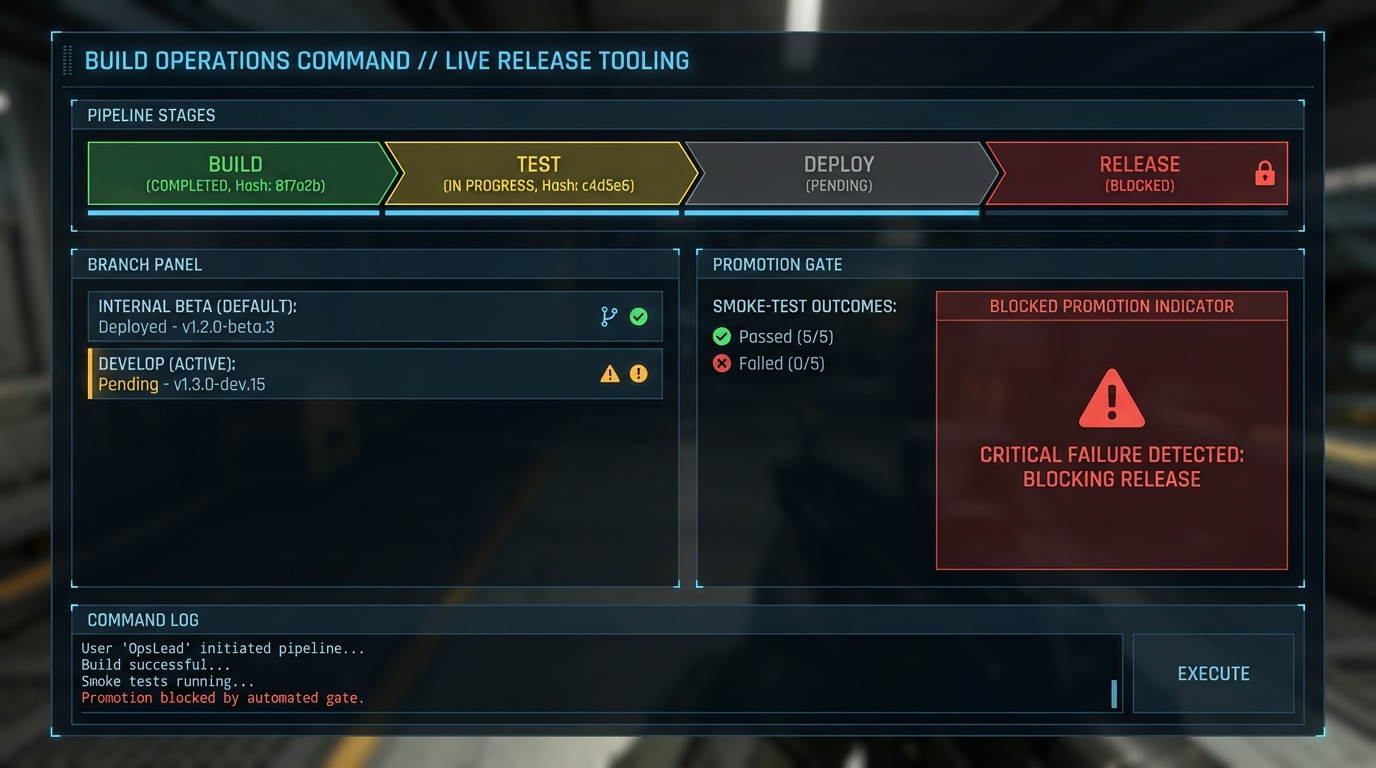
A Steam-focused build and release pipeline simulator with reproducible artifacts, branch uploads, and promotion gate enforcement.
Visible game deliverable:
- Pipeline dashboard with build stages and artifact hashes
- Branch panel (internal/beta/default) showing latest deployment status
- Promotion gate panel with smoke-test outcomes
3.2 Functional Requirements
- Package deterministic build artifacts with manifest hashes.
- Upload release candidates to non-public branch first.
- Run smoke tests and policy checks before promotion.
- Provide rollback instructions tied to build identifiers.
3.3 Non-Functional Requirements
- Performance: Must remain inside project-appropriate frame budget.
- Reliability: Must recover from at least one injected failure mode.
- Usability: Outcome must be observable by a reviewer in under two minutes.
3.4 Example Usage / Output
[PIPE] build_id=2026.02.11.3 artifact_hash=9f1a...
[PIPE] upload branch=beta result=PASS
[PIPE] promotion default=BLOCKED smoke_failures=1
3.5 Data Formats / Schemas / Protocols
- Event record: {timestamp, module, action, result}
- Feature state snapshot: {version, state, counters, flags}
3.6 Edge Cases
- Artifact mismatch between local and CI outputs.
- Upload succeeds but manifest hash mismatch.
- Promotion requested with stale smoke-test results.
3.7 Real World Outcome
This is a game-facing outcome you can see and play immediately.
What you will see in the game window:
- Pipeline dashboard with build stages and artifact hashes
- Branch panel (internal/beta/default) showing latest deployment status
- Promotion gate panel with smoke-test outcomes
How you interact:
- B trigger build
- U upload beta
- P attempt branch promotion
3.7.1 How to Run (Copy/Paste)
$ dotnet restore
$ dotnet build
$ dotnet run --project src/Game -- --scene build-pipeline-lab
3.7.2 Golden Path Demo (Deterministic)
- Start the scene and confirm all HUD panels load.
- Perform the three core interactions listed above.
- Verify the success signal appears without warnings.
3.7.3 If CLI: exact transcript
$ dotnet run --project src/Game -- --scene build-pipeline-lab
[PIPE] build_id=2026.02.11.3 artifact_hash=9f1a...
[PIPE] upload branch=beta result=PASS
[PIPE] promotion default=BLOCKED smoke_failures=1
3.7.7 If GUI / Desktop
+------------------------------------------------------+
| build-pipeline-lab                                   [F1 HUD] |
|------------------------------------------------------|
| PLAYFIELD: gameplay objects and interactions         |
| HUD: key metrics + status badges                    |
| STATUS: success/failure cues and prompts            |
+------------------------------------------------------+
4. Solution Architecture
4.1 High-Level Design
Source Snapshot -> Build Artifact -> Validation Gates -> Branch Upload -> Promotion/Block
Source Snapshot -> Build Artifact -> Validation Gates -> Branch Upload -> Promotion/Block
4.2 Key Components
| Component | Responsibility | Key Decisions |
|---|---|---|
| ArtifactBuilder | Creates versioned deterministic packages | Embed manifest hash in release metadata |
| BranchDeployer | Pushes builds to Steam branches | Never deploy directly to default first |
| PromotionGate | Evaluates smoke and policy checks | Explicitly block unsafe promotions |
4.4 Algorithm Overview
- Validate preconditions.
- Apply deterministic transition.
- Emit feedback and telemetry.
- Persist if required.
5. Implementation Guide
5.3 The Core Question You’re Answering
“How do you ship quickly without breaking your live branch?”
5.4 Concepts You Must Understand First
- Artifact reproducibility
- Branch promotion gates
- Rollback drills
5.5 Questions to Guide Your Design
- What makes an artifact reproducible across machines?
- Which gate failures should hard-block branch promotion?
- How will you execute rollback quickly after bad beta signal?
5.6 Thinking Exercise
Trace one full success path and one failure path on paper before implementation.
5.7 The Interview Questions They’ll Ask
- Why did you pick this architecture boundary?
- Which failure mode did you prioritize first and why?
- How does your instrumentation accelerate debugging?
- How would you scale this feature to a larger game?
5.8 Hints in Layers
- Hint 1: Stabilize one invariant before feature expansion.
- Hint 2: Add diagnostics before optimization.
- Hint 3: Keep platform calls at system boundaries.
- Hint 4: Re-run deterministic scenario after each refactor.
5.9 Books That Will Help
| Topic | Book | Chapter |
|---|---|---|
| Core concept | “Accelerate by Forsgren Humble and Kim” | Relevant concept chapter |
| Reliability | “Release It!” | Failure handling chapters |
| Architecture | “Clean Architecture” | Boundary and dependency chapters |
6. Testing Strategy
- Golden path completes and emits success signal.
- Injected failure path recovers without crash.
- Re-run scenario after restart and confirm consistency.
7. Common Pitfalls & Debugging
- Hidden initialization order coupling
- Time-coupled behavior tied to render rate
- Missing fallback behavior on platform call failure
8. Extensions & Challenges
- Beginner: add one extra diagnostics panel metric.
- Intermediate: add replay capture for event flow.
- Advanced: add automated stress test harness.
9. Real-World Connections
This project mirrors shipping feature-module work in real indie and mid-size game teams.
10. Resources
- Steamworks official docs
- MonoGame docs
- Gemini image generation docs (for asset-related projects)
11. Self-Assessment Checklist
- I can explain the feature invariant and prove it in a demo.
- I can trigger and handle one deterministic failure scenario.
- I can describe tradeoffs and future scaling choices.
12. Submission / Completion Criteria
Minimum Viable Completion:
- Feature works in deterministic golden path.
- One controlled failure path is handled gracefully.
- Core diagnostics are visible and documented.
Full Completion:
- All minimum criteria plus edge-case coverage and regression checks.
Excellence:
- Includes polished instrumentation and clear productionization notes.