Project 1: Sketchbook Bootloader
Create a stable Processing runtime template that you can reuse for every later project.
Quick Reference
| Attribute | Value |
|---|---|
| Difficulty | Level 1 (Beginner) |
| Time Estimate | 1 weekend |
| Main Programming Language | Processing (Java Mode) |
| Alternative Programming Languages | p5.js, openFrameworks, TouchDesigner (project dependent) |
| Coolness Level | Level 2: Practical but Forgettable |
| Business Potential | Portfolio + professional creative tooling opportunities |
| Prerequisites | Core Processing syntax, lifecycle model, and debugging basics |
| Key Topics | Runtime lifecycle, deterministic resets, frame diagnostics |
1. Learning Objectives
By completing this project, you will:
- Translate a creative goal into a bounded technical architecture.
- Define deterministic workflows for iteration, debugging, and export.
- Enforce performance and reliability constraints appropriate to project scope.
- Produce an observable artifact with clear validation criteria.
2. All Theory Needed (Per-Concept Breakdown)
Sketch Lifecycle Contract
Fundamentals
Sketch Lifecycle Contract is the conceptual backbone of Sketchbook Bootloader. The goal is not only to produce a result that looks interesting, but to construct a system you can reason about under different conditions. In Processing, results can appear correct for short demos while hiding structural flaws such as unstable timing, fragile state transitions, or uncontrolled parameter coupling. Fundamentals means defining what state exists, when it changes, what constraints are always true, and how failures are detected early. You should treat visuals as evidence of underlying rules, not as the rules themselves. That mindset turns creative exploration into reproducible engineering practice and makes this project useful beyond a single artifact.
Deep Dive into the concept
A strong implementation of Sketch Lifecycle Contract requires explicit control over four dimensions: state, time, mapping, and validation.
State must be modeled intentionally. You should list entities, resources, and control modes with clear ownership. If state is scattered across ad hoc variables, the system becomes difficult to reset and difficult to debug. In this project, define a canonical state snapshot and ensure every frame can be explained as a transition from prior state to next state. This allows repeatable troubleshooting and preserves creative confidence during iteration.
Time must be treated as a resource, not an afterthought. Real-time creative systems operate under frame budgets and latency constraints. Even non-live projects benefit from time discipline because deterministic playback is essential for comparing parameter variants. Use runtime telemetry to track frame stability, update costs, and transition timing. This is where many projects fail: they reach visual complexity before they establish timing observability.
Mapping is where artistic intent meets system design. Whether you are mapping geometry, audio features, sensor input, or data attributes, mapping functions need constraints, defaults, and guardrails. Direct raw mapping often causes noisy and unintuitive behavior. Better practice is staged mapping: normalize input, smooth or debounce where needed, then map to semantically meaningful visual controls. In practical terms, this means each visual behavior should answer a design question rather than react blindly.
Validation closes the loop. For this project, define objective checks that complement subjective aesthetic review. Examples include deterministic replay checks, stability tests over longer runtime windows, export consistency across resolutions, and failure-mode drills. Validation converts “it seems fine” into “it is known to be reliable within declared boundaries.”
Failure modes deserve first-class treatment. Typical failures include hidden performance cliffs, mode transition dead-ends, unbounded resource growth, and brittle startup assumptions. Build proactive safeguards: bounded collections, startup readiness checks, explicit mode guards, and fallback behaviors. Doing this early is cheaper than patching reliability after feature complexity has grown.
Finally, remember that this project is part of a mastery series. Design your implementation so assets, configuration schema, and control abstractions can be reused in later projects. Reuse transforms isolated wins into compounding capability.
How this fit on projects
This concept is the central lens for Project 1 and appears again in later projects where complexity and reliability requirements increase.
Definitions & key terms
- State snapshot: Complete representation of current system values.
- Transition rule: Deterministic logic that updates state.
- Guardrail: Constraint that prevents unsafe parameter combinations.
- Operational mode: Distinct behavior profile (for example edit/play/export).
- Validation pass: Structured check proving requirements were met.
Mental model diagram (ASCII)
Input conditions -> Normalization -> State transition -> Render output -> Validation
       |                                  |                  |              |
       +------------ constraints ---------+                  +---- metrics --+
How it works (step-by-step, with invariants and failure modes)
- Define baseline configuration and deterministic seed behavior.
- Initialize state and resources through a startup checklist.
- Process inputs/events and map them through validated control paths.
- Update simulation/model state with explicit ordering.
- Render outputs and collect runtime metrics.
- Run invariant checks and trigger fallback behavior on violation.
Invariants:
- State remains bounded and internally consistent.
- Runtime remains within target responsiveness thresholds.
- Reset or replay produces expected deterministic behavior.
Failure modes:
- Hidden allocation growth causes long-session degradation.
- Illegal state transitions cause stuck interaction modes.
- Missing assets or invalid input produce undefined behavior.
Minimal concrete example (pseudocode)
ON startup:
  load_config()
  assert(resources_available)
  init_state(seed)

ON frame:
  intent = map_input(raw_input)
  state = transition(state, intent)
  render(state)
  report_metrics(state)
  IF invariant_violation: enter_safe_mode()
Common misconceptions
- “If the output looks good once, the system is done.” False: repeatability and stability matter.
- “Creative projects do not need strict constraints.” False: constraints are what make exploration productive.
- “Performance tuning is optional.” False for real-time and long-running visual systems.
Check-your-understanding questions
- Which invariants must never be violated in this project?
- What inputs need normalization before mapping?
- How will you verify deterministic replay or repeatable export?
Check-your-understanding answers
- Bounded state, valid transitions, and stable runtime responsiveness.
- Any noisy, out-of-range, or high-frequency signal source.
- By logging seeds/config and rerunning defined golden scenarios.
Real-world applications
- Interactive exhibits and gallery installations.
- Live visual performance toolchains.
- Creative automation tools for content generation.
Where you’ll apply it
- Primary: this project.
- Secondary: follow-up projects in the same mastery track that reuse runtime and mapping architecture.
References
- Processing reference: https://processing.org/reference
- Processing tutorials: https://processing.org/tutorials
- Main guide:
project_based_ideas/GRAPHICS_GAMES/PROCESSING_LANGUAGE_MASTERY.md
Key insights
Sketch Lifecycle Contract works best when artistic goals are encoded as explicit, testable system behavior.
Summary
Mastering this concept means building a sketch that remains expressive, deterministic, and operationally trustworthy under realistic runtime conditions.
Homework/Exercises to practice the concept
- Write a one-page state model and transition table before implementation.
- Define three invariants and one automated check for each.
- Design one failure drill and expected recovery behavior.
Solutions to the homework/exercises
- Include startup, runtime, and reset state ownership clearly.
- Use runtime counters, mode validators, and boundary assertions.
- Simulate a missing dependency and verify graceful fallback path.
3. Project Specification
3.1 What You Will Build
You will build Sketchbook Bootloader, a complete artifact that demonstrates mastery of Runtime lifecycle, deterministic resets, frame diagnostics in Processing. The deliverable includes runtime controls, explicit validation criteria, and reproducible output behavior.
Included:
- Core visual/interaction system defined by this project.
- Runtime observability (health metrics and status reporting).
- Deterministic run and reset behavior.
- Export or presentation path for final artifact.
Excluded:
- Non-essential feature creep unrelated to project core question.
- Unbounded experiments that break deterministic workflow.
3.2 Functional Requirements
- System boots from a known configuration.
- Core behavior operates as specified in normal mode.
- Runtime metrics can be observed during execution.
- Reset/replay path reproduces expected output.
- Failure conditions trigger controlled fallback behavior.
3.3 Non-Functional Requirements
- Performance: Must stay within target frame/latency budget for intended scenario.
- Reliability: Must recover from one defined failure drill without manual code edits.
- Usability: Controls and modes must be clear to an operator or reviewer.
3.4 Example Usage / Output
[BOOT] configuration loaded
[READY] runtime loop active
[HEALTH] fps=stable mode=primary errors=0
[ACTION] deterministic reset completed
[EXPORT] artifact generated with metadata snapshot
3.5 Data Formats / Schemas / Protocols
config: preset name, seed, quality tier, mode defaults.runtime snapshot: frame index, key counters, active mode.export metadata: seed, timestamp, profile, version notes.
3.6 Edge Cases
- Missing or malformed config values.
- Invalid or noisy input bursts.
- Runtime under sustained load near frame-budget threshold.
3.7 Real World Outcome
A reviewer should be able to run this project, observe stable behavior, trigger at least one controlled failure scenario, and verify deterministic recovery and reproducible output.
3.7.1 How to Run (Copy/Paste)
$ processing-java --sketch=/path/to/P01-sketchbook-bootloader --run
$ processing-java --sketch=/path/to/P01-sketchbook-bootloader --present
3.7.2 Golden Path Demo (Deterministic)
- Launch with fixed seed/profile.
- Observe normal-mode output for 2 minutes.
- Trigger reset and verify behavior replay.
- Export one artifact and confirm metadata captured.
3.7.3 If CLI: exact transcript
$ processing-java --sketch=/path/to/P01-sketchbook-bootloader --run
[BOOT] ok
[HEALTH] stable
[RESET] deterministic replay verified
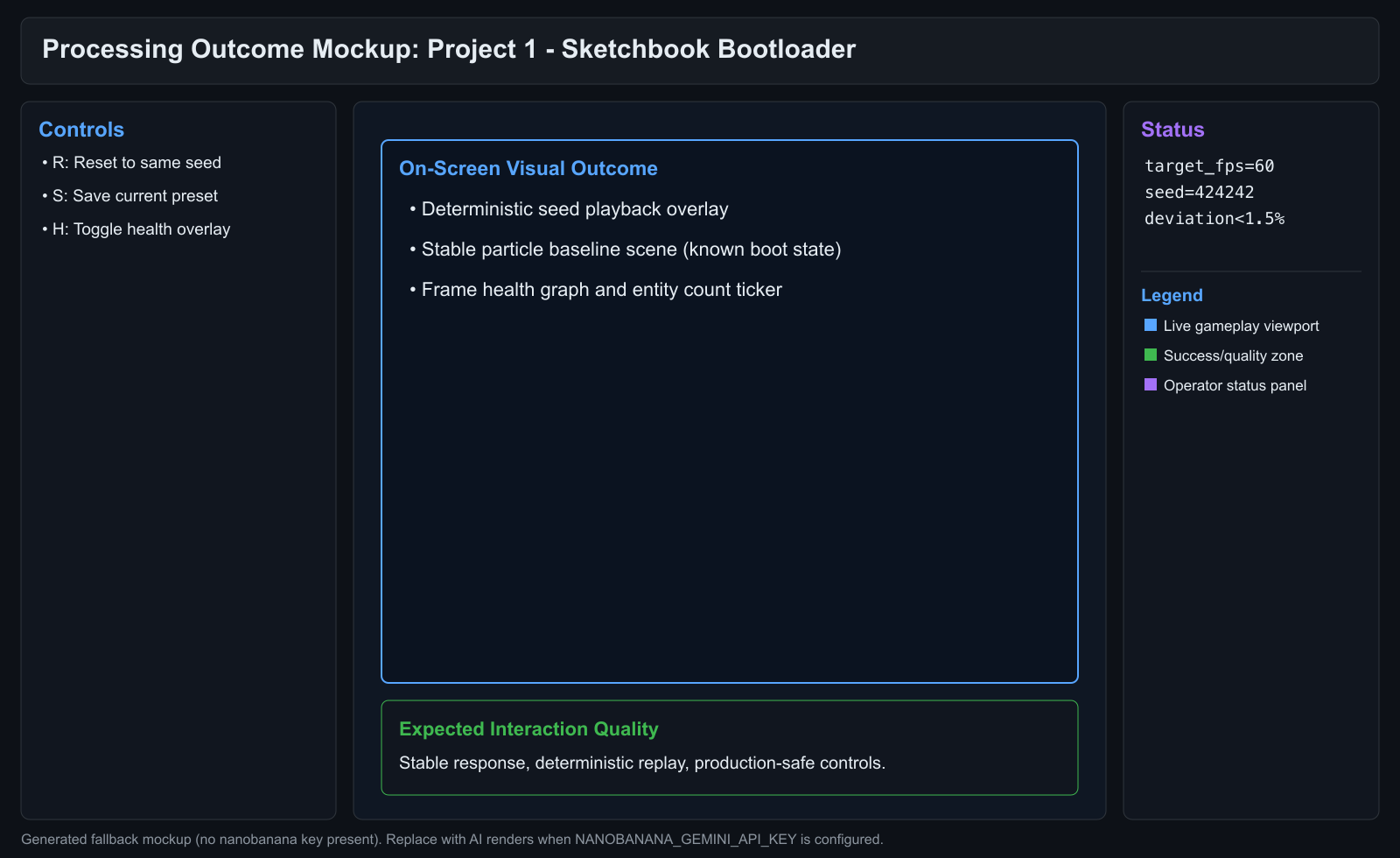
3.7.4 If GUI / Desktop
- Single primary canvas with optional control panel.
- Clear labels for mode, health, and fallback status.
- Visible state change when entering/exiting safe mode.
4. Solution Architecture
4.1 High-Level Design
Inputs/Config -> Control Layer -> State Engine -> Render Pipeline -> Diagnostics/Export
4.2 Key Components
| Component | Responsibility | Key Decisions |
|---|---|---|
| Boot/Config | Initialize deterministic runtime | Fail fast on missing prerequisites |
| State Engine | Apply transition rules | Keep update order explicit |
| Render Layer | Convert state to visuals | Isolate draw cost hotspots |
| Diagnostics | Report health and errors | Always available in debug mode |
4.3 Data Structures (No Full Code)
State:
  mode
  seed
  entities/resources
  metrics

Config:
  quality_profile
  limits
  mapping_parameters
4.4 Algorithm Overview
- Normalize inputs and enforce guardrails.
- Update state in deterministic order.
- Render based on current mode and quality tier.
- Collect metrics and trigger safeguards when needed.
Complexity considerations:
- Time cost should scale predictably with controlled entity/resource bounds.
- Memory growth should remain bounded by explicit caps.
5. Implementation Guide
5.1 Development Environment Setup
$ processing-java --version
$ processing-java --sketch=/path/to/P01-sketchbook-bootloader --run
5.2 Project Structure
project-root/
├── sketch/
│   ├── runtime files
│   ├── control/mode logic
│   └── render modules
├── assets/
├── presets/
└── logs/
5.3 The Core Question You’re Answering
How do I guarantee that every sketch run starts clean, stays stable, and is debuggable under pressure?
5.4 Concepts You Must Understand First
- Lifecycle and deterministic state transitions.
- Mapping strategy and guardrail design.
- Performance budget and fallback planning.
5.5 Questions to Guide Your Design
- Which parts of the system are allowed to fail without total collapse?
- Which values must be logged for full reproducibility?
- Which controls are operator-only vs viewer-facing?
5.6 Thinking Exercise
Trace one full run from startup to export, including one injected fault and recovery.
5.7 The Interview Questions They’ll Ask
- What are the core invariants of this system?
- How do you guarantee deterministic behavior?
- What is your fallback strategy under degraded conditions?
- How do you measure and protect runtime performance?
- How does this architecture scale to a more complex project?
5.8 Hints in Layers
- Hint 1: Build deterministic boot and reset before advanced visuals.
- Hint 2: Add diagnostics early to avoid blind debugging.
- Hint 3: Keep mode transitions explicit and validated.
- Hint 4: Practice failure drills, not only success demos.
5.9 Books That Will Help
| Topic | Book | Chapter |
|---|---|---|
| Creative coding systems | “Getting Started with Processing” | Runtime chapters |
| Generative behavior | “The Nature of Code” | Relevant concept chapters |
| Design systems | “Generative Design” | Composition and structure |
5.10 Implementation Phases
Phase 1: Foundation
- Define architecture and deterministic boot.
- Add diagnostics and seed logging.
Phase 2: Core Functionality
- Implement primary visual/interaction behavior.
- Validate with golden deterministic scenario.
Phase 3: Reliability and Polish
- Add fallback/safe mode behavior.
- Run soak tests and finalize export pipeline.
5.11 Key Implementation Decisions
| Decision | Options | Recommendation | Rationale |
|---|---|---|---|
| Update strategy | fixed vs variable step | fixed where possible | Better deterministic behavior |
| Input handling | direct vs intent mapping | intent mapping | Decouples controls from logic |
| Degradation | none vs tiered | tiered | Maintains responsiveness under load |
6. Testing Strategy
6.1 Test Categories
| Category | Purpose | Examples |
|---|---|---|
| Functional | Verify core behavior | startup, mode switch, reset |
| Reliability | Verify stability | long-run soak test |
| Failure | Verify recovery | missing input, invalid config |
6.2 Critical Test Cases
- Deterministic replay after reset.
- Stable runtime under target workload.
- Controlled fallback on defined failure trigger.
6.3 Test Data
- Fixed seed profile A.
- Stress profile with maximum allowed load.
- Fault profile with missing/invalid input scenario.
7. Common Pitfalls & Debugging
7.1 Frequent Mistakes
| Pitfall | Symptom | Solution |
|---|---|---|
| Hidden state mutation | Unreproducible behavior | Centralize transitions |
| No guardrails | Chaotic output or crashes | Clamp/validate parameters |
| Late diagnostics | Slow debugging cycles | Add telemetry from day one |
7.2 Debugging Strategies
- Reproduce issues with fixed seed and scripted event sequences.
- Compare runtime traces between good and bad runs.
- Disable subsystems incrementally to isolate bottlenecks.
7.3 Performance Traps
- Per-frame allocation and uncontrolled list growth.
- High-cost rendering operations applied indiscriminately.
- Missing quality tiers for degraded hardware conditions.
8. Extensions & Challenges
8.1 Beginner Extensions
- Add one new preset with documented constraints.
- Add one extra telemetry metric.
8.2 Intermediate Extensions
- Add profile switching without restart.
- Add batch export with metadata snapshots.
8.3 Advanced Extensions
- Add remote control input (OSC/MIDI/serial as relevant).
- Add automated quality-tier adaptation based on frame budget.
9. Real-World Connections
9.1 Industry Applications
- Creative technology studios building interactive media installations.
- Performance visual pipelines for live events.
- Design tooling for generative branding systems.
9.2 Related Open Source Projects
- Processing core: https://github.com/processing/processing4
- p5.js ecosystem: https://github.com/processing/p5.js
9.3 Interview Relevance
This project demonstrates system thinking beyond aesthetics: deterministic behavior, runtime observability, constraint design, and failure recovery.
10. Resources
10.1 Essential Reading
- Processing reference and tutorials.
- The corresponding sections in
PROCESSING_LANGUAGE_MASTERY.md.
10.2 Video Resources
- Processing Foundation and community talks on creative coding workflows.
- Live coding and interactive media performance breakdowns.
10.3 Tools & Documentation
- Processing docs: https://processing.org/reference
- Processing download/releases: https://processing.org/download
10.4 Related Projects in This Series
- Previous project: use as prerequisite baseline.
- Next project: use as progression target for increased complexity.
11. Self-Assessment Checklist
11.1 Understanding
- I can explain the project architecture and invariants clearly.
- I can justify my mapping and control decisions.
- I can explain failure handling and fallback design.
11.2 Implementation
- Core functionality works in normal mode.
- Deterministic replay or reproducible export is verified.
- Defined failure drills pass with expected recovery behavior.
11.3 Growth
- I documented at least three lessons learned.
- I can describe one architectural improvement for next iteration.
- I can present this project as a professional case study.
12. Submission / Completion Criteria
Minimum Viable Completion:
- Working core behavior with deterministic startup/reset.
- At least one successful golden-path run.
- Basic diagnostics visible during execution.
Full Completion:
- All minimum criteria plus:
- Successful fault drill with graceful recovery.
- Stable long-run behavior under defined workload.
Excellence (Going Above & Beyond):
- Automated profile testing and export metadata pipeline.
- Clear operator runbook and polished portfolio presentation.