Learn C++ Metaprogramming: From Templates to Compile-Time Magic
Goal: To master C++ template metaprogramming, from the foundational mechanics of type traits and SFINAE to modern C++20 Concepts and advanced design patterns like CRTP and policy-based design.
Why Learn This?
Template Metaprogramming (TMP) is the art of performing computation at compile-time. Instead of running code, you’re writing code that generates or validates other code as the compiler works. It’s the foundation of the C++ Standard Library (<type_traits>, <vector>, <functional>) and is the key to writing libraries that are simultaneously highly generic, incredibly performant, and perfectly type-safe.
After completing these projects, you will:
- Understand how the compiler “thinks” about types.
- Be able to write code that enables or disables function overloads based on template parameters (SFINAE).
- Master variadic templates to create functions and types that handle any number of arguments.
- Use C++20 Concepts to write clean, readable, and constrained generic code.
- Implement powerful design patterns like CRTP for static polymorphism and policy-based design for ultimate customization.
Core Concept Analysis
The World of Compile-Time C++
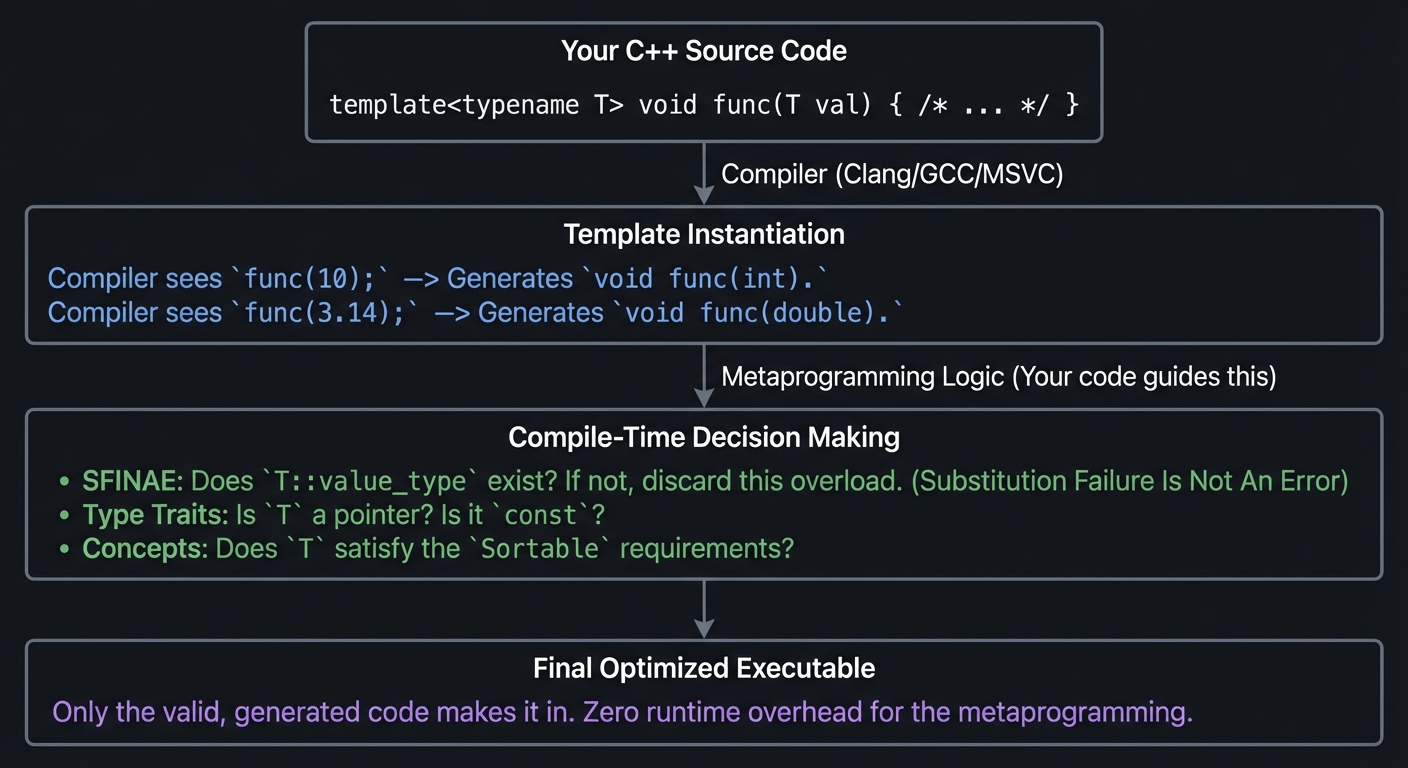
┌───────────────────────────────────────────────────────────┐
│                    Your C++ Source Code                   │
│   template<typename T> void func(T val) { /* ... */ }     │
└───────────────────────────────────────────────────────────┘
                           │
                           ▼ Compiler (Clang/GCC/MSVC)
┌───────────────────────────────────────────────────────────┐
│                 Template Instantiation                    │
│                                                           │
│   Compiler sees `func(10);` -> Generates `void func(int)`.
│   Compiler sees `func(3.14);` -> Generates `void func(double)`.
└───────────────────────────────────────────────────────────┘
                           │
                           ▼ Metaprogramming Logic (Your code guides this)
┌───────────────────────────────────────────────────────────┐
│              Compile-Time Decision Making                 │
│                                                           │
│ • SFINAE: Does `T::value_type` exist? If not, discard     │
│           this overload. (Substitution Failure Is Not An Error)
│                                                           │
│ • Type Traits: Is `T` a pointer? Is it `const`?           │
│                                                           │
│ • Concepts: Does `T` satisfy the `Sortable` requirements? │
└───────────────────────────────────────────────────────────┘
                           │
                           ▼
┌───────────────────────────────────────────────────────────┐
│                 Final Optimized Executable                │
│ (Only the valid, generated code makes it in. Zero runtime │
│             overhead for the metaprogramming.)            │
└───────────────────────────────────────────────────────────┘
Fundamental Concepts
-
Type Traits: A struct template that provides information about a type at compile-time. The standard library provides many in
<type_traits>, likestd::is_pointer<T>,std::is_integral<T>,std::add_const<T>. They are the building blocks of TMP. -
SFINAE (Substitution Failure Is Not An Error): A core principle. If the compiler tries to substitute a type into a template and it results in invalid code (e.g., calling a member function on an
int), it doesn’t fail compilation. It just quietly discards that function overload from the set of candidates. This is the mechanism that makesstd::enable_ifwork. -
std::enable_if: The classic tool for conditional template instantiation. It allows you to include or exclude a function or class specialization based on a compile-time boolean condition, usually derived from a type trait. - Variadic Templates: Templates that can take a variable number of arguments. Indicated by
template<typename... Args>. This is howstd::tuple,std::function, andstd::printfare implemented.- Fold Expressions (C++17): A concise syntax for applying a binary operator to all elements of a parameter pack (e.g.,
(args + ...)).
- Fold Expressions (C++17): A concise syntax for applying a binary operator to all elements of a parameter pack (e.g.,
- C++20 Concepts: The modern, readable way to apply constraints to templates. Instead of cryptic SFINAE expressions, you define a named set of requirements (a
concept) and apply it directly.template<typename T> requires MyConcept<T>
-
CRTP (Curiously Recurring Template Pattern): A powerful pattern where a class
Dinherits from a base class template that is instantiated withDitself:class Derived : public Base<Derived>. This allows the base class to know the static type of the derived class and perform “static polymorphism.” - Policy-Based Design: A design approach where a class’s behavior is customized by providing “policy” classes as template arguments. This allows you to mix and match behaviors (e.g., threading model, storage strategy) at compile-time with no virtual function overhead.
Project List
These projects are designed to build your understanding from the ground up, starting with the fundamental mechanics and moving to advanced patterns.
Project 1: Build Your Own Type Traits Library
- File: LEARN_CPP_METAPROGRAMMING_DEEP_DIVE.md
- Main Programming Language: C++
- Alternative Programming Languages: N/A
- Coolness Level: Level 3: Genuinely Clever
- Business Potential: 1. The “Resume Gold”
- Difficulty: Level 2: Intermediate
- Knowledge Area: C++ / Template Metaprogramming
- Software or Tool: C++17 Compiler (GCC/Clang/MSVC)
- Main Book: “Effective Modern C++” by Scott Meyers
What you’ll build: A small header-only library, my_type_traits.hpp, that replicates some of the core utilities from the standard <type_traits> header. You’ll implement is_pointer, is_void, is_const, and remove_reference from scratch.
Why it teaches the fundamentals: This is the “Hello, World!” of template metaprogramming. It forces you to understand template specialization, the core mechanism for making compile-time decisions. You’ll learn how to “ask the compiler questions” about types and get boolean answers.
Core challenges you’ll face:
- Creating a base template that defaults to
false→ maps to the general case for any given type - Creating partial specializations for specific cases → maps to how to provide the
trueanswer for matching types (e.g.,T*) - Inheriting from
std::true_typeandstd::false_type→ maps to the standard idiom for representing compile-time booleans - Implementing transformation traits → maps to defining a nested
::typealias to represent the transformed type
Key Concepts:
- Template Specialization: cppreference.com - Template specialization
std::integral_constant: The base class fortrue_typeandfalse_type.
Difficulty: Intermediate Time estimate: Weekend Prerequisites: Strong understanding of C++ templates (basic function and class templates).
Real world outcome:
A header file you can include in other projects. You will be able to write static_assert(my_traits::is_pointer<int*>::value, "Must be a pointer!"); and have it compile, but have it fail to compile for int.
Implementation Hints:
- The Base Template (General Case):
// For is_pointer, the general case is that a type T is NOT a pointer. template<typename T> struct is_pointer : std::false_type {}; - The Specialization:
// We create a partial specialization that matches any type T that IS a pointer.
template<typename T>
struct is_pointer<T*> : std::true_type {};
When the compiler sees
is_pointer<int*>, this specialization is a better match than the general one, so it gets chosen. Its base class isstd::true_type, so::valueistrue. - Transformation Trait (
remove_reference):// General case: T is not a reference, so its type is just T. template<typename T> struct remove_reference { using type = T; }; // Specialization for lvalue references template<typename T> struct remove_reference<T&> { using type = T; }; // Specialization for rvalue references template<typename T> struct remove_reference<T&&> { using type = T; };
Learning milestones:
is_voidworks correctly → You understand full template specialization.is_pointerworks correctly → You understand partial template specialization.remove_referenceworks for both&and&&→ You understand transformation traits and type aliases.- You can write a
static_assertusing your own trait → You’ve successfully performed a compile-time check.
Project 2: The SFINAE and enable_if Lab
- File: LEARN_CPP_METAPROGRAMMING_DEEP_DIVE.md
- Main Programming Language: C++
- Alternative Programming Languages: N/A
- Coolness Level: Level 4: Hardcore Tech Flex
- Business Potential: 1. The “Resume Gold”
- Difficulty: Level 3: Advanced
- Knowledge Area: C++ / Template Metaprogramming
- Software or Tool: C++17 Compiler
- Main Book: “C++ Templates: The Complete Guide, 2nd Edition” by Vandevoorde, Josuttis, and Gregor
What you’ll build: A set of small, targeted examples in a single file that use std::enable_if to conditionally compile function overloads. You’ll create a function that only works on integral types, another that only works for types that have a .begin() member, etc.
Why it teaches SFINAE: This project forces you to grapple with the classic C++11/14/17 method of constraining templates. You’ll learn the different ways to apply enable_if (as a return type, a function argument, or a template parameter) and understand the cryptic error messages that result when constraints aren’t met.
Core challenges you’ll face:
- Using
enable_ifin a template parameter → maps to the simplest form of SFINAE - Using
enable_ifas a function return type → maps to a common and powerful pattern - Detecting the existence of a member function → maps to more advanced SFINAE techniques (the “void_t” trick)
- Interpreting compiler errors when a substitution fails → maps to learning to read the template spaghetti in error messages
Key Concepts:
std::enable_if: cppreference.com - std::enable_if- SFINAE: cppreference.com - SFINAE
void_t(C++17): A utility for detecting valid expressions in a SFINAE context.
Difficulty: Advanced Time estimate: Weekend Prerequisites: Project 1, solid understanding of type traits.
Real world outcome: A set of functions that appear to be overloads but are actually mutually exclusive based on the properties of the types they are called with.
// This call will resolve to your integral-only function
process(42);

// This call will resolve to your iterable-only function
std::vector<int> v;
process(v);

// This call will fail to compile, as neither overload is valid
// process(3.14);
Implementation Hints:
Technique 1: As a Template Parameter
template<typename T,
         typename = std::enable_if_t<std::is_integral_v<T>>>
void process_integral(T value) {
    // This function only exists for integral types
}
If T is not integral, enable_if has no ::type, substitution fails, and the overload is discarded.
Technique 2: As a Return Type (Trailing)
template<typename T>
auto process_integral_v2(T value) -> std::enable_if_t<std::is_integral_v<T>, void> {
    // Also only exists for integral types
}
This is often preferred as it’s more flexible and less likely to clash with other template parameters.
Technique 3: void_t for member detection
// Trait to check for a .begin() member
template<typename, typename = void>
struct has_begin : std::false_type {};

template<typename T>
struct has_begin<T, std::void_t<decltype(std::declval<T>().begin())>> : std::true_type {};

// Use it
template<typename T>
auto process_iterable(T& container) -> std::enable_if_t<has_begin<T>::value, void> {
    // This overload only exists if T has a .begin() method
}
Learning milestones:
- You create a function that only accepts integral types → You’ve mastered basic
enable_if. - You create two distinct overloads for integral and floating point types → You can use SFINAE to choose between functions.
- You create a function enabled based on the presence of a member function → You’ve learned advanced detection idioms.
- You can explain why a call fails to compile by reading the error messages → You have truly understood SFINAE.
Project 3: A Type-Safe printf
- File: LEARN_CPP_METAPROGRAMMING_DEEP_DIVE.md
- Main Programming Language: C++
- Alternative Programming Languages: N/A
- Coolness Level: Level 4: Hardcore Tech Flex
- Business Potential: 1. The “Resume Gold”
- Difficulty: Level 3: Advanced
- Knowledge Area: C++ / Variadic Templates
- Software or Tool: C++17 Compiler
- Main Book: “C++ Templates: The Complete Guide, 2nd Edition”
What you’ll build: A safe_printf function that parses a format string at compile time and validates that the provided arguments match the format specifiers (%d, %s, etc.). A correct call compiles; a mismatched call results in a static_assert failure.
Why it teaches variadic templates: This is a perfect, practical application of variadic templates and compile-time logic. You have to process a list of types of arbitrary length and compare it against a format string. It combines constexpr functions, recursion (or fold expressions), and variadic templates.
Core challenges you’ll face:
- Parsing a string at compile time → maps to using
constexprfunctions to iterate over the format string - Handling a variable number of arguments → maps to using variadic templates (
...Args) - Matching a specifier to a type → maps to writing compile-time logic to check, e.g., if
%dcorresponds to an integral type - Iterating through the types in a parameter pack → maps to template recursion or C++17 fold expressions
Key Concepts:
- Variadic Templates: cppreference.com - Variadic templates
constexprfunctions: cppreference.com - constexpr- Fold Expressions (C++17): cppreference.com - Fold expression
Difficulty: Advanced
Time estimate: 1-2 weeks
Prerequisites: Project 2, comfortable with constexpr.
Real world outcome:
A safer printf that eliminates an entire class of runtime bugs.
safe_printf("Hello %s, the number is %d\n", "world", 42); // Compiles and runs

// This line will fail to compile with a static_assert!
// safe_printf("Hello %d, the number is %s\n", "world", 42);
Implementation Hints:
- Compile-Time String Parsing: Write a
constexprfunction that takes aconst char*and an index, and returns the character at that index. You’ll need anotherconstexprfunction to find the next%specifier. - The Main Entry Point:
template<typename... Args> void safe_printf(const char* format, const Args&... args) { // Your compile-time checker will go here. // If it passes, just call regular printf. static_assert(check_format_string(format, args...), "Format string mismatch!"); printf(format, args...); } - The Checker (
check_format_string): This will be the heart of your logic. It’s a recursiveconstexprfunction.- Base Case: An empty format string and no more arguments. Return
true. - Recursive Step:
- Find the next
%in the format string. - If it’s
%%, ignore it and recurse on the rest of the string. - If it’s
%d, check if the head of theArgs...pack is an integral type (std::is_integral). If yes, recurse on the rest of the string and the tail of theArgs...pack. If no, returnfalse. - If it’s
%s, check if the argument is aconst char*. - And so on.
- Find the next
- Base Case: An empty format string and no more arguments. Return
Learning milestones:
- You can parse a simple format string like
"%d"at compile time → You understandconstexprfunctions. - Your function accepts a variable number of arguments → You’re comfortable with variadic template syntax.
- Your recursive checker can validate a format string with multiple arguments → You have mastered variadic template recursion.
- The
static_asserttriggers with a clear message on a type mismatch → You have successfully built a compile-time validation tool.
Project 4: C++20 Concepts - A Clean Refactor
- File: LEARN_CPP_METAPROGRAMMING_DEEP_DIVE.md
- Main Programming Language: C++
- Alternative Programming Languages: N/A
- Coolness Level: Level 3: Genuinely Clever
- Business Potential: 1. The “Resume Gold”
- Difficulty: Level 2: Intermediate
- Knowledge Area: C++20 / Generic Programming
- Software or Tool: C++20 Compiler
- Main Book: “Beginning C++20” by Ivor Horton, Peter Van Weert
What you’ll build: You will take your code from Project 2 (the SFINAE lab) and refactor it completely to use C++20 Concepts. You will replace the complex enable_if and void_t constructs with clean, readable, named concepts.
Why it teaches Concepts: This project brilliantly demonstrates the power and readability of Concepts by contrasting them directly with the older, more verbose SFINAE techniques. It makes the “why” of Concepts crystal clear.
Core challenges you’ll face:
- Defining a simple concept → maps to using type traits within a
conceptdefinition - Defining a concept that requires a member function → maps to using
requiresexpressions - Constraining a function template with a concept → maps to the
requiresclause or constrained template parameter syntax - Understanding concept-based compiler errors → maps to seeing how much clearer the errors are compared to SFINAE
Key Concepts:
- Concepts: cppreference.com - Concepts library
requiresclause and expression: cppreference.com - requires clause
Difficulty: Intermediate Time estimate: Weekend Prerequisites: Project 2.
Real world outcome: Two sets of code (before and after) that accomplish the same thing, but the “after” (Concepts) version is vastly more readable and maintainable.
Implementation Hints:
Before (SFINAE from Project 2)
template<typename T>
auto process(T value) -> std::enable_if_t<std::is_integral_v<T>, void> {
    // ...
}
After (Concepts)
// 1. Define the concept
template<typename T>
concept Integral = std::is_integral_v<T>;

// 2. Use the concept to constrain the template
template<Integral T> // The "terse" syntax
void process(T value) {
    // ...
}

// Or with a requires clause
template<typename T>
    requires Integral<T>
void process(T value) {
    // ...
}
Before (Member function detection)
template<typename T>
auto process_iterable(T& container) -> std::enable_if_t<has_begin<T>::value, void> {
    // ...
}
After (Concepts)
// 1. Define the concept with a requires expression
template<typename T>
concept Iterable = requires(T a) {
    // This expression must be valid for T to be Iterable
    { a.begin() } -> std::same_as<typename T::iterator>; // Fancier check
    { a.end() };
};

// 2. Use it
template<Iterable T>
void process_iterable(T& container) {
    // ...
}
Learning milestones:
- You successfully replace an
enable_ifwith a simple concept → You understand the basic syntax. - You define and use a concept that checks for member functions → You’ve mastered
requiresexpressions. - You can combine concepts using
&&and||→ You can build more complex constraints. - You trigger a compiler error and see the clean, concept-based message → You appreciate the huge improvement in diagnostics.
Project 5: Policy-Based Design - A Customizable Smart Pointer
- File: LEARN_CPP_METAPROGRAMMING_DEEP_DIVE.md
- Main Programming Language: C++
- Alternative Programming Languages: N/A
- Coolness Level: Level 4: Hardcore Tech Flex
- Business Potential: 2. The “Micro-SaaS / Pro Tool”
- Difficulty: Level 4: Expert
- Knowledge Area: C++ / Software Design / Generic Programming
- Software or Tool: C++17 Compiler
- Main Book: “Modern C++ Design” by Andrei Alexandrescu
What you’ll build: A “smart” pointer class, SmartPtr, whose core behaviors—like ownership, thread safety, and checking—are not hard-coded but are provided by policy classes as template arguments.
Why it teaches policy-based design: This is the canonical example of the pattern. It forces you to separate a class’s core logic (being a pointer) from its variable behaviors (how it copies, how it checks for null). It’s a masterclass in creating flexible, reusable, and performant components.
Core challenges you’ll face:
- Designing the main class template → maps to accepting policy classes as template parameters
- Defining the policy interfaces → maps to deciding what functions each policy class must provide (e.g.,
clone,lock,check) - Implementing different policy classes → maps to creating concrete behaviors like deep-copy vs. shallow-copy, or single-threaded vs. mutex-locking
- Composing the policies within the main class → maps to inheriting from or containing policy objects to access their functionality
Key Concepts:
- Policy-Based Design: The core idea from “Modern C++ Design”.
- Template-Template Parameters (optional but powerful): For more advanced policy definitions.
Difficulty: Expert Time estimate: 1-2 weeks Prerequisites: Strong understanding of C++ class design and templates.
Real world outcome:
A single SmartPtr template that can be instantiated in many ways to create different kinds of smart pointers, all at compile time with no virtual function overhead.
// A pointer that is thread-safe and performs deep copies
using SafeWidgetPtr = SmartPtr<Widget, DeepCopy, MultiThreaded>;

// A pointer for single-threaded use that does no checking for speed
using FastUnsafeWidgetPtr = SmartPtr<Widget, ShallowCopy, SingleThreaded, NoChecking>;

SafeWidgetPtr p1 = new Widget();
FastUnsafeWidgetPtr p2;
Implementation Hints:
- Define Policy Interfaces (Conceptually):
OwnershipPolicyneeds aT* clone(T*)method.ThreadingPolicyneedsvoid lock()andvoid unlock()methods.
- Implement Concrete Policies:
template<typename T> struct DeepCopy { static T* clone(T* p) { return p ? new T(*p) : nullptr; } }; template<typename T> struct ShallowCopy { static T* clone(T* p) { return p; } }; struct MultiThreaded { std::mutex mtx; void lock() { mtx.lock(); } void unlock() { mtx.unlock(); } }; - Design the Host Class (
SmartPtr):template< typename T, template<class> class OwnershipPolicy, class ThreadingPolicy > class SmartPtr : private ThreadingPolicy // Inherit to get lock/unlock { private: T* ptr; public: // ... constructor, destructor, etc. ... // Example: copy constructor uses the policies SmartPtr(const SmartPtr& other) { other.lock(); // from ThreadingPolicy // from OwnershipPolicy ptr = OwnershipPolicy<T>::clone(other.ptr); other.unlock(); } };(Note: Using template-template parameters as shown is one way; simply passing concrete policy types is another.)
Learning milestones:
- You design a
SmartPtrthat takes at least one policy template argument → You understand the basic structure. - You can swap out an
OwnershipPolicyto change copy behavior → You have successfully decoupled a core behavior. - You can add a
ThreadingPolicywithout changing the existing ownership code → You see the power of orthogonal policies. - Your final design is composed entirely of a core algorithm and a set of injected policies → You have mastered policy-based design.
Project Comparison Table
| Project | Difficulty | Time | Depth of Understanding | Fun Factor |
|---|---|---|---|---|
| My First Type Traits | Level 2: Intermediate | Weekend | ★★☆☆☆ | ★★★☆☆ |
SFINAE and enable_if Lab |
Level 3: Advanced | Weekend | ★★★★☆ | ★★★☆☆ |
A Type-Safe printf |
Level 3: Advanced | 1-2 weeks | ★★★★☆ | ★★★★☆ |
| C++20 Concepts Refactor | Level 2: Intermediate | Weekend | ★★★☆☆ | ★★★★★ |
| Policy-Based Smart Pointer | Level 4: Expert | 1-2 weeks | ★★★★★ | ★★★★☆ |
Recommendation
Follow the projects in order. Start with Project 1: Build Your Own Type Traits Library. It’s the absolute foundation. You must understand how to query types before you can constrain them.
Then, proceed to Project 2: The SFINAE and enable_if Lab. It is crucial to understand the “old way” to fully appreciate the “new way” you’ll see in the Concepts project. After that, you’ll be ready for the more advanced design patterns in the later projects. Project 4 (Concepts Refactor) will feel incredibly rewarding after you’ve struggled through the SFINAE syntax.
This path will methodically build your skills from the essential mechanics to the high-level design patterns that define modern, generic C++.
Summary
| Project | Main Programming Language |
|---|---|
| Build Your Own Type Traits Library | C++ |
The SFINAE and enable_if Lab |
C++ |
A Type-Safe printf |
C++ |
| C++20 Concepts - A Clean Refactor | C++ |
| Policy-Based Design - A Customizable Smart Pointer | C++ |