Understanding Functional Programming Through Building
A comprehensive project-based learning journey through functional programming concepts. Each project is designed to teach specific FP principles through hands-on implementation.
Learning Path Overview
| # | Project | Difficulty | Key Concepts | Language |
|---|---|---|---|---|
| 1 | JSON Query Tool | Intermediate | Composition, Pipelines, Immutability | Rust |
| 2 | Scheme/Lisp Interpreter | Advanced | Closures, First-Class Functions, Recursion | Haskell |
| 3 | Reactive Spreadsheet Engine | Intermediate | Declarative Programming, Dataflow | TypeScript |
| 4 | Parser Combinator Library | Advanced | Higher-Order Functions, Monads | C |
| 5 | Redux from Scratch | Intermediate | Immutability, Pure Reducers | TypeScript |
| 6 | Distributed Task Processing System | Expert | All FP Concepts Combined | Rust |
Core FP Concepts Covered
| Concept | What It Means | Why It Matters |
|---|---|---|
| Pure Functions | Same input → same output, no side effects | Predictable, testable, parallelizable |
| Immutability | Data never changes; you create new versions | No “spooky action at a distance”, safe concurrency |
| First-Class Functions | Functions are values (pass them, return them, store them) | Enables composition and abstraction |
| Higher-Order Functions | Functions that take/return other functions | map, filter, reduce—the bread and butter |
| Function Composition | Building complex operations from simple ones | f(g(x)) chains become pipelines |
| Declarative Style | Describe what, not how | More readable, less error-prone |
| Referential Transparency | Expressions can be replaced with their values | Enables optimization, easier reasoning |
| Algebraic Data Types | Sum types (Either/Maybe) and product types | Model domain precisely, eliminate null errors |
Where FP Shines
- Data transformation pipelines: Immutable transforms are easy to reason about and parallelize
- Concurrent/parallel systems: No shared mutable state = no race conditions
- Compilers/interpreters: AST transformations are naturally functional
- Financial systems: Correctness and auditability matter enormously
- UI state management: Redux, Elm Architecture—FP tamed frontend chaos
- Distributed systems: Idempotent, pure operations make retry logic trivial
Recommended Learning Order
Beginner Path
- Project 5: Redux from Scratch - Gentlest introduction to immutability and pure functions
- Project 1: JSON Query Tool - Learn composition and pipelines with immediate practical value
- Project 3: Reactive Spreadsheet - Understand declarative programming
Deep Understanding Path
- Project 1: JSON Query Tool - Foundation in composition and transformation
- Project 2: Scheme Interpreter - Deep dive into how FP actually works
- Project 4: Parser Combinators - Master higher-order functions and monads
Production-Ready Path
- Project 3: Reactive Spreadsheet - Modern reactive patterns
- Project 1: JSON Query Tool - Practical CLI tool development
- Project 6: Distributed Task System - Scale FP to real systems
Essential Reading
Foundation Books
| Book | Focus | Best For | |——|——-|———-| | Learn You a Haskell for Great Good! | Haskell fundamentals | Higher-order functions, monads | | Domain Modeling Made Functional | F# domain modeling | Pure functions, pipelines | | Fluent Python (2nd Ed.) | Python FP patterns | First-class functions, immutability | | Programming Rust (2nd Ed.) | Rust ownership/errors | Result types, error handling | | Structure and Interpretation of Computer Programs | Scheme/Lisp | Interpreters, closures |
Concept-Specific Resources
| Concept | Resource | |———|———-| | Category Theory | Category Theory for Programmers by Bartosz Milewski | | Parser Combinators | “Monadic Parser Combinators” by Hutton & Meijer | | Reactive Programming | “The Elm Architecture” - Official Elm Guide | | Distributed Systems | Designing Data-Intensive Applications by Kleppmann |
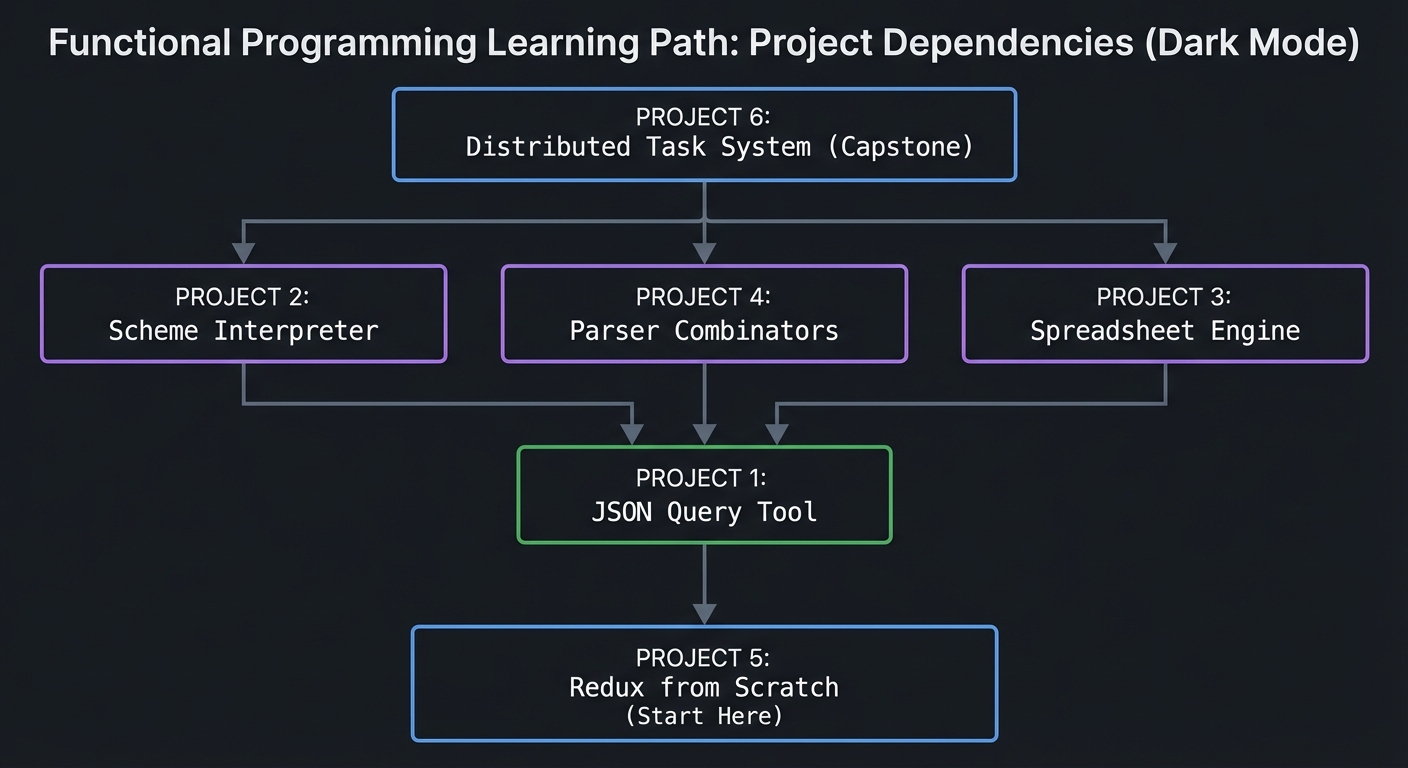
Project Dependencies
                    ┌─────────────────┐
                    │  Project 6:     │
                    │  Distributed    │
                    │  Task System    │
                    │  (Capstone)     │
                    └────────┬────────┘
                             │
           ┌─────────────────┼─────────────────┐
           │                 │                 │
    ┌──────▼──────┐   ┌──────▼──────┐   ┌──────▼──────┐
    │  Project 2: │   │  Project 4: │   │  Project 3: │
    │   Scheme    │   │   Parser    │   │ Spreadsheet │
    │ Interpreter │   │ Combinators │   │   Engine    │
    └──────┬──────┘   └──────┬──────┘   └──────┬──────┘
           │                 │                 │
           └─────────────────┼─────────────────┘
                             │
                    ┌────────▼────────┐
                    │  Project 1:     │
                    │  JSON Query     │
                    │  Tool           │
                    └────────┬────────┘
                             │
                    ┌────────▼────────┐
                    │  Project 5:     │
                    │  Redux from     │
                    │  Scratch        │
                    │  (Start Here)   │
                    └─────────────────┘
The “Why” Summary
By the end of these projects, you’ll understand FP not as a set of rules (“avoid mutation!”, “use map not for loops!”) but as a design philosophy:
| FP Principle | Why It Actually Matters |
|---|---|
| Pure functions | Testing is trivial, parallelism is free, debugging shows exact cause |
| Immutability | Time-travel debugging, safe concurrency, caching is automatic |
| Composition | Complexity managed through combination, not accumulation |
| Declarative style | Express intent, not mechanism—code becomes specification |
| Explicit effects | Side effects are visible, controlled, and testable |
Functional programming shines wherever correctness matters more than cleverness—compilers, finance, distributed systems, data pipelines, and increasingly, everywhere else.