Project 5: Implement Redux from Scratch
Project Overview
| Attribute | Value |
|---|---|
| Difficulty | Intermediate |
| Time Estimate | 1 week |
| Main Language | TypeScript |
| Alternatives | JavaScript, Rust, Python |
| Prerequisites | Basic callbacks, closures understanding |
| Key FP Concepts | Immutability, pure functions, state machines, unidirectional data flow |
Learning Objectives
By completing this project, you will:
- Internalize immutability - Experience why never mutating state eliminates bugs
- Master pure reducers - Write functions that transform state predictably
- Understand unidirectional data flow - See how one-way data makes apps predictable
- Implement time-travel debugging - Experience why immutability enables the impossible
- Isolate side effects - Learn to push impurity to the edges with middleware
- Build the observer pattern functionally - Subscriptions without mutation
The Core Question
“Why did Redux conquer frontend state management? What problem does ‘pure functions + immutable state’ actually solve?”
Before Redux, frontend state was chaos:
- State scattered across components
- Mutations happening anywhere
- No way to know what changed or why
- Debugging required stepping through code
Redux’s insight: treat state changes as a stream of events (actions), process them with pure reducer functions, and never mutate state. The result:
- Every state change is logged
- You can replay any sequence of actions
- Time-travel debugging becomes trivial
- Testing requires no mocks or setup
Deep Theoretical Foundation
1. The Problem Redux Solves
Consider this typical UI code:
// Scattered, mutable state
let todos = [];
let filter = 'all';
let user = null;

function addTodo(text) {
  todos.push({ id: Date.now(), text, done: false });  // Mutation!
  renderTodos();
}

function toggleTodo(id) {
  const todo = todos.find(t => t.id === id);
  todo.done = !todo.done;  // Mutation!
  renderTodos();
}

function setFilter(f) {
  filter = f;  // Mutation!
  renderTodos();
}
Problems:
- Where did state change? Any function can mutate anything
- What was the previous state? Lost forever
- Why did state change? No record of intent
- Can I reproduce a bug? Only if I remember the exact sequence of actions
2. The Redux Architecture
┌─────────────────────────────────────────────────────────────┐
│                         STORE                                │
│  ┌─────────────────────────────────────────────────────┐    │
│  │                      STATE                           │    │
│  │  { todos: [...], filter: 'all', user: {...} }       │    │
│  └─────────────────────────────────────────────────────┘    │
│                           │                                  │
│                    getState()                                │
│                           ▼                                  │
│  ┌─────────────────────────────────────────────────────┐    │
│  │                       UI                             │    │
│  └─────────────────────────────────────────────────────┘    │
│                           │                                  │
│                    dispatch(action)                          │
│                           ▼                                  │
│  ┌─────────────────────────────────────────────────────┐    │
│  │                     ACTION                           │    │
│  │  { type: 'ADD_TODO', payload: { text: 'Learn FP' } }│    │
│  └─────────────────────────────────────────────────────┘    │
│                           │                                  │
│                    reducer(state, action)                    │
│                           ▼                                  │
│  ┌─────────────────────────────────────────────────────┐    │
│  │                     REDUCER                          │    │
│  │  (state, action) => newState  (PURE FUNCTION)       │    │
│  └─────────────────────────────────────────────────────┘    │
│                           │                                  │
│                     (creates new state)                      │
│                           ▼                                  │
│                      [back to STATE]                         │
└─────────────────────────────────────────────────────────────┘
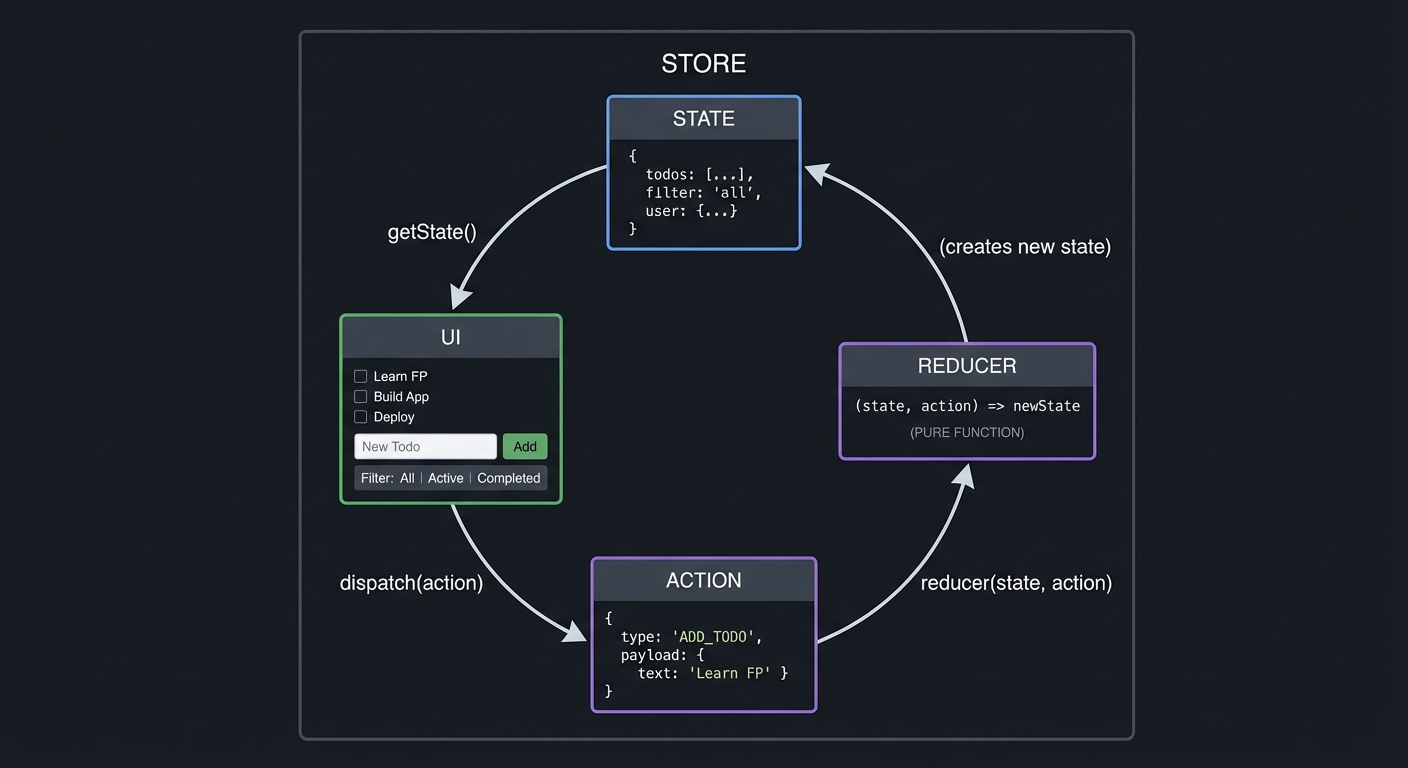
Key principles:
- Single source of truth: One state object in one store
- State is read-only: Never mutate; create new state objects
- Changes via pure functions: Reducers take (state, action) → newState
3. Pure Reducers: The Heart of Redux
A reducer is a pure function: (state, action) => newState
// PURE: No mutations, no side effects
function todosReducer(state: Todo[] = [], action: Action): Todo[] {
  switch (action.type) {
    case 'ADD_TODO':
      // Return NEW array with new todo
      return [...state, { id: Date.now(), text: action.payload.text, done: false }];

    case 'TOGGLE_TODO':
      // Return NEW array with modified todo
      return state.map(todo =>
        todo.id === action.payload.id
          ? { ...todo, done: !todo.done }  // New object!
          : todo
      );

    case 'REMOVE_TODO':
      return state.filter(todo => todo.id !== action.payload.id);

    default:
      return state;  // Unknown action: return unchanged
  }
}
Why pure?
- Same inputs → same output (testable)
- No side effects (predictable)
- Doesn’t mutate input (enables history)
4. Actions: Describing What Happened
Actions are plain objects describing events:
// Actions are data, not function calls
const addTodoAction = {
  type: 'ADD_TODO',
  payload: { text: 'Learn Redux' }
};

const toggleTodoAction = {
  type: 'TOGGLE_TODO',
  payload: { id: 123 }
};

// Action creators: functions that return actions
function addTodo(text: string): Action {
  return { type: 'ADD_TODO', payload: { text } };
}

function toggleTodo(id: number): Action {
  return { type: 'TOGGLE_TODO', payload: { id } };
}
Why objects?
- Serializable (can be logged, saved, replayed)
- Inspectable (debugger tools can show them)
- Declarative (describe intent, not implementation)
5. Immutable Updates: Creating New State
The hardest part of Redux is updating nested state immutably:
// State shape
interface State {
  user: {
    profile: {
      name: string;
      settings: {
        theme: string;
      };
    };
  };
}

// WRONG: Mutating nested state
function updateThemeWrong(state: State, theme: string): State {
  state.user.profile.settings.theme = theme;  // Mutation!
  return state;
}

// RIGHT: Immutable update at each level
function updateThemeRight(state: State, theme: string): State {
  return {
    ...state,
    user: {
      ...state.user,
      profile: {
        ...state.user.profile,
        settings: {
          ...state.user.profile.settings,
          theme  // Only this changes
        }
      }
    }
  };
}
This is verbose! That’s why libraries like Immer exist. But understanding the manual approach teaches you why immutability works.
6. The Store: Holding It All Together
The store is a closure that holds state and provides methods:
function createStore(reducer, initialState) {
  let state = initialState;
  let listeners = [];

  return {
    getState() {
      return state;
    },

    dispatch(action) {
      state = reducer(state, action);  // Compute new state
      listeners.forEach(fn => fn());    // Notify subscribers
      return action;
    },

    subscribe(listener) {
      listeners.push(listener);
      return () => {  // Return unsubscribe function
        listeners = listeners.filter(l => l !== listener);
      };
    }
  };
}
Why a closure?
stateis private (can’t be mutated from outside)- Only
dispatchcan change state (enforces the pattern) subscribeenables reactive UI updates
7. Time-Travel Debugging: The Payoff
Because state is never mutated and actions are logged:
interface StoreWithHistory {
  past: State[];
  present: State;
  future: State[];
}

function enhanceWithUndo(reducer) {
  return function(state, action) {
    switch (action.type) {
      case 'UNDO':
        if (state.past.length === 0) return state;
        return {
          past: state.past.slice(0, -1),
          present: state.past[state.past.length - 1],
          future: [state.present, ...state.future]
        };

      case 'REDO':
        if (state.future.length === 0) return state;
        return {
          past: [...state.past, state.present],
          present: state.future[0],
          future: state.future.slice(1)
        };

      default:
        const newPresent = reducer(state.present, action);
        if (newPresent === state.present) return state;
        return {
          past: [...state.past, state.present],
          present: newPresent,
          future: []  // Clear redo stack on new action
        };
    }
  };
}
This is impossible with mutations. You can’t go back if you overwrote the previous value!
8. Middleware: Handling Side Effects
Pure reducers can’t do async operations. Middleware handles effects:
// Middleware signature
type Middleware = (store) => (next) => (action) => any;

// Logger middleware
const logger: Middleware = store => next => action => {
  console.log('Dispatching:', action);
  const result = next(action);
  console.log('New state:', store.getState());
  return result;
};

// Thunk middleware: actions can be functions
const thunk: Middleware = store => next => action => {
  if (typeof action === 'function') {
    return action(store.dispatch, store.getState);
  }
  return next(action);
};
The pattern: Keep the core pure, push effects to the edges.
Project Specification
What You’re Building
A minimal but complete Redux implementation:
// Create a store
const store = createStore(rootReducer, initialState);

// Subscribe to changes
const unsubscribe = store.subscribe(() => {
  console.log('State changed:', store.getState());
});

// Dispatch actions
store.dispatch({ type: 'ADD_TODO', payload: { text: 'Learn Redux' } });
store.dispatch({ type: 'TOGGLE_TODO', payload: { id: 1 } });

// Undo/redo
store.dispatch({ type: 'UNDO' });
store.dispatch({ type: 'REDO' });

// Combine reducers
const rootReducer = combineReducers({
  todos: todosReducer,
  filter: filterReducer,
  user: userReducer
});

// Apply middleware
const store = createStore(
  rootReducer,
  applyMiddleware(logger, thunk)
);
Core API
| Function | Description |
|---|---|
createStore(reducer, initialState?, enhancer?) |
Create a Redux store |
store.getState() |
Get current state |
store.dispatch(action) |
Send action to reducer |
store.subscribe(listener) |
Register change listener |
combineReducers(reducers) |
Combine multiple reducers |
applyMiddleware(...middlewares) |
Add middleware to store |
Features to Implement
- Basic store: getState, dispatch, subscribe
- Reducer composition: combineReducers
- Middleware: applyMiddleware, compose
- Time-travel: Undo/redo enhancer
- DevTools: Action logging, state inspection
Solution Architecture
Type Definitions
// Actions
interface Action {
  type: string;
  payload?: any;
}

type ActionCreator = (...args: any[]) => Action;

// Reducers
type Reducer<S> = (state: S | undefined, action: Action) => S;

// Store
interface Store<S> {
  getState(): S;
  dispatch(action: Action): Action;
  subscribe(listener: () => void): () => void;
  replaceReducer(reducer: Reducer<S>): void;
}

// Middleware
type Middleware<S> = (
  store: { getState: () => S; dispatch: Dispatch }
) => (next: Dispatch) => (action: Action) => any;

type Dispatch = (action: Action) => Action;

// Enhancer
type StoreEnhancer = (createStore: StoreCreator) => StoreCreator;
type StoreCreator = <S>(reducer: Reducer<S>, initialState?: S) => Store<S>;
Module Structure
src/
├── index.ts            # Public API exports
├── createStore.ts      # Store creation
├── combineReducers.ts  # Reducer composition
├── applyMiddleware.ts  # Middleware application
├── compose.ts          # Function composition utility
├── enhancers/
│   └── undoable.ts     # Undo/redo enhancer
├── middleware/
│   ├── logger.ts       # Logging middleware
│   └── thunk.ts        # Async action support
└── examples/
    └── todos.ts        # Example todo app
Implementation Guide
Phase 1: Basic Store (Day 1)
Goal: Implement createStore with getState, dispatch, subscribe.
// createStore.ts
export function createStore<S>(
  reducer: Reducer<S>,
  initialState?: S
): Store<S> {
  let state: S = initialState ?? reducer(undefined, { type: '@@INIT' });
  let listeners: Array<() => void> = [];

  function getState(): S {
    return state;
  }

  function dispatch(action: Action): Action {
    if (typeof action.type !== 'string') {
      throw new Error('Actions must have a type property');
    }

    state = reducer(state, action);

    listeners.forEach(listener => listener());

    return action;
  }

  function subscribe(listener: () => void): () => void {
    if (typeof listener !== 'function') {
      throw new Error('Listener must be a function');
    }

    listeners.push(listener);

    // Return unsubscribe function
    return () => {
      listeners = listeners.filter(l => l !== listener);
    };
  }

  return { getState, dispatch, subscribe };
}
Phase 2: Combine Reducers (Day 2)
Goal: Compose multiple reducers into one.
// combineReducers.ts
type ReducerMap<S> = {
  [K in keyof S]: Reducer<S[K]>;
};

export function combineReducers<S>(reducers: ReducerMap<S>): Reducer<S> {
  const reducerKeys = Object.keys(reducers) as Array<keyof S>;

  return function combination(state: S = {} as S, action: Action): S {
    let hasChanged = false;
    const nextState = {} as S;

    for (const key of reducerKeys) {
      const reducer = reducers[key];
      const previousStateForKey = state[key];
      const nextStateForKey = reducer(previousStateForKey, action);

      nextState[key] = nextStateForKey;

      // Track if any slice changed
      hasChanged = hasChanged || nextStateForKey !== previousStateForKey;
    }

    // Return same reference if nothing changed (optimization)
    return hasChanged ? nextState : state;
  };
}
Phase 3: Compose Utility (Day 3)
Goal: Compose functions right-to-left.
// compose.ts
export function compose<R>(...funcs: Function[]): (...args: any[]) => R {
  if (funcs.length === 0) {
    return (arg => arg) as any;
  }

  if (funcs.length === 1) {
    return funcs[0] as any;
  }

  return funcs.reduce(
    (a, b) => (...args: any[]) => a(b(...args))
  );
}

// Usage: compose(f, g, h)(x) === f(g(h(x)))
Phase 4: Apply Middleware (Day 4)
Goal: Intercept dispatch with middleware chain.
// applyMiddleware.ts
export function applyMiddleware<S>(
  ...middlewares: Middleware<S>[]
): StoreEnhancer {
  return (createStore) => (reducer, initialState) => {
    const store = createStore(reducer, initialState);

    // Placeholder dispatch that throws during setup
    let dispatch: Dispatch = () => {
      throw new Error('Dispatching during middleware setup');
    };

    const middlewareAPI = {
      getState: store.getState,
      dispatch: (action: Action) => dispatch(action)
    };

    // Apply each middleware with store API
    const chain = middlewares.map(middleware => middleware(middlewareAPI));

    // Compose middleware chain and wrap original dispatch
    dispatch = compose<Dispatch>(...chain)(store.dispatch);

    return {
      ...store,
      dispatch
    };
  };
}
Phase 5: Logger Middleware (Day 5)
Goal: Create useful middleware examples.
// middleware/logger.ts
export const logger: Middleware<any> = store => next => action => {
  console.group(action.type);
  console.log('Previous state:', store.getState());
  console.log('Action:', action);

  const result = next(action);

  console.log('Next state:', store.getState());
  console.groupEnd();

  return result;
};

// middleware/thunk.ts
export const thunk: Middleware<any> = store => next => action => {
  // If action is a function, call it with dispatch and getState
  if (typeof action === 'function') {
    return action(store.dispatch, store.getState);
  }

  return next(action);
};

// Usage with thunk:
// dispatch((dispatch, getState) => {
//   setTimeout(() => {
//     dispatch({ type: 'DELAYED_ACTION' });
//   }, 1000);
// });
Phase 6: Undo/Redo Enhancer (Day 6)
Goal: Add time-travel capability.
// enhancers/undoable.ts
interface UndoableState<S> {
  past: S[];
  present: S;
  future: S[];
}

export function undoable<S>(reducer: Reducer<S>): Reducer<UndoableState<S>> {
  // Get initial state from reducer
  const initialState: UndoableState<S> = {
    past: [],
    present: reducer(undefined, { type: '@@INIT' }),
    future: []
  };

  return function undoableReducer(
    state: UndoableState<S> = initialState,
    action: Action
  ): UndoableState<S> {
    const { past, present, future } = state;

    switch (action.type) {
      case 'UNDO':
        if (past.length === 0) return state;
        return {
          past: past.slice(0, -1),
          present: past[past.length - 1],
          future: [present, ...future]
        };

      case 'REDO':
        if (future.length === 0) return state;
        return {
          past: [...past, present],
          present: future[0],
          future: future.slice(1)
        };

      case 'CLEAR_HISTORY':
        return {
          past: [],
          present,
          future: []
        };

      default:
        const newPresent = reducer(present, action);

        // If state didn't change, return same reference
        if (newPresent === present) return state;

        return {
          past: [...past, present],
          present: newPresent,
          future: []  // New action clears redo stack
        };
    }
  };
}

// Action creators
export const undo = () => ({ type: 'UNDO' });
export const redo = () => ({ type: 'REDO' });
export const clearHistory = () => ({ type: 'CLEAR_HISTORY' });
Phase 7: Complete Example (Day 7)
Goal: Build a working todo app with all features.
// examples/todos.ts
import { createStore, combineReducers, applyMiddleware } from '../index';
import { logger, thunk } from '../middleware';
import { undoable, undo, redo } from '../enhancers/undoable';

// Types
interface Todo {
  id: number;
  text: string;
  done: boolean;
}

type Filter = 'all' | 'active' | 'completed';

interface RootState {
  todos: Todo[];
  filter: Filter;
}

// Reducers
function todosReducer(state: Todo[] = [], action: Action): Todo[] {
  switch (action.type) {
    case 'ADD_TODO':
      return [...state, {
        id: Date.now(),
        text: action.payload.text,
        done: false
      }];

    case 'TOGGLE_TODO':
      return state.map(todo =>
        todo.id === action.payload.id
          ? { ...todo, done: !todo.done }
          : todo
      );

    case 'REMOVE_TODO':
      return state.filter(todo => todo.id !== action.payload.id);

    default:
      return state;
  }
}

function filterReducer(state: Filter = 'all', action: Action): Filter {
  switch (action.type) {
    case 'SET_FILTER':
      return action.payload.filter;
    default:
      return state;
  }
}

// Combined reducer with undo/redo
const rootReducer = undoable(
  combineReducers({
    todos: todosReducer,
    filter: filterReducer
  })
);

// Create store with middleware
const store = createStore(
  rootReducer,
  applyMiddleware(logger, thunk)
);

// Action creators
const addTodo = (text: string) => ({ type: 'ADD_TODO', payload: { text } });
const toggleTodo = (id: number) => ({ type: 'TOGGLE_TODO', payload: { id } });
const removeTodo = (id: number) => ({ type: 'REMOVE_TODO', payload: { id } });
const setFilter = (filter: Filter) => ({ type: 'SET_FILTER', payload: { filter } });

// Async action (thunk)
const addTodoAsync = (text: string) => (dispatch: Dispatch) => {
  setTimeout(() => {
    dispatch(addTodo(text));
  }, 1000);
};

// Usage
store.subscribe(() => {
  const state = store.getState();
  console.log('Todos:', state.present.todos);
  console.log('Filter:', state.present.filter);
  console.log('Can undo:', state.past.length > 0);
  console.log('Can redo:', state.future.length > 0);
});

store.dispatch(addTodo('Learn Redux'));
store.dispatch(addTodo('Build app'));
store.dispatch(toggleTodo(1));
store.dispatch(undo());  // Back to before toggle
store.dispatch(redo());  // Redo the toggle
Testing Strategy
Store Tests
describe('createStore', () => {
  const reducer = (state = 0, action: Action) => {
    switch (action.type) {
      case 'INCREMENT': return state + 1;
      case 'DECREMENT': return state - 1;
      default: return state;
    }
  };

  test('returns initial state', () => {
    const store = createStore(reducer);
    expect(store.getState()).toBe(0);
  });

  test('uses provided initial state', () => {
    const store = createStore(reducer, 10);
    expect(store.getState()).toBe(10);
  });

  test('dispatch updates state', () => {
    const store = createStore(reducer);
    store.dispatch({ type: 'INCREMENT' });
    expect(store.getState()).toBe(1);
  });

  test('subscribe is called on dispatch', () => {
    const store = createStore(reducer);
    const listener = jest.fn();
    store.subscribe(listener);
    store.dispatch({ type: 'INCREMENT' });
    expect(listener).toHaveBeenCalledTimes(1);
  });

  test('unsubscribe removes listener', () => {
    const store = createStore(reducer);
    const listener = jest.fn();
    const unsubscribe = store.subscribe(listener);
    unsubscribe();
    store.dispatch({ type: 'INCREMENT' });
    expect(listener).not.toHaveBeenCalled();
  });
});
Reducer Tests
describe('todosReducer', () => {
  test('returns initial state', () => {
    const result = todosReducer(undefined, { type: '@@INIT' });
    expect(result).toEqual([]);
  });

  test('ADD_TODO adds a todo', () => {
    const result = todosReducer([], addTodo('Test'));
    expect(result).toHaveLength(1);
    expect(result[0].text).toBe('Test');
    expect(result[0].done).toBe(false);
  });

  test('TOGGLE_TODO toggles done', () => {
    const initial = [{ id: 1, text: 'Test', done: false }];
    const result = todosReducer(initial, toggleTodo(1));
    expect(result[0].done).toBe(true);
  });

  test('does not mutate state', () => {
    const initial = [{ id: 1, text: 'Test', done: false }];
    const result = todosReducer(initial, toggleTodo(1));
    expect(result).not.toBe(initial);
    expect(result[0]).not.toBe(initial[0]);
  });
});
Middleware Tests
describe('thunk middleware', () => {
  test('passes actions through', () => {
    const store = createStore(reducer);
    const next = jest.fn(action => action);
    const dispatch = thunk({ getState: store.getState, dispatch: store.dispatch })(next);

    dispatch({ type: 'TEST' });
    expect(next).toHaveBeenCalledWith({ type: 'TEST' });
  });

  test('calls function actions', () => {
    const store = createStore(reducer);
    const dispatch = store.dispatch;
    const thunkAction = jest.fn();

    const enhanced = thunk({ getState: store.getState, dispatch })(dispatch);
    enhanced(thunkAction);

    expect(thunkAction).toHaveBeenCalledWith(dispatch, store.getState);
  });
});
Undo/Redo Tests
describe('undoable', () => {
  const reducer = (state = 0, action: Action) =>
    action.type === 'INCREMENT' ? state + 1 : state;

  const undoableReducer = undoable(reducer);

  test('tracks history', () => {
    let state = undoableReducer(undefined, { type: '@@INIT' });
    state = undoableReducer(state, { type: 'INCREMENT' });
    state = undoableReducer(state, { type: 'INCREMENT' });

    expect(state.present).toBe(2);
    expect(state.past).toEqual([0, 1]);
    expect(state.future).toEqual([]);
  });

  test('undo restores previous state', () => {
    let state = undoableReducer(undefined, { type: '@@INIT' });
    state = undoableReducer(state, { type: 'INCREMENT' });
    state = undoableReducer(state, { type: 'INCREMENT' });
    state = undoableReducer(state, undo());

    expect(state.present).toBe(1);
    expect(state.past).toEqual([0]);
    expect(state.future).toEqual([2]);
  });

  test('redo restores undone state', () => {
    let state = undoableReducer(undefined, { type: '@@INIT' });
    state = undoableReducer(state, { type: 'INCREMENT' });
    state = undoableReducer(state, undo());
    state = undoableReducer(state, redo());

    expect(state.present).toBe(1);
    expect(state.past).toEqual([0]);
    expect(state.future).toEqual([]);
  });
});
Common Pitfalls and Debugging
Pitfall 1: Mutating State in Reducer
Symptom: State changes but UI doesn’t update, or weird bugs
// WRONG: Mutating state
function todosReducer(state = [], action) {
  switch (action.type) {
    case 'ADD_TODO':
      state.push(action.payload);  // Mutation!
      return state;  // Same reference!
  }
}

// RIGHT: Creating new state
function todosReducer(state = [], action) {
  switch (action.type) {
    case 'ADD_TODO':
      return [...state, action.payload];  // New array
  }
}
Debug: Use Object.freeze() on state in development:
function createStore(reducer, initialState) {
  let state = Object.freeze(initialState);
  // ...
  dispatch(action) {
    state = Object.freeze(reducer(state, action));  // Throws if mutated
  }
}
Pitfall 2: Returning Wrong Reference
Symptom: Unnecessary re-renders, performance issues
// WRONG: Always creating new object
function reducer(state = initialState, action) {
  return {
    ...state,
    unchanged: state.unchanged  // Same data, new reference
  };
}

// RIGHT: Return same reference if unchanged
function reducer(state = initialState, action) {
  switch (action.type) {
    case 'SPECIFIC_ACTION':
      return { ...state, changed: action.payload };
    default:
      return state;  // Same reference
  }
}
Pitfall 3: Side Effects in Reducers
Symptom: Non-deterministic behavior, can’t replay actions
// WRONG: Side effects in reducer
function reducer(state, action) {
  switch (action.type) {
    case 'FETCH_USER':
      fetch('/api/user').then(...);  // Side effect!
      return state;

    case 'ADD_TODO':
      console.log('Adding todo');  // Side effect!
      return { ...state, todos: [...state.todos, {
        id: Date.now(),  // Non-deterministic!
        ...action.payload
      }]};
  }
}

// RIGHT: Put side effects in middleware/thunks, use deterministic IDs
const addTodo = (text) => ({
  type: 'ADD_TODO',
  payload: { id: uuid(), text }  // ID generated in action creator
});
Pitfall 4: Subscribing in Dispatch
Symptom: Infinite loops, stack overflow
// WRONG: Dispatching in listener can cause loops
store.subscribe(() => {
  store.dispatch({ type: 'SYNC' });  // Triggers listener again!
});

// RIGHT: Guard against re-entry
let syncing = false;
store.subscribe(() => {
  if (syncing) return;
  syncing = true;
  store.dispatch({ type: 'SYNC' });
  syncing = false;
});
Extensions and Challenges
Challenge 1: Selector Library
Implement reselect-style memoized selectors:
function createSelector(...inputSelectors, resultFunc) {
  let lastInputs = [];
  let lastResult;

  return (state) => {
    const inputs = inputSelectors.map(sel => sel(state));
    const inputsChanged = inputs.some((input, i) => input !== lastInputs[i]);

    if (inputsChanged) {
      lastInputs = inputs;
      lastResult = resultFunc(...inputs);
    }

    return lastResult;
  };
}

const getVisibleTodos = createSelector(
  state => state.todos,
  state => state.filter,
  (todos, filter) => {
    switch (filter) {
      case 'active': return todos.filter(t => !t.done);
      case 'completed': return todos.filter(t => t.done);
      default: return todos;
    }
  }
);
Challenge 2: Redux DevTools Integration
Add support for the Redux DevTools browser extension:
function createStoreWithDevTools(reducer, initialState) {
  const store = createStore(reducer, initialState);

  if (typeof window !== 'undefined' && window.__REDUX_DEVTOOLS_EXTENSION__) {
    const devTools = window.__REDUX_DEVTOOLS_EXTENSION__.connect();

    devTools.init(store.getState());

    const originalDispatch = store.dispatch;
    store.dispatch = (action) => {
      const result = originalDispatch(action);
      devTools.send(action, store.getState());
      return result;
    };
  }

  return store;
}
Challenge 3: Observable Store
Make the store work with RxJS:
import { Observable } from 'rxjs';

function createObservableStore(reducer, initialState) {
  const store = createStore(reducer, initialState);

  return {
    ...store,
    state$: new Observable(subscriber => {
      subscriber.next(store.getState());
      return store.subscribe(() => subscriber.next(store.getState()));
    })
  };
}
Challenge 4: Immutable.js Integration
Use Immutable.js for efficient immutable updates:
import { Map, List } from 'immutable';

function todosReducer(state = List(), action) {
  switch (action.type) {
    case 'ADD_TODO':
      return state.push(Map({ id: action.payload.id, text: action.payload.text, done: false }));
    case 'TOGGLE_TODO':
      const index = state.findIndex(todo => todo.get('id') === action.payload.id);
      return state.updateIn([index, 'done'], done => !done);
    default:
      return state;
  }
}
Real-World Connections
Redux Ecosystem
| Library | Purpose |
|---|---|
| Redux Toolkit | Official, batteries-included toolset |
| Redux-Saga | Complex async flows with generators |
| Redux-Observable | RxJS-based async middleware |
| Reselect | Memoized selectors |
| React-Redux | React bindings |
| Redux DevTools | Time-travel debugging |
Patterns That Use Redux Ideas
- Event Sourcing: Store events, not state; derive state from events
- CQRS: Command Query Responsibility Segregation
- Flux: Facebook’s original pattern (Redux simplified it)
- Elm Architecture: Message, Update, Model (pure FP version)
- Vuex/Pinia: Vue’s state management (same concepts)
- NgRx: Angular’s Redux implementation
When to Use Redux
Good fit:
- Complex state shared across many components
- State changes need to be auditable
- Team needs strict state management discipline
- Time-travel debugging would help
Overkill:
- Simple apps with local state
- State doesn’t need to be shared
- Rapid prototyping
Resources
Essential Reading
| Topic | Resource |
|---|---|
| Immutability | Fluent Python 2nd Ed. Ch. 6 |
| Pure functions | Domain Modeling Made Functional Ch. 4 |
| The Elm Architecture | Official Elm Guide |
| State machines | Domain Modeling Made Functional Ch. 8 |
Official Resources
Video Resources
- Dan Abramov’s “Getting Started with Redux” (free on Egghead)
- Dan Abramov’s “Building React Applications with Idiomatic Redux”
Self-Assessment Checklist
Core Store
- createStore returns store object
- getState returns current state
- dispatch updates state via reducer
- subscribe registers listeners
- unsubscribe removes listeners
- Initial action (@@INIT) is dispatched
Reducer Composition
- combineReducers merges multiple reducers
- Each reducer handles its slice of state
- Unknown actions return current state
- State reference unchanged if nothing changed
Middleware
- applyMiddleware creates enhancer
- Middleware can intercept actions
- Middleware chain works correctly
- Thunk middleware handles function actions
- Logger middleware logs actions and state
Time Travel
- Past states are tracked
- Undo restores previous state
- Redo restores future state
- New actions clear future stack
Quality
- No state mutation in reducers
- Tests cover all functionality
- TypeScript types are correct
- Example app demonstrates features
Interview Questions
- “What problem does Redux solve?”
- Expected: Predictable state management via pure functions and immutability
- “Why must reducers be pure functions?”
- Expected: Same input = same output, enables testing, time-travel, SSR
- “How does immutability enable time-travel?”
- Expected: Previous states preserved, can restore any point in history
- “What is the middleware pattern in Redux?”
- Expected: Functions that wrap dispatch, can intercept/transform actions
- “When would you use a thunk vs a saga?”
- Expected: Thunk for simple async, saga for complex flows with cancellation
- “How do you handle side effects in Redux?”
- Expected: Keep reducers pure, use middleware for effects
- “What are selectors and why memoize them?”
- Expected: Derive data from state, memoize to avoid unnecessary recomputation