Expert C Programming Mastery - Real World Projects
Goal: Build a compiler-level mental model of C so you can predict what will happen before you run the program. You will learn to read complex declarations as the compiler does, reason about memory layout and object lifetimes, and diagnose linking and ABI issues without guessing. By finishing the projects, you will be able to explain why subtle C behaviors occur, recognize undefined behavior traps, and design safer C interfaces that still respect performance constraints. The outcome is not just “working code,” but reliable, portable, and debuggable systems code.
Introduction
- What is Expert C Programming? It is the craft of understanding how the C language is translated, laid out, and executed at the machine level, including the rules that are not obvious from syntax alone.
- What problem does it solve today? It eliminates costly low-level bugs, performance regressions, and portability failures by helping you reason about the compiler, linker, ABI, and memory model.
- What will you build? Declaration parsers, memory layout visualizers, symbol analyzers, macro expanders, ABI inspectors, and safety tooling that reveal what C is really doing.
- Scope boundaries: This guide focuses on C language mechanics, compilation, linking, and runtime behavior. It does not teach operating system design, C++ features, or full compiler construction.
Big-picture overview (your learning pipeline)
Problem Statement
    |
    v
C Source  ->  Mental Model  ->  Observable Tool/Experiment  ->  Verified Insight
    |             |                     |                          |
    |             |                     v                          v
    |             |            CLI output / diagnostics      You can predict behavior
    |             |
    v             v
Compiler/Linker Reality (the real ground truth)
The “Expert C” mindset in one picture
Question: "What will the compiler do with this?"

         ┌──────────────────────────────────────────┐
         │   Declarations / Types / Storage Class   │
         └──────────────────────────────────────────┘
                           |
                           v
         ┌──────────────────────────────────────────┐
         │   Translation Pipeline (preprocess→link) │
         └──────────────────────────────────────────┘
                           |
                           v
         ┌──────────────────────────────────────────┐
         │   Runtime Reality (ABI, stack, heap)     │
         └──────────────────────────────────────────┘
                           |
                           v
         ┌──────────────────────────────────────────┐
         │   Correctness + Portability + Performance│
         └──────────────────────────────────────────┘
A famous C gotcha that shows why expertise matters
Why do programmers confuse Halloween and Christmas?

Because Oct 31 = Dec 25
If you do not immediately understand this joke, you are in the right place. Here is the explanation:
┌─────────────────────────────────────────────────────────────────────────────┐
│                         THE HALLOWEEN = CHRISTMAS JOKE                       │
├─────────────────────────────────────────────────────────────────────────────┤
│                                                                             │
│  In C (and many languages), numbers can be written in different bases:      │
│                                                                             │
│  OCTAL (base 8):    Numbers prefixed with 0                                 │
│  DECIMAL (base 10): Numbers with no prefix (default)                        │
│  HEXADECIMAL (base 16): Numbers prefixed with 0x                            │
│                                                                             │
│  The joke:                                                                  │
│  ─────────                                                                  │
│  Oct 31  =  Octal 31  =  3×8 + 1  =  25 in decimal                          │
│  Dec 25  =  Decimal 25  =  25                                               │
│                                                                             │
│  So: Oct 31 == Dec 25 (both equal 25)                                       │
│                                                                             │
│  Halloween (October 31st) "equals" Christmas (December 25th)!               │
│                                                                             │
│  IN C CODE:                                                                 │
│  ──────────                                                                 │
│  int oct = 031;    // This is OCTAL!  = 25 decimal                          │
│  int dec = 25;     // This is decimal = 25                                  │
│  printf("%d\n", oct == dec);  // Prints: 1 (true!)                          │
│                                                                             │
│  WARNING: This is a common source of bugs!                                  │
│  int permissions = 0644;  // Octal 644 = 420 decimal (intentional)          │
│  int zip_code = 01234;    // Bug! Octal 1234 = 668 decimal (not 1234!)      │
│                                                                             │
└─────────────────────────────────────────────────────────────────────────────┘

C in the software stack (why C shows up everywhere)
┌─────────────────────────────────────────────────────────────────────────────┐
│                         THE SOFTWARE STACK                                   │
├─────────────────────────────────────────────────────────────────────────────┤
│                                                                             │
│  ┌───────────────────────────────────────────────────────────────────────┐  │
│  │                        YOUR APPLICATION                               │  │
│  │              (Python, JavaScript, Go, Rust, Java...)                  │  │
│  └───────────────────────────────────────────────────────────────────────┘  │
│                                    │                                        │
│                                    ▼                                        │
│  ┌───────────────────────────────────────────────────────────────────────┐  │
│  │                      LANGUAGE RUNTIME / VM                            │  │
│  │            (CPython, V8, Go runtime, JVM, .NET CLR)                   │  │
│  │                     ┌─────────────────────────┐                       │  │
│  │                     │   Written in C or C++   │                       │  │
│  │                     └─────────────────────────┘                       │  │
│  └───────────────────────────────────────────────────────────────────────┘  │
│                                    │                                        │
│                                    ▼                                        │
│  ┌───────────────────────────────────────────────────────────────────────┐  │
│  │                         C STANDARD LIBRARY                            │  │
│  │              (glibc, musl, macOS libSystem, MSVCRT)                   │  │
│  │           printf, malloc, fopen, pthread_create, socket...           │  │
│  └───────────────────────────────────────────────────────────────────────┘  │
│                                    │                                        │
│                                    ▼                                        │
│  ┌───────────────────────────────────────────────────────────────────────┐  │
│  │                        SYSTEM CALL INTERFACE                          │  │
│  │               (The boundary between user and kernel)                  │  │
│  │                    write(), read(), mmap(), fork()                    │  │
│  └───────────────────────────────────────────────────────────────────────┘  │
│                                    │                                        │
│                                    ▼                                        │
│  ┌───────────────────────────────────────────────────────────────────────┐  │
│  │                        OPERATING SYSTEM KERNEL                        │  │
│  │                     (Linux, macOS XNU, Windows NT)                    │  │
│  │                     ┌─────────────────────────┐                       │  │
│  │                     │      Written in C       │                       │  │
│  │                     └─────────────────────────┘                       │  │
│  └───────────────────────────────────────────────────────────────────────┘  │
│                                    │                                        │
│                                    ▼                                        │
│  ┌───────────────────────────────────────────────────────────────────────┐  │
│  │                             HARDWARE                                  │  │
│  │             (CPU, Memory, Devices - accessed via drivers)             │  │
│  └───────────────────────────────────────────────────────────────────────┘  │
│                                                                             │
│  KEY INSIGHT: C is at EVERY level except the hardware itself.              │
│                                                                             │
└─────────────────────────────────────────────────────────────────────────────┘

How to Use This Guide
- Read the Theory Primer first. It is the mental model you will apply in every project.
- Pick a learning path that matches your goals (interview prep, systems depth, or tooling mastery).
- For each project, start with the Core Question and Thinking Exercise, then build toward the Real World Outcome.
- Use the Definition of Done checklists to validate correctness and reproducibility.
Prerequisites & Background Knowledge
Essential Prerequisites (Must Have)
- Solid C syntax and control flow (functions, loops, structs, arrays)
- Comfort with pointers and basic memory reasoning
- Basic command line usage (compile, run, inspect files)
- Familiarity with compilation steps (preprocess, compile, link)
- Recommended Reading: “The C Programming Language” by Kernighan & Ritchie - Ch. 1-2
Helpful But Not Required
- Assembly reading (learn during Projects 17-18)
- Debugger usage (learn during Projects 3-5, 14)
- ABI knowledge (learn during Projects 4 and 17)
Self-Assessment Questions
- Can you explain why
int *p[10]andint (*p)[10]are different? - Do you know when arrays do not decay to pointers?
- Can you predict the result of comparing signed and unsigned integers?
- Can you explain why modifying a string literal is undefined behavior?
Development Environment Setup Required Tools:
- GCC or Clang (C11 or later)
- GDB or LLDB
nm,objdump,readelf(orotoolon macOS)make
Recommended Tools:
valgrind(orasan/ubsanif Valgrind is unavailable)strace/dtruss
Testing Your Setup:
$ cc --version
[compiler name/version info]
Time Investment
- Simple projects: 4-8 hours each
- Moderate projects: 10-20 hours each
- Complex projects: 20-40 hours each
- Total sprint: 2-4 months depending on background
Important Reality Check This sprint is intentionally uncomfortable. You will encounter behaviors that look like bugs but are actually allowed by the C standard. The goal is to replace guesswork with invariants and evidence.
Big Picture / Mental Model
C is a contract between source code and the compiler, not a guarantee of machine behavior. The compiler assumes you follow the rules, and when you don’t, it is free to optimize in ways that surprise you. The mental model below shows the layers you must reason about together:
C Source Rules
  | (syntax + types + qualifiers)
  v
Translation Units
  | (preprocess, compile, assemble)
  v
Linker Model
  | (symbols + relocations + visibility)
  v
ABI + Runtime
  | (calling convention + stack/heap layout)
  v
Observable Behavior
  | (correctness + performance + portability)
Theory Primer
Chapter 1: Declarations, Types, and the Spiral Rule
Fundamentals
C declarations are read from the identifier outward, and the binding order is not “left to right” but a precedence-based structure that makes function pointers and arrays particularly tricky. A declaration combines type specifiers (such as int, unsigned, struct) with type constructors (pointers, arrays, function types) to build a type. The key idea is that the identifier is the core, and every surrounding operator tells you how to interpret it. Qualifiers such as const and volatile attach to the thing immediately to their right (or the left if nothing is to the right). Understanding declarations is not just academic: it is the foundation for reading APIs, dissecting system headers, and interpreting diagnostics. If you can parse a declaration, you can also design one that communicates intent clearly.
Deep Dive
The C type system is constructed by layering: base types plus type constructors. The spiral (clockwise) rule is a mnemonic for how declarators are parsed. Start at the identifier, then move right if possible, then left, honoring parentheses to override default binding. This mirrors the grammar: an abstract-declarator or declarator is built from pointer operators and direct declarators that can be arrays or function parameter lists. A common trap is assuming that const always means “constant value.” In C, const modifies the thing it directly qualifies. That means const int *p makes the pointee const (you cannot modify the int through p), while int * const p makes the pointer itself const (you cannot reassign p). This is why int const *p is equivalent to const int *p: const binds to the int, not to the pointer. Another deep rule is that function parameters are adjusted: array parameters are converted to pointers, and function parameters are converted to function pointers. This is not just a convenience; it’s an ABI detail that impacts how arguments are passed. Declarations also interact with storage class (static, extern) and linkage (internal vs external) in ways that matter for linking. If you write static at file scope, you are not making the value constant; you are restricting visibility to the translation unit. That difference shows up in symbol tables, not just semantics. Function pointer declarations encode calling signatures; if you get them wrong, you can cause undefined behavior by calling a function with mismatched types. The deeper mastery is the ability to read declaration complexity and simplify it into “noun phrases.” For example, a declaration like “char *(*fp)(int, float)” should become: “fp is a pointer to a function taking int and float, returning pointer to char.” Practicing this transforms compiler error messages into actionable clues rather than noise.
How this fits on projects You will need declaration mastery to build the cdecl clone (Project 1), interpret function pointer dispatch tables (Project 10), and reason about ABI constraints (Projects 4, 17, 18).
Definitions & key terms
- Declarator: The part of a declaration that introduces an identifier and type constructors.
- Type constructor: Pointer, array, or function type operator.
- Qualifier:
const,volatile,restrict,_Atomic. - Linkage: Visibility of identifiers across translation units.
Mental model diagram
   [base type]
        |
        v
  +-------------+
  | declarator  |  ->  identifier
  +-------------+
        |
        +-- pointer (*)
        +-- array [n]
        +-- function (params)

Spiral read: start at identifier, walk outwards.
┌─────────────────────────────────────────────────────────────────────────────┐
│                    THE CLOCKWISE/SPIRAL RULE                                 │
├─────────────────────────────────────────────────────────────────────────────┤
│                                                                             │
│  ALGORITHM:                                                                 │
│  1. Start at the identifier                                                 │
│  2. Move clockwise/spiral outward                                           │
│  3. At each element, read it aloud                                          │
│  4. Parentheses group and redirect the spiral                               │
│                                                                             │
│  EXAMPLE: char *(*fp)(int, float);                                          │
│                                                                             │
│        ┌──────────────────────────────┐                                     │
│        │    ┌────────────────────┐    │                                     │
│        │    │   ┌─────────┐      │    │                                     │
│        ▼    ▼   ▼         │      │    │
│      char *(*   fp   )(int, float)    │
│        │         │   ▲               │
│        │         └───┘               │
│        └─────────────────────────────┘                                      │
│                                                                             │
│  Reading: "fp is a pointer to a function(int, float) returning char*"      │
│                                                                             │
└─────────────────────────────────────────────────────────────────────────────┘

How it works (step-by-step)
- Identify the base type (e.g.,
int,struct foo). - Locate the identifier (the name being declared).
- Walk outward by precedence: parentheses override, then arrays/functions, then pointers.
- Apply qualifiers to the thing they directly bind to.
- Check storage class and linkage rules at file scope.
- Validate that the final type makes sense for its usage (e.g., function pointer signature matches call sites).
Minimal concrete example (pseudo)
Declaration: char *(*fp)(int, float)
Read: fp -> pointer -> function(int, float) -> returns pointer -> char
Common misconceptions
- “
constmakes the pointer const.” (Not always.) - “Arrays are pointers.” (They are not; they often decay.)
- “If it compiles, the signature is correct.” (Mismatched function pointer types can compile yet be UB.)
Check-your-understanding questions
- What does
int (*fptr)(void)mean compared toint *fptr(void)? - How does
constbind inchar * const *p? - Why do array parameters become pointers in function declarations?
Check-your-understanding answers
fptris a pointer to a function returningint, whereasfptris a function returning pointer toint.ppoints to a const pointer to char; the middle pointer cannot be reassigned.- The language adjusts array parameters to pointers as part of the function type rule; the array size is not part of the parameter type.
Real-world applications
- Interpreting system headers (
signal,pthread_create,qsortcallbacks) - Building pluggable interfaces with function pointers
- Understanding compiler diagnostics for complex APIs
Where you’ll apply it Projects 1, 4, 10, 17, 18
References
- “Expert C Programming” by Peter van der Linden - Ch. 3
- “The C Programming Language” by Kernighan & Ritchie - Appendix A
- “C Interfaces and Implementations” by David Hanson - Ch. 2
Key insights A declaration is a type sentence you must learn to read, not just a compiler obstacle.
Summary Once you can parse declarations mechanically, you can design clearer interfaces and debug complex C APIs quickly.
Homework/Exercises to practice the concept
- Translate 10 complex declarations into plain English and verify with a tool.
- Write three function pointer declarations for different callbacks and explain them aloud.
Solutions to the homework/exercises
- The correct reading always starts at the identifier and follows precedence outward.
- Ensure each callback’s signature matches how the function will be called.
Chapter 2: Arrays, Pointers, and Addressing Semantics
Fundamentals
Arrays and pointers are closely related but fundamentally different types. Arrays represent a fixed region of contiguous elements, while pointers hold an address that can reference such a region. Most array expressions decay into pointers to their first element, which is why array notation often “feels” like pointer notation. But decay is a conversion with rules and exceptions: it does not happen with sizeof, with unary &, or with string literal initialization. Pointer arithmetic scales by the size of the pointed-to type, which is a source of both power and bugs. Multidimensional arrays add another layer: they are arrays of arrays, and their address arithmetic depends on row-major layout. Understanding these distinctions is essential for safe indexing, correct function signatures, and memory correctness.
Deep Dive
The decay rule is a convenience for passing arrays to functions, but it hides the array’s size. When you write int a[10] at file scope or block scope, a is an object with size 10 * sizeof(int). In most expressions, a is converted to &a[0] of type int *. The conversion is automatic and invisible, which is why confusion persists. But sizeof(a) yields the size of the entire array, while sizeof(a + 0) yields the size of a pointer. This difference is a key diagnostic technique. Another subtlety is that arrays are not assignable and are not modifiable lvalues; you cannot reassign a because the array is not a pointer. When arrays appear in function parameter lists, the language adjusts the parameter type to a pointer, which is why void f(int a[10]) and void f(int *a) are the same function signature. For multidimensional arrays, only the first dimension may be omitted in function parameters; the remaining dimensions must be known so the compiler can compute the correct offsets. A int matrix[3][4] is a 3-element array of 4-element arrays; matrix decays to a pointer to a 4-element array, not a pointer to pointer. This is why int ** is not compatible with a 2D array. Pointer arithmetic relies on the element size: p + 1 advances by sizeof(*p) bytes. This scaling is what makes pointer arithmetic work naturally with typed arrays, but it also means that casting to char * (byte pointer) changes the stride. Effective mastery includes mental models for address calculation, stride, and bounds, and the discipline to avoid out-of-bounds access, which is undefined behavior.
How this fits on projects Projects 2, 8, and 9 are dedicated to exposing array/pointer differences and address scaling. The memory layout visualizer (Project 3) reinforces how contiguous storage is structured.
Definitions & key terms
- Array decay: Implicit conversion of array to pointer to its first element.
- Row-major layout: Multidimensional arrays laid out with contiguous rows.
- Pointer arithmetic: Addition/subtraction scaled by element size.
- Non-modifiable lvalue: An lvalue that cannot be assigned to (arrays).
Mental model diagram
int m[2][3]

m (array of 2) --> [ row0 ][ row1 ]
row0 (array of 3) --> [e0][e1][e2]

Address math:
& m[i][j] = base + (i * cols + j) * sizeof(int)
┌─────────────────────────────────────────────────────────────────────────────┐
│                    ARRAYS ARE NOT POINTERS                                   │
├─────────────────────────────────────────────────────────────────────────────┤
│                                                                             │
│  MEMORY LAYOUT:                                                             │
│                                                                             │
│  int arr[5] = {10, 20, 30, 40, 50};                                         │
│  int *ptr = arr;                                                            │
│                                                                             │
│  STACK:                                                                     │
│  ┌───────────────────────────────────────────────────────────────────────┐  │
│  │ arr:  │ 10  │ 20  │ 30  │ 40  │ 50  │  (20 bytes on 32-bit)          │  │
│  │       └─────┴─────┴─────┴─────┴─────┘                                 │  │
│  │        ▲                                                              │  │
│  │        │                                                              │  │
│  │ ptr:   └─────────────────────────────────  (4/8 bytes for pointer)   │  │
│  └───────────────────────────────────────────────────────────────────────┘  │
│                                                                             │
│  CRITICAL: arr IS the memory; ptr POINTS TO memory.                         │
│                                                                             │
│  WHEN ARRAYS DECAY:              WHEN ARRAYS DO NOT DECAY:                  │
│  ✓ Function parameters           ✗ With sizeof                              │
│  ✓ In expressions                ✗ With & (address-of)                      │
│  ✓ Most operators                ✗ String literal initializers              │
│                                                                             │
└─────────────────────────────────────────────────────────────────────────────┘

How it works (step-by-step)
- Determine the true type of the array expression (array vs pointer).
- Identify whether decay applies in that context.
- For pointer arithmetic, compute stride = sizeof(element).
- For multidimensional arrays, compute offsets using row-major rules.
- Validate bounds: any access outside
[0, size)is undefined.
Minimal concrete example (pseudo)
If a is int[4], then:
- sizeof(a) == 4 * sizeof(int)
- sizeof(a + 0) == sizeof(int*)
- a + 1 points to element index 1
Common misconceptions
- “Arrays are pointers.” (They are not.)
- “
int **can replace any 2D array.” (It cannot.) - “Pointer arithmetic is always byte-based.” (It is scaled by element size.)
Check-your-understanding questions
- Why does
sizeof(a)differ inside and outside a function? - What type does a 2D array decay to?
- Why can you not reassign an array variable?
Check-your-understanding answers
- Inside a function, the parameter has already decayed to a pointer, losing size info.
- It decays to a pointer to its first row (an array of the inner dimension).
- Arrays are not assignable; the array name denotes a fixed storage location.
Real-world applications
- Correctly declaring function parameters for arrays
- Building memory-safe indexing logic
- Interfacing with C libraries that use array sizes explicitly
Where you’ll apply it Projects 2, 8, 9, 13
References
- “Expert C Programming” by Peter van der Linden - Ch. 4
- “Understanding and Using C Pointers” by Richard Reese - Ch. 2-4
- “The C Programming Language” by Kernighan & Ritchie - Ch. 5
Key insights Arrays are storage; pointers are addresses; decay is a conversion, not an identity.
Summary When you separate “object” from “address,” pointer arithmetic and function signatures become predictable.
Homework/Exercises to practice the concept
- Write a table of array expressions and label whether decay occurs.
- Draw the memory layout of a 3x4 array and compute three addresses by hand.
Solutions to the homework/exercises
- Decay occurs in most expressions except
sizeof,&, and string literal initialization. - Address math follows
base + (row * cols + col) * sizeof(elem).
Chapter 3: Storage Duration, Object Lifetime, and Memory Layout
Fundamentals C programs use multiple storage regions: text (code), read-only data (literals), initialized data, BSS (zeroed globals), heap (dynamic allocation), and stack (automatic storage). Each object has a storage duration (static, automatic, allocated), a lifetime (when it is valid), and a representation (bytes and alignment). Understanding where objects live explains why returning a pointer to a local variable is invalid, why string literals should be treated as read-only, and why alignment and padding affect structure sizes. This foundation is required for debugging memory issues and for reasoning about performance.
Deep Dive
Memory layout is both an ABI convention and an OS policy. The typical process layout places code (text) at low addresses, then read-only data, initialized data, BSS, heap growing upward, and stack growing downward. This is not guaranteed by the C standard, but it is a stable practical model on modern systems. Storage duration explains lifetime: automatic objects are valid only within their scope; static objects live for the entire program; allocated objects live until they are freed. Errors like use-after-free, double-free, and stack-use-after-return are violations of lifetime. Object representation also matters: alignment rules require certain addresses for types, leading to padding within structs. This padding is why struct sizes often exceed the sum of their fields. Endianness determines byte order inside multi-byte objects; it affects serialization, networking, and interpreting raw bytes. String literals are typically stored in a read-only segment; modifying them is undefined behavior even if it “seems to work” on a particular build. Finally, the heap is managed by an allocator that may keep freed blocks, reuse them, or split/coalesce them, which is why memory debugging requires both logical reasoning and tooling. If you can map an object to its storage region and its lifetime, you can predict the kinds of bugs that are possible at that location.
How this fits on projects Projects 3 and 14 focus on memory layout and allocation behavior. Project 15 reveals alignment and padding. Project 13 builds safe string interfaces that respect object lifetimes.
Definitions & key terms
- Storage duration: How long an object exists (static, automatic, allocated).
- Lifetime: The period when an object is valid to access.
- Alignment: Required address multiples for a type.
- Padding: Extra bytes inserted to satisfy alignment.
- BSS: Segment for zero-initialized globals.
Mental model diagram
High Address
+-------------------+  Stack (automatic, grows down)
|   local vars      |
+-------------------+
|   unmapped gap    |
+-------------------+  Heap (allocated, grows up)
|   malloc blocks   |
+-------------------+
|   BSS (zeroed)    |
+-------------------+
|   DATA (init)     |
+-------------------+
|   RODATA          |
+-------------------+
|   TEXT (code)     |
+-------------------+
Low Address
┌─────────────────────────────────────────────────────────────────────────────┐
│                    PROCESS MEMORY LAYOUT                                     │
├─────────────────────────────────────────────────────────────────────────────┤
│  HIGH ADDRESS                                                               │
│  ┌───────────────────────────────────────────────────────────────────────┐  │
│  │                          STACK                                        │  │
│  │   • Local variables, function parameters                              │  │
│  │   • Grows DOWNWARD ↓                                                  │  │
│  ├ ─ ─ ─ ─ ─ ─ ─ ─ ─ ─ ─ ─ ─ ─ ─ ─ ─ ─ ─ ─ ─ ─ ─ ─ ─ ─ ─ ─ ─ ─ ─ ─ ─ ─ ┤  │
│  │                     [ unmapped gap ]                                  │  │
│  ├ ─ ─ ─ ─ ─ ─ ─ ─ ─ ─ ─ ─ ─ ─ ─ ─ ─ ─ ─ ─ ─ ─ ─ ─ ─ ─ ─ ─ ─ ─ ─ ─ ─ ─ ┤  │
│  │                          HEAP                                         │  │
│  │   • malloc, calloc, realloc                                           │  │
│  │   • Grows UPWARD ↑                                                    │  │
│  ├───────────────────────────────────────────────────────────────────────┤  │
│  │                          BSS                                          │  │
│  │   • Uninitialized globals (zeroed)                                    │  │
│  ├───────────────────────────────────────────────────────────────────────┤  │
│  │                         DATA                                          │  │
│  │   • Initialized globals                                               │  │
│  ├───────────────────────────────────────────────────────────────────────┤  │
│  │                        RODATA                                         │  │
│  │   • String literals, const globals                                    │  │
│  ├───────────────────────────────────────────────────────────────────────┤  │
│  │                         TEXT                                          │  │
│  │   • Executable code                                                   │  │
│  └───────────────────────────────────────────────────────────────────────┘  │
│  LOW ADDRESS                                                                │
└─────────────────────────────────────────────────────────────────────────────┘

How it works (step-by-step)
- Identify storage duration from declaration and allocation method.
- Determine object lifetime boundaries (scope exit, free, program end).
- Check alignment requirements for each type.
- Compute struct layout: field order, padding, total size.
- Map objects to their segment and reason about access safety.
Minimal concrete example (pseudo)
Object: local array -> automatic storage -> stack
Object: global const string -> static storage -> rodata
Object: malloc buffer -> allocated storage -> heap
Common misconceptions
- “Heap memory is always zeroed.” (It is not.)
- “String literals are modifiable.” (They are not.)
- “Struct size equals sum of fields.” (Padding exists.)
Check-your-understanding questions
- Why is returning the address of a local variable undefined behavior?
- Why can adding a
charfield increase struct size by more than 1 byte? - What happens if you access memory after
free?
Check-your-understanding answers
- The object’s lifetime ends at scope exit; the address becomes invalid.
- Alignment forces padding to satisfy the next field’s alignment.
- The memory no longer belongs to the object; access is undefined.
Real-world applications
- Debugging memory corruption and leaks
- Designing ABI-stable structs
- Building safe allocation patterns and string handling
Where you’ll apply it Projects 3, 14, 15, 13, 18
References
- “Expert C Programming” by Peter van der Linden - Ch. 6
- “Computer Systems: A Programmer’s Perspective” - Ch. 6-9
- “Effective C” by Robert Seacord - Ch. 5
Key insights If you can explain where an object lives and when it dies, you can predict most memory bugs.
Summary Memory layout is predictable once you account for storage duration, alignment, and lifetime.
Homework/Exercises to practice the concept
- Diagram where globals, locals, literals, and heap allocations live.
- Compute struct sizes with different field orders.
Solutions to the homework/exercises
- Globals and literals live in static segments; locals live on the stack; heap allocations live on the heap.
- Reordering fields to reduce padding can shrink struct size.
Chapter 4: Translation Pipeline (Preprocessor to Linker)
Fundamentals C source code is not what the compiler directly processes. The program passes through preprocessing (macro expansion and include handling), compilation (translation to an intermediate representation), assembly (machine code generation), and linking (resolving symbols into a final binary). The preprocessor is a text-substitution engine with its own rules for tokenization and expansion. The linker is a symbol resolver with strict rules for visibility and duplication. Mastery requires understanding each stage so that you can reason about errors that appear long after your source file seems correct.
Deep Dive
The translation phases defined by the C standard include tokenization, preprocessing, compilation, and linking. The preprocessor expands macros, includes header files, and performs conditional compilation. It operates on tokens, not characters, which is why #define expansions can behave unexpectedly if you do not respect macro boundaries. Include guards and #pragma once prevent duplicate header content. After preprocessing, each translation unit is compiled independently. The compiler creates object files containing machine code, data, and symbol tables. At this stage, references to external symbols are unresolved. The assembler converts compiler output into object files with relocation entries. Finally, the linker combines object files and libraries, resolves external symbols, and creates the executable or shared object. Errors like “undefined reference” or “multiple definition” are link-time errors, not compile-time errors. Understanding this pipeline clarifies why a header should declare but not define most global objects, and why a static function in a .c file is invisible to other translation units. It also explains why macro-based code generation can be powerful but dangerous: the compiler does not see the macro intent, only its expansion. Tooling like -E (preprocess only), -S (assembly output), and -c (compile to object) lets you inspect each stage. A deep understanding of the pipeline turns “mysterious” build issues into predictable, solvable problems.
How this fits on projects Projects 11, 6, and 7 focus on preprocessor output, symbol tables, and linker errors. Project 18 reveals how high-level constructs map into assembly.
Definitions & key terms
- Translation unit: A preprocessed source file plus its includes.
- Object file: Compiled machine code plus symbols and relocations.
- Relocation: Metadata telling the linker how to fix addresses.
- Include guard: Mechanism preventing multiple inclusion of headers.
Mental model diagram
source.c
   |
   v
[Preprocessor] -> source.i
   |
   v
[Compiler] -> source.s
   |
   v
[Assembler] -> source.o
   |
   v
[Linker] -> executable / shared lib
┌─────────────────────────────────────────────────────────────────────────────┐
│                         THE LINKING PROCESS                                  │
├─────────────────────────────────────────────────────────────────────────────┤
│                                                                             │
│   main.c                              math.c                                │
│   ────────                            ────────                              │
│   extern int add(int, int);           int add(int a, int b) {               │
│   int main() {                            return a + b;                     │
│       return add(3, 4);               }                                     │
│   }                                                                         │
│       │                                   │                                 │
│       ▼                                   ▼                                 │
│   main.o                              math.o                                │
│   ┌────────────────────┐              ┌────────────────────┐                │
│   │ DEFINED: main      │              │ DEFINED: add       │                │
│   │ UNDEFINED: add     │◄────────────►│                    │                │
│   └────────────────────┘              └────────────────────┘                │
│                                                                             │
│                      LINKER RESOLVES                                        │
│                            │                                                │
│                            ▼                                                │
│                   ┌─────────────────┐                                       │
│                   │   EXECUTABLE    │                                       │
│                   │  main → add     │                                       │
│                   └─────────────────┘                                       │
│                                                                             │
└─────────────────────────────────────────────────────────────────────────────┘

How it works (step-by-step)
- Preprocessor expands macros and includes to produce a translation unit.
- Compiler parses and optimizes into machine instructions.
- Assembler emits object files with symbol and relocation tables.
- Linker resolves symbols, merges sections, and produces the final binary.
- Loader maps the binary and resolves dynamic symbols at runtime (for shared libs).
Minimal concrete example (pseudo)
$ cc -E file.c   -> file.i (expanded macros)
$ cc -S file.c   -> file.s (assembly)
$ cc -c file.c   -> file.o (object)
$ cc file.o -o app
Common misconceptions
- “The compiler sees my macros.” (It only sees expansions.)
- “Linker errors mean compilation failed.” (Different stage.)
- “Headers are compiled.” (Headers are included into translation units.)
Check-your-understanding questions
- Why does a definition in a header often cause multiple-definition errors?
- What is the difference between
-cand-S? - Why do link errors appear even when compilation succeeded?
Check-your-understanding answers
- Every translation unit gets its own copy of that definition.
-cproduces an object file;-Sproduces assembly output.- The linker is resolving cross-file references that the compiler cannot see.
Real-world applications
- Diagnosing build system failures
- Understanding why macros can break tooling
- Writing portable headers and libraries
Where you’ll apply it Projects 6, 7, 11, 18
References
- “Expert C Programming” by Peter van der Linden - Ch. 5
- “Linkers and Loaders” by John Levine - Ch. 1-3
- GCC/Clang documentation (compiler phases)
Key insights Most “C bugs” in large systems are actually translation or linking misunderstandings.
Summary When you can isolate which phase caused the issue, you can fix it with far less trial and error.
Homework/Exercises to practice the concept
- Build a small program using
-E,-S, and-cand inspect each output. - Trigger one undefined-reference error and explain why it happens.
Solutions to the homework/exercises
- The preprocessed output shows macro expansion; the assembly reveals instruction selection; the object file shows symbol tables.
- Undefined references occur when the linker cannot find a definition for a declared symbol.
Chapter 5: Integer Conversions and Representation
Fundamentals
C silently converts values in many contexts, especially when mixing signed and unsigned integers or smaller integer types. The “usual arithmetic conversions” rule determines the common type for operations. Integer promotions happen first: char and short become int (or unsigned int) before arithmetic. Signedness matters because conversions can change the numerical value, not just its representation. Understanding these rules prevents logic bugs and security vulnerabilities.
Deep Dive
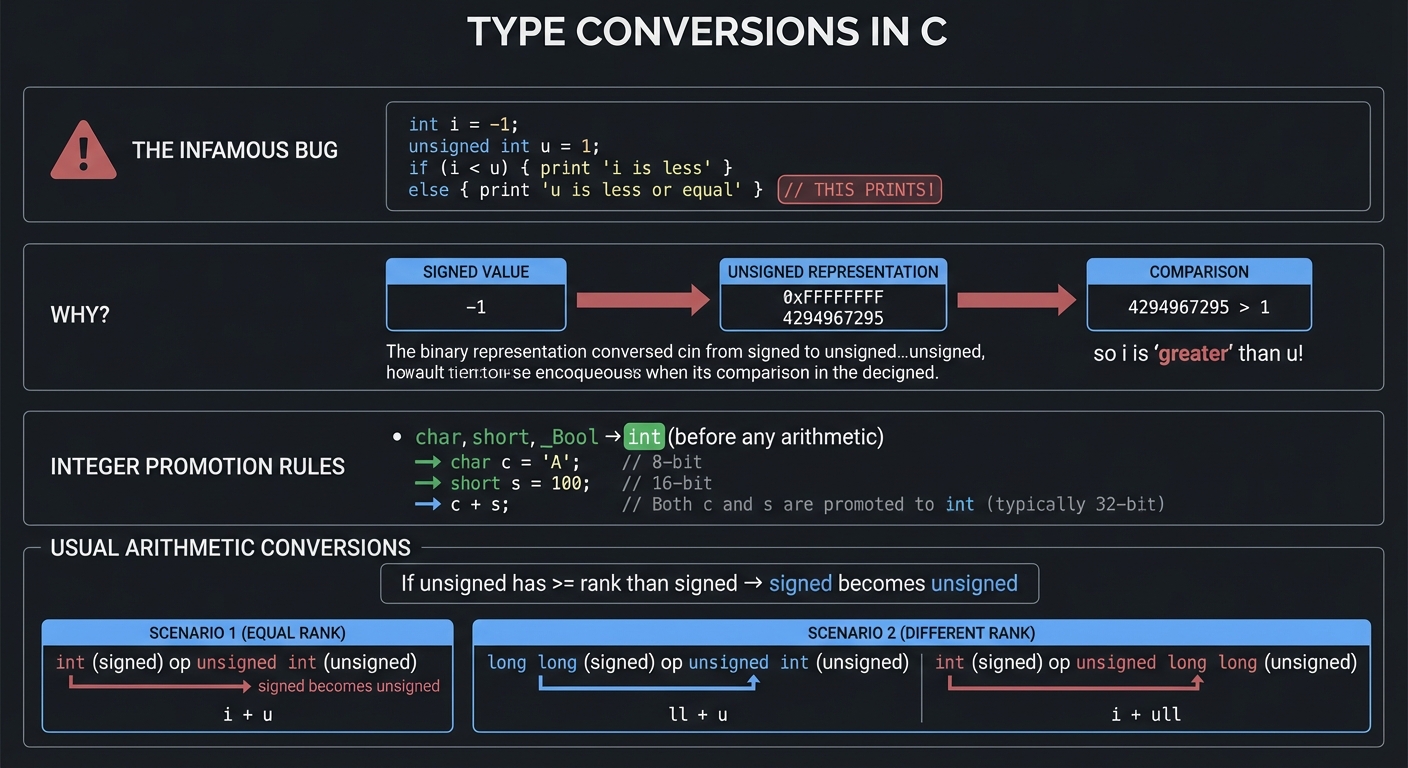
Every integer operation in C is governed by a precise conversion ladder. Integer promotions raise smaller types to int or unsigned int before any arithmetic, which affects comparisons and bitwise operations. The usual arithmetic conversions then choose a common type for both operands. If one operand is unsigned and has rank greater than or equal to the signed operand, the signed value is converted to unsigned, which can produce large positive values for what you thought were negatives. This is the root cause of classic bugs like if (i < u) when i is negative and u is unsigned. Overflow is another trap: signed overflow is undefined behavior, while unsigned overflow wraps modulo 2^N. That difference impacts optimization and correctness. Representations (two’s complement, ones’ complement, sign-magnitude) are mostly standardized today as two’s complement, but the C standard still permits others, which matters for portability. Bitwise operations on signed types can also lead to implementation-defined or undefined results. The correct approach is to use explicit types (uint32_t, int32_t) when you need defined widths, and to be explicit about conversions. Tooling like -Wsign-compare and -Wconversion helps surface issues, and sanitizers can catch undefined behavior involving signed overflow.
How this fits on projects Project 5 is a dedicated type-promotion lab. Projects 12 and 16 depend on understanding integer edge cases and UB.
Definitions & key terms
- Integer promotion: Automatic conversion of smaller integer types to
int/unsigned int. - Usual arithmetic conversions: Rules that choose a common type for binary operators.
- Signed overflow: Undefined behavior in C.
- Unsigned wraparound: Well-defined modulo arithmetic.
Mental model diagram
small ints -> int/unsigned int (promote)
           -> choose common type (rank + signedness)
           -> perform operation
┌─────────────────────────────────────────────────────────────────────────────┐
│                    TYPE CONVERSIONS IN C                                     │
├─────────────────────────────────────────────────────────────────────────────┤
│                                                                             │
│  THE INFAMOUS BUG:                                                          │
│  ────────────────                                                           │
│  int i = -1;                                                                │
│  unsigned int u = 1;                                                        │
│  if (i < u) {                                                               │
│      printf(\"i is less\\n\");                                                 │
│  } else {                                                                   │
│      printf(\"u is less or equal\\n\");  // THIS PRINTS!                       │
│  }                                                                          │
│                                                                             │
│  WHY? -1 is converted to unsigned:                                          │
│  -1 (signed) → 0xFFFFFFFF (unsigned) → 4294967295                           │
│  4294967295 > 1, so i is \"greater\" than u!                                  │
│                                                                             │
│  INTEGER PROMOTION RULES:                                                   │
│  ────────────────────────                                                   │
│  char, short, _Bool → int (before any arithmetic)                           │
│                                                                             │
│  USUAL ARITHMETIC CONVERSIONS:                                              │
│  ─────────────────────────────                                              │
│  If unsigned has >= rank than signed → signed becomes unsigned              │
│                                                                             │
└─────────────────────────────────────────────────────────────────────────────┘
How it works (step-by-step)
- Apply integer promotions to operands.
- Determine the “rank” and signedness of each operand.
- Convert to a common type using the usual arithmetic conversions.
- Perform the operation in that common type.
- Apply result type and conversion back if needed.
Minimal concrete example (pseudo)
signed i = -1
unsigned u = 1
Comparison uses unsigned -> i becomes large positive -> i < u is false
Common misconceptions
- “Signed overflow wraps like unsigned.” (It does not.)
- “
charis always signed.” (It can be signed or unsigned.) - “Comparisons are safe if types look similar.” (Conversions happen silently.)
Check-your-understanding questions
- Why can
-1 < 1ube false? - Why is
chardangerous in arithmetic? - What is the difference between signed and unsigned overflow?
Check-your-understanding answers
- The signed value is converted to unsigned before comparison.
- It is promoted to
int(signedness depends on implementation) which changes behavior. - Signed overflow is UB; unsigned overflow wraps modulo 2^N.
Real-world applications
- Preventing integer-based security bugs
- Designing safe APIs that avoid surprising conversions
- Writing portable numeric code
Where you’ll apply it Projects 5, 12, 16
References
- “Expert C Programming” by Peter van der Linden - Ch. 2
- “Effective C” by Robert Seacord - Ch. 3
- ISO/IEC 9899 (C standard) - Integer conversions
Key insights C does not warn you when it changes your values; you must know when it happens.
Summary Conversions are a hidden execution layer; once you see them, many bugs disappear.
Homework/Exercises to practice the concept
- Write a table of 10 mixed signed/unsigned expressions and predict results.
- Identify where promotions occur in a small arithmetic expression chain.
Solutions to the homework/exercises
- Apply integer promotion first, then usual arithmetic conversions.
- Use explicit casts or fixed-width types to control conversions.
Chapter 6: Undefined Behavior, Aliasing, and Portability
Fundamentals Undefined behavior (UB) is the set of actions for which the C standard imposes no requirements. That means the compiler can assume UB never happens and optimize accordingly. UB is not just “crash” or “random behavior”; it is permission for the compiler to make transformations that break your assumptions. Common sources include out-of-bounds access, use-after-free, signed overflow, and strict aliasing violations. Portability requires avoiding UB and implementation-defined assumptions such as integer sizes and endianness.
Deep Dive
UB is central to expert C. The compiler’s job is to generate correct code for well-defined programs. If you violate a rule, the compiler is allowed to optimize in ways that produce unexpected results. For example, if the compiler can prove that a signed integer cannot overflow in a well-defined program, it can remove overflow checks or reorder code. That means that even if the program “seems to work” with one compiler or optimization level, it may fail elsewhere. Strict aliasing is another major pitfall: the compiler assumes that pointers of different types do not refer to the same memory (with some exceptions). If you violate this by type-punning through incompatible pointers, the compiler may reorder or eliminate loads, producing surprising results. Sequencing rules (formerly “sequence points”) determine when side effects are applied; expressions like i = i++ or a[i] = i++ have undefined or unspecified behavior. Portability also includes assumptions about sizeof(int), struct layout, and endianness. Expert C code isolates machine-specific behavior behind explicit checks or uses fixed-width types and well-defined conversions. The deeper skill is to reason about invariants: “This pointer always points to a valid object,” “This index is always in bounds,” “This object is accessed only through its effective type.” Tools like sanitizers and static analyzers help, but they are not a substitute for understanding the rules that define correctness.
How this fits on projects Project 12 catalogs UB patterns. Project 16 builds a portability checker. Project 14’s memory debugger highlights lifetime and bounds violations.
Definitions & key terms
- Undefined behavior: No requirements on the result.
- Unspecified behavior: One of several possibilities, not documented which.
- Implementation-defined behavior: Defined by the compiler, may vary.
- Strict aliasing: Rules about accessing objects through different types.
Mental model diagram
Well-defined program
   -> compiler guarantees correct behavior
UB occurs
   -> compiler free to assume UB never happens
   -> surprising optimizations possible
How it works (step-by-step)
- Identify potential UB sources (bounds, lifetime, overflow, aliasing).
- Replace assumptions with explicit checks or well-defined constructs.
- Use fixed-width types and clear conversions for portability.
- Validate with sanitizers and cross-compiler builds.
Minimal concrete example (pseudo)
if (x + 1 > x)  // always true for defined signed arithmetic
// but if x can overflow, compiler may treat this as always true
Common misconceptions
- “UB means it will just crash.” (It can silently corrupt or be optimized away.)
- “If it works with -O0, it will work with -O2.” (UB breaks that assumption.)
- “Type-punning is safe if I know what I’m doing.” (Not under strict aliasing.)
Check-your-understanding questions
- Why can a compiler remove bounds checks?
- What is the difference between unspecified and undefined behavior?
- Why does strict aliasing matter for optimization?
Check-your-understanding answers
- If UB would occur, the compiler can assume it does not and optimize away checks.
- Unspecified behavior is one of several allowed results; UB has no requirements.
- The compiler assumes different types do not alias, enabling reordering.
Real-world applications
- Hardening C code against compiler and platform differences
- Debugging “Heisenbugs” that disappear under the debugger
- Writing portable libraries for multiple architectures
Where you’ll apply it Projects 12, 14, 16, 18
References
- “Effective C” by Robert Seacord - Ch. 2, 4
- “Expert C Programming” by Peter van der Linden - Ch. 1
- ISO/IEC 9899 (C standard) - Behavior categories
Key insights Undefined behavior is not a corner case; it is the lever compilers use for optimization.
Summary Portable, reliable C is mostly about eliminating UB and making assumptions explicit.
Homework/Exercises to practice the concept
- Identify 10 common UB patterns and explain why they are UB.
- Compile the same program with different optimization levels and compare behavior.
Solutions to the homework/exercises
- Focus on bounds, lifetime, overflow, and aliasing rules.
- Differences across optimization levels often indicate UB.
Chapter 7: ABI, Calling Conventions, and Stack Frames
Fundamentals The ABI (Application Binary Interface) defines how functions are called, how parameters are passed, how return values are delivered, and how the stack is organized. Calling conventions specify which registers are used for arguments, which must be preserved, and where local variables live. A stack frame is the runtime structure that stores return addresses, saved registers, and locals. Without this knowledge, debugging crashes or interfacing with assembly is guesswork.
Deep Dive At runtime, a function call is a contract between caller and callee: which registers contain arguments, who saves which registers, how the stack pointer is aligned, and where the return value is placed. On x86-64 System V, the first integer arguments are passed in specific registers, floating-point arguments in XMM registers, and the stack is aligned to 16 bytes before a call. The caller saves volatile registers; the callee saves non-volatile ones. Variadic functions add complexity: the caller must place arguments in both registers and a home area so the callee can walk them. Stack frames typically include a return address, saved base pointer (optional), and space for locals and spilled registers. Optimizing compilers can omit frame pointers, reorder locals, and allocate variables in registers instead of the stack, which changes what you see in a debugger. Understanding the ABI lets you interpret backtraces, unwind stacks, and diagnose mis-matched function signatures. It also explains why calling a function through a pointer of the wrong type can corrupt registers or stack state.
How this fits on projects Project 4 inspects stack frames. Project 17 visualizes calling conventions. Project 18 maps C constructs to assembly and ABI conventions.
Definitions & key terms
- ABI: Binary interface between compiled units.
- Calling convention: Rules for argument passing and register preservation.
- Stack frame: Per-call stack region with metadata and locals.
- Callee-saved registers: Registers the callee must preserve.
Mental model diagram
Caller
  | places args in registers/stack
  v
Call instruction -> pushes return address
  v
Callee
  | saves non-volatile registers
  | allocates locals on stack
  | executes
  | restores registers and returns
How it works (step-by-step)
- Caller loads arguments into ABI-specified registers/stack slots.
- Call instruction transfers control and saves return address.
- Callee sets up stack frame (optional frame pointer).
- Function executes and stores return value in ABI-defined location.
- Callee restores state and returns to caller.
Minimal concrete example (pseudo)
Call f(a,b):
- a -> register R1
- b -> register R2
- call f
- return value -> register R0
Common misconceptions
- “The stack always looks the same.” (Optimizations change it.)
- “Any function pointer call is safe.” (Signature mismatches break ABI.)
- “The debugger shows all locals.” (Optimized builds may omit them.)
Check-your-understanding questions
- Why do variadic functions need special handling?
- What happens if a callee fails to restore a non-volatile register?
- Why might a backtrace be incorrect in optimized code?
Check-your-understanding answers
- The callee must access arguments whose locations are not fixed at compile time.
- The caller’s expected state is corrupted, leading to undefined behavior.
- The compiler may omit frame pointers or rearrange stack usage.
Real-world applications
- Debugging crashes with stack traces
- Writing language bindings and FFI layers
- Reading assembly generated by the compiler
Where you’ll apply it Projects 4, 17, 18
References
- System V AMD64 ABI documentation
- “Computer Systems: A Programmer’s Perspective” - Ch. 3
- “Expert C Programming” by Peter van der Linden - Ch. 7
Key insights ABI rules are the “physics” of C binaries; ignore them and everything breaks.
Summary Stack frames and calling conventions are predictable once you know the ABI contract.
Homework/Exercises to practice the concept
- Read a simple function’s assembly and identify argument locations.
- Compare stack traces from debug vs optimized builds.
Solutions to the homework/exercises
- Use ABI docs to map register usage.
- Expect locals to disappear or move under optimization.
Glossary
- ABI: Binary-level contract for calling and linking compiled code.
- Array decay: Implicit conversion of array to pointer to first element.
- BSS: Memory segment for zero-initialized global variables.
- Declarator: The portion of a declaration that defines the identifier’s type.
- Linker: Tool that resolves symbols and produces executables or libraries.
- Relocation: Link-time fixups that patch addresses.
- Storage duration: The lifetime category of an object.
- Undefined behavior: Actions with no requirements in the C standard.
Why Expert C Programming Matters
- Modern motivation: C powers operating systems, runtimes, and embedded systems; deep C knowledge translates into reliability and performance where abstractions leak.
- Real-world impact (stats):
- The Linux kernel is overwhelmingly C, with Open Hub reporting ~35.9M C code lines out of ~37.3M total code lines as of Dec 2025. (Source: Open Hub, Dec 2025, https://www.openhub.net/p/linux/analyses/latest/languages_summary)
- SQLite states there are over 1 trillion SQLite databases in active use and that SQLite is the most used database engine in the world. (Source: sqlite.org, 2025, https://www.sqlite.org/mostdeployed.html ; https://www.sqlite.org/facts.html)
- The TIOBE Index for Dec 2025 ranks C as #2 in popularity with ~10.11% rating. (Source: TIOBE Index, Dec 2025, https://www.tiobe.com/tiobe-index/)
- Context & evolution: C’s core model (manual memory, explicit types, translation units) has remained stable while compilers, hardware, and security constraints have advanced.
Old vs new mental model
Old mental model: "C is close to the machine, so it will do what I mean."
New mental model: "C is a contract; the compiler assumes I follow it."
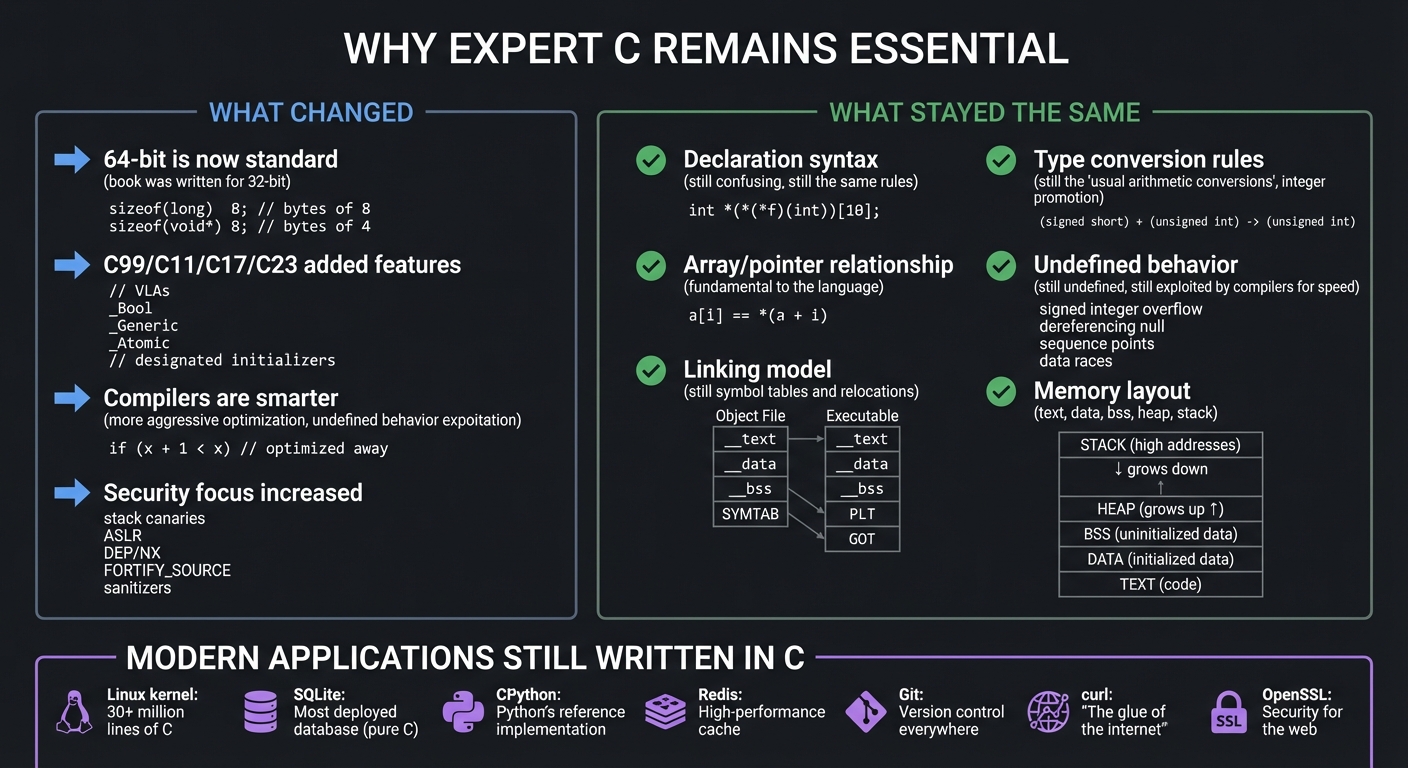
Why Expert C Remains Essential
┌─────────────────────────────────────────────────────────────────────────────┐
│                    WHY EXPERT C REMAINS ESSENTIAL                            │
├─────────────────────────────────────────────────────────────────────────────┤
│                                                                             │
│  WHAT CHANGED:                                                              │
│  ─────────────                                                              │
│  • 64-bit is now standard (book was written for 32-bit)                     │
│  • C99/C11/C17/C23 added features (VLAs, _Bool, _Generic, etc.)             │
│  • Compilers are smarter (more aggressive optimization)                     │
│  • Security focus increased (stack canaries, ASLR, etc.)                    │
│                                                                             │
│  WHAT STAYED THE SAME:                                                      │
│  ─────────────────────                                                      │
│  • Declaration syntax (still confusing, still the same rules)               │
│  • Array/pointer relationship (fundamental to the language)                 │
│  • Linking model (still symbol tables and relocations)                      │
│  • Type conversion rules (still the "usual arithmetic conversions")         │
│  • Undefined behavior (still undefined, still exploited by compilers)       │
│  • Memory layout (text, data, bss, heap, stack)                             │
│                                                                             │
│  MODERN APPLICATIONS STILL WRITTEN IN C:                                    │
│  ────────────────────────────────────────                                   │
│  Linux kernel .............. 30+ million lines of C                         │
│  SQLite .................... Most deployed database (pure C)                │
│  CPython ................... Python's reference implementation              │
│  Redis ..................... High-performance cache                         │
│  Git ....................... Version control everywhere                     │
│  curl ...................... "The glue of the internet"                      │
│  OpenSSL ................... Security for the web                           │
│                                                                             │
└─────────────────────────────────────────────────────────────────────────────┘
Concept Summary Table
| Concept Cluster | What You Need to Internalize |
|---|---|
| Declarations & Type System | How C builds types from declarators, qualifiers, and function/array constructors. |
| Arrays, Pointers, Addressing | When arrays decay, how pointer arithmetic scales, and why int** is not a 2D array. |
| Storage Duration & Memory Layout | Object lifetime, segments, alignment, and struct padding. |
| Translation Pipeline & Linking | Preprocessing, compilation, object files, and symbol resolution. |
| Integer Conversions & Representation | Promotions, usual arithmetic conversions, and overflow behavior. |
| Undefined Behavior & Portability | UB categories, strict aliasing, and portability constraints. |
| ABI & Calling Conventions | Register/stack rules, frame layout, and call mechanics. |
Project-to-Concept Map
| Project | Concepts Applied |
|---|---|
| Project 1 | Declarations & Type System, Translation Pipeline & Linking |
| Project 2 | Arrays, Pointers, Addressing |
| Project 3 | Storage Duration & Memory Layout |
| Project 4 | ABI & Calling Conventions, Storage Duration & Memory Layout |
| Project 5 | Integer Conversions & Representation |
| Project 6 | Translation Pipeline & Linking |
| Project 7 | Translation Pipeline & Linking |
| Project 8 | Arrays, Pointers, Addressing |
| Project 9 | Arrays, Pointers, Addressing |
| Project 10 | Declarations & Type System, ABI & Calling Conventions |
| Project 11 | Translation Pipeline & Linking |
| Project 12 | Undefined Behavior & Portability |
| Project 13 | Storage Duration & Memory Layout, Undefined Behavior & Portability |
| Project 14 | Storage Duration & Memory Layout, Undefined Behavior & Portability |
| Project 15 | Storage Duration & Memory Layout |
| Project 16 | Undefined Behavior & Portability |
| Project 17 | ABI & Calling Conventions |
| Project 18 | Translation Pipeline & Linking, ABI & Calling Conventions |
Deep Dive Reading by Concept
| Concept | Book and Chapter | Why This Matters |
|---|---|---|
| Declarations & Type System | “Expert C Programming” - Ch. 3 | Master complex declarators and qualifiers. |
| Arrays, Pointers, Addressing | “Expert C Programming” - Ch. 4 | Understand decay and pointer arithmetic. |
| Storage Duration & Memory Layout | “Expert C Programming” - Ch. 6 | Ground truth for lifetime and memory bugs. |
| Translation Pipeline & Linking | “Linkers and Loaders” - Ch. 1-3 | Linker model and symbol resolution. |
| Integer Conversions & Representation | “Effective C” - Ch. 3 | Prevent silent conversion bugs. |
| Undefined Behavior & Portability | “Effective C” - Ch. 2,4 | Write portable, optimizer-safe C. |
| ABI & Calling Conventions | CS:APP - Ch. 3 | Connect C calls to assembly and ABI. |
Quick Start: Your First 48 Hours
Day 1:
- Read Theory Primer Chapters 1-3.
- Start Project 1 and get basic parsing output working.
Day 2:
- Validate Project 1 against its Definition of Done.
- Run Project 2’s tests and record your observations.
- Skim Chapters 4 and 5 to prepare for linker and conversion projects.
Recommended Learning Paths
Path 1: The Systems Builder
- Project 1 -> 3 -> 4 -> 6 -> 7 -> 14 -> 17 -> 18
Path 2: The Debugging Specialist
- Project 3 -> 5 -> 12 -> 14 -> 16 -> 18
Path 3: The C Interview Prepper
- Project 1 -> 2 -> 5 -> 12 -> 15 -> 17
Success Metrics
- You can predict pointer arithmetic results and explain them without running code.
- You can diagnose linker errors by reading symbol tables.
- You can explain why a snippet is undefined behavior and how to fix it.
- You can read compiler-generated assembly and explain the calling convention.
Debugging and Tooling Cheat Sheet
| Tool | Purpose | Typical Use |
|---|---|---|
nm |
Symbol inspection | Find defined/undefined symbols in object files |
objdump -t |
Symbol table dump | Inspect symbols and sections |
readelf |
ELF introspection | Check relocation entries and sections |
-E/-S/-c |
Compiler phases | Inspect preprocessing/assembly/object outputs |
asan/ubsan |
Runtime checks | Catch memory and UB bugs quickly |
Project Overview Table
| # | Project | Difficulty | Time | Primary Outcome |
|---|---|---|---|---|
| 1 | C Declaration Parser | 3 | 8-12h | English translation of any declaration |
| 2 | Arrays vs Pointers Lab | 2 | 4-6h | Empirical proof of decay rules |
| 3 | Memory Layout Visualizer | 3 | 10-15h | Runtime memory map of a process |
| 4 | Stack Frame Inspector | 4 | 15-20h | Visualized call stack frames |
| 5 | Type Promotion Tester | 2 | 6-8h | Interactive conversion demos |
| 6 | Symbol Table Analyzer | 4 | 15-25h | Symbol table and relocation report |
| 7 | Linker Error Simulator | 3 | 8-12h | Catalog of linker failures |
| 8 | Multi-dim Array Navigator | 3 | 10-12h | Row-major memory visualization |
| 9 | Pointer Arithmetic Visualizer | 3 | 8-12h | Pointer stride and bounds map |
| 10 | Function Pointer Dispatch | 3 | 8-12h | Command dispatcher with callbacks |
| 11 | Preprocessor Output Analyzer | 3 | 10-15h | Macro expansion report |
| 12 | Bug Catalog (Language Features) | 3 | 10-15h | Documented UB/edge case compendium |
| 13 | Safe String Library | 4 | 20-30h | Safe string API with tests |
| 14 | Memory Debugger (Mini-Valgrind) | 5 | 30-40h | Leak/overflow detector |
| 15 | Struct Packing Analyzer | 3 | 10-15h | Layout and padding analyzer |
| 16 | Portable Code Checker | 4 | 20-30h | Portability and UB checks |
| 17 | Calling Convention Visualizer | 4 | 20-30h | ABI register/stack trace viewer |
| 18 | C to Assembly Translator | 4 | 20-30h | Annotated C->ASM mapping |
Project List
The following projects guide you from declaration mastery to ABI-level understanding.
Project 1: Build a C Declaration Parser (cdecl clone)
- File: project_based_ideas/SYSTEMS_PROGRAMMING/EXPERT_C_PROGRAMMING_DEEP_DIVE/P01-c-declaration-parser.md
- Main Programming Language: C
- Alternative Programming Languages: Rust, C++, Zig
- Coolness Level: See REFERENCE.md
- Business Potential: See REFERENCE.md
- Difficulty: See REFERENCE.md
- Knowledge Area: Parsing, C Type System
- Software or Tool: cdecl-style parser
- Main Book: “Expert C Programming” by Peter van der Linden
What you will build: A CLI tool that turns any C declaration into a clear English description.
Why it teaches Expert C: It forces you to model the grammar and precedence rules the compiler uses.
Core challenges you will face:
- Parsing declarators -> Declarations & Type System
- Handling nested parentheses -> Declarations & Type System
- Reporting readable output -> Translation Pipeline & Linking
Real World Outcome
You can pass a declaration string and get a deterministic English explanation.
$ ./cdecl "char *(*fp)(int, float)"
fp is a pointer to a function taking (int, float) returning pointer to char

$ ./cdecl "void (*signal(int, void (*)(int)))(int)"
signal is a function taking (int, pointer to function(int)) returning pointer to function(int)
The Core Question You Are Answering
“How do C declarations encode type meaning, and how can I parse them reliably?”
This question matters because misreading declarations leads to mismatched function signatures and subtle ABI bugs.
Concepts You Must Understand First
- Declarators and precedence
- How do arrays, functions, and pointers bind?
- Book Reference: “Expert C Programming” - Ch. 3
- Type qualifiers
- Where does
constbind and why? - Book Reference: K&R - Appendix A
- Where does
- Function pointers
- Why do signatures matter for ABI?
- Book Reference: CS:APP - Ch. 3
Questions to Guide Your Design
- Grammar Design
- What minimal grammar handles pointers, arrays, and functions?
- How will you represent nested declarators internally?
- Output Design
- How will you generate readable English without ambiguity?
- How will you format parameter lists?
Thinking Exercise
Declarator Walkthrough
Manually parse these declarations and explain them aloud:
char *(*(*x)(void))[5]const char * const *ppint (*(*callbacks[10])(int))(void)
Questions to answer:
- Where do parentheses change binding?
- Which part is the identifier?
The Interview Questions They Will Ask
- “Explain the difference between
int *p[10]andint (*p)[10].” - “How would you parse a declaration in a compiler?”
- “What is the spiral rule and when does it fail?”
- “Why is
constplacement so confusing in C?”
Hints in Layers
Hint 1: Starting Point Start at the identifier and build outward using a stack of modifiers.
Hint 2: Next Level Treat arrays and functions as higher-precedence than pointers.
Hint 3: Technical Details Represent the declarator as a sequence of tokens and reduce it with a small grammar.
Hint 4: Tools/Debugging
Compare your output to cdecl or cdecl.org for validation.
Books That Will Help
| Topic | Book | Chapter |
|---|---|---|
| Declaration syntax | “Expert C Programming” | Ch. 3 |
| C grammar | K&R | Appendix A |
Common Pitfalls and Debugging
Problem 1: “Parentheses are ignored”
- Why: Your parser treats parentheses as tokens, not grouping operators.
- Fix: Build a parse tree that preserves nesting.
- Quick test: Parse a declaration with nested parentheses and compare outputs.
Definition of Done
- Any declaration from the test suite is translated correctly
- Nested parentheses are handled without ambiguity
- Output format is human-readable and consistent
- Behavior matches at least one known cdecl tool
Project 2: Prove Arrays and Pointers Are Different
- File: project_based_ideas/SYSTEMS_PROGRAMMING/EXPERT_C_PROGRAMMING_DEEP_DIVE/P02-arrays-vs-pointers.md
- Main Programming Language: C
- Alternative Programming Languages: C++, Zig, Rust
- Coolness Level: See REFERENCE.md
- Business Potential: See REFERENCE.md
- Difficulty: See REFERENCE.md
- Knowledge Area: Type System, Memory Semantics
- Software or Tool: Test harness
- Main Book: “Expert C Programming”
What you will build: A lab that runs controlled experiments showing when arrays decay and when they do not.
Why it teaches Expert C: It replaces folklore with evidence and builds intuition about types.
Core challenges you will face:
- Designing experiments -> Arrays, Pointers, Addressing
- Interpreting
sizeofresults -> Arrays, Pointers, Addressing - Explaining array parameter adjustment -> Declarations & Type System
Real World Outcome
$ ./array_pointer_lab --test sizeof
int arr[10]: sizeof = 40 bytes
int *ptr:   sizeof = 8 bytes
PROOF: sizeof(array) != sizeof(pointer)
The Core Question You Are Answering
“If arrays decay to pointers, why are they still different types?”
This matters because incorrect assumptions cause incorrect function signatures and UB.
Concepts You Must Understand First
- Array decay rules
- When does decay happen?
- Book Reference: “Expert C Programming” - Ch. 4
- Parameter adjustment
- Why
int a[10]becomesint *ain parameters? - Book Reference: K&R - Ch. 5
- Why
- Pointer arithmetic
- Why does pointer math scale by element size?
- Book Reference: Reese - Ch. 3
Questions to Guide Your Design
- Experiment Coverage
- Which contexts prevent decay (
sizeof,&, initializers)? - How will you show address differences?
- Which contexts prevent decay (
- Output Clarity
- How will you present evidence to make the conclusion obvious?
- What comparisons will be most persuasive?
Thinking Exercise
Extern Mismatch
Consider a global array defined in one file and declared as a pointer in another. What breaks and why?
Questions to answer:
- How does the linker interpret those symbols?
- Why is this not just a “type mismatch” but a storage mismatch?
The Interview Questions They Will Ask
- “Are arrays and pointers the same in C?”
- “Why does
sizeofbehave differently in and out of functions?” - “Why doesn’t
int **accept a 2D array?” - “What is array-to-pointer decay?”
Hints in Layers
Hint 1: Starting Point
Use sizeof, &array, and pointer arithmetic outputs to show differences.
Hint 2: Next Level Include a test where you pass an array to a function and show type adjustment.
Hint 3: Technical Details
Print both value and address of array, &array, and array + 1.
Hint 4: Tools/Debugging
Use -Wall -Wextra and inspect warnings about parameter types.
Books That Will Help
| Topic | Book | Chapter |
|---|---|---|
| Arrays vs pointers | “Expert C Programming” | Ch. 4 |
| Pointers | “Understanding and Using C Pointers” | Ch. 2-3 |
Common Pitfalls and Debugging
Problem 1: “Results look the same”
- Why: You are printing only pointer values, not sizes or types.
- Fix: Include
sizeofand&arraycomparisons. - Quick test: Show
sizeof(array)vssizeof(ptr)side-by-side.
Definition of Done
- All decay exceptions are demonstrated
- Output clearly proves arrays are not pointers
- At least one counterexample is explained
- Results are reproducible across compilers
Project 3: Build a Memory Layout Visualizer
- File: project_based_ideas/SYSTEMS_PROGRAMMING/EXPERT_C_PROGRAMMING_DEEP_DIVE/P03-memory-layout-visualizer.md
- Main Programming Language: C
- Alternative Programming Languages: Rust, C++
- Coolness Level: See REFERENCE.md
- Business Potential: See REFERENCE.md
- Difficulty: See REFERENCE.md
- Knowledge Area: Process Memory Organization
- Software or Tool: Address visualizer
- Main Book: “Expert C Programming”
What you will build: A CLI tool that prints the addresses of objects in each memory segment.
Why it teaches Expert C: It makes abstract memory segments concrete and visible.
Core challenges you will face:
- Identifying segment boundaries -> Storage Duration & Memory Layout
- Distinguishing object lifetimes -> Storage Duration & Memory Layout
- Presenting readable output -> Tooling clarity
Real World Outcome
$ ./memlayout
SEGMENT   OBJECT            ADDRESS
TEXT      main              0x0000000000401130
RODATA    "hello"           0x0000000000404008
DATA      global_init       0x0000000000601030
BSS       global_zero       0x0000000000601040
HEAP      malloc_block      0x0000000001c2a000
STACK     local_var         0x00007ffc1d2b7a2c
The Core Question You Are Answering
“How does a process’s virtual address space map program objects to memory?”
Concepts You Must Understand First
- Storage duration
- How are static, automatic, and allocated objects different?
- Book Reference: “Expert C Programming” - Ch. 6
- Segments and layout
- What lives in text, rodata, data, bss, heap, stack?
- Book Reference: CS:APP - Ch. 6
- String literals
- Why are they typically read-only?
- Book Reference: Seacord - Ch. 5
Questions to Guide Your Design
- Data collection
- Which objects will you place in each segment?
- How will you label them consistently?
- Output format
- How will you order segments for readability?
- How will you align columns to show addresses clearly?
Thinking Exercise
Pointer Lifetime Map
Sketch a timeline of when each object in your program becomes valid and invalid.
Questions to answer:
- Which objects live the entire program?
- Which objects die when a function returns?
The Interview Questions They Will Ask
- “Where do string literals live?”
- “Why is returning a pointer to a local variable wrong?”
- “What is BSS and why does it exist?”
- “How does the heap grow compared to the stack?”
Hints in Layers
Hint 1: Starting Point Use global variables, local variables, and dynamically allocated memory in one program.
Hint 2: Next Level Print the addresses of each object and group them by expected segment.
Hint 3: Technical Details
Use printf-style formatting to align columns and show hex addresses.
Hint 4: Tools/Debugging
Compare your output to nm or objdump -t to verify segments.
Books That Will Help
| Topic | Book | Chapter |
|---|---|---|
| Memory layout | “Expert C Programming” | Ch. 6 |
| Virtual memory | CS:APP | Ch. 9 |
Common Pitfalls and Debugging
Problem 1: “Addresses appear unordered”
- Why: ASLR randomizes address layouts between runs.
- Fix: Document that addresses change, but ordering remains.
- Quick test: Run twice and compare relative segment ordering.
Definition of Done
- All major segments are represented
- Output labels are accurate
- You can explain why each object appears in its segment
- Demonstrates effect of ASLR
Project 4: Implement a Stack Frame Inspector
- File: project_based_ideas/SYSTEMS_PROGRAMMING/EXPERT_C_PROGRAMMING_DEEP_DIVE/P04-stack-frame-inspector.md
- Main Programming Language: C
- Alternative Programming Languages: Rust, C++
- Coolness Level: See REFERENCE.md
- Business Potential: See REFERENCE.md
- Difficulty: See REFERENCE.md
- Knowledge Area: ABI, Calling Conventions
- Software or Tool: Stack walker
- Main Book: CS:APP
What you will build: A tool that walks stack frames and displays call-chain metadata.
Why it teaches Expert C: It connects high-level calls to low-level ABI mechanics.
Core challenges you will face:
- Walking frame pointers -> ABI & Calling Conventions
- Handling optimized builds -> ABI & Calling Conventions
- Rendering readable traces -> Debugging design
Real World Outcome
$ ./stacktrace_demo
#0  main()          @ 0x4012a0
#1  parse_config()  @ 0x4011f0
#2  load_file()     @ 0x4010c0
#3  _start()        @ 0x400f00
The Core Question You Are Answering
“What exactly is stored in a stack frame, and how can I walk the chain?”
Concepts You Must Understand First
- Calling conventions
- What is callee-saved vs caller-saved?
- Book Reference: CS:APP - Ch. 3
- Frame pointer usage
- When is it omitted, and why does it matter?
- Book Reference: ABI documentation
- Return addresses
- How does the call instruction store the return address?
- Book Reference: CS:APP - Ch. 3
Questions to Guide Your Design
- Stack walking strategy
- Will you rely on frame pointers or debug metadata?
- How will you handle optimized builds?
- Symbol resolution
- How will you map addresses to function names?
- What toolchain will you depend on (
nm,addr2line)?
Thinking Exercise
Frame Layout Sketch
Draw a stack frame with saved registers, return address, and locals.
Questions to answer:
- Which values are pushed by the caller vs callee?
- What happens if the frame pointer is omitted?
The Interview Questions They Will Ask
- “What is a stack frame?”
- “What does a frame pointer do?”
- “How does stack unwinding work?”
- “Why do optimized builds make debugging harder?”
Hints in Layers
Hint 1: Starting Point Compile with frame pointers enabled to simplify initial stack walks.
Hint 2: Next Level Use symbol resolution tools to map addresses to names.
Hint 3: Technical Details Follow the saved frame pointer chain until you hit a null or invalid frame.
Hint 4: Tools/Debugging
Compare your output to gdb backtraces for validation.
Books That Will Help
| Topic | Book | Chapter |
|---|---|---|
| Stack frames | CS:APP | Ch. 3 |
| ABI | System V AMD64 ABI | Sections on calling convention |
Common Pitfalls and Debugging
Problem 1: “Backtrace stops early”
- Why: Frame pointer omission or corrupted stack.
- Fix: Compile with frame pointers; verify stack alignment.
- Quick test: Rebuild with debug flags and compare.
Definition of Done
- Stack frames are walked correctly
- Output matches debugger backtrace
- Works on a multi-level call chain
- Handles or documents optimized build limitations
Project 5: Create a Type Promotion Tester
- File: project_based_ideas/SYSTEMS_PROGRAMMING/EXPERT_C_PROGRAMMING_DEEP_DIVE/P05-type-promotion-tester.md
- Main Programming Language: C
- Alternative Programming Languages: C++, Rust
- Coolness Level: See REFERENCE.md
- Business Potential: See REFERENCE.md
- Difficulty: See REFERENCE.md
- Knowledge Area: Integer Conversions
- Software or Tool: Interactive tester
- Main Book: “Expert C Programming”
What you will build: An interactive CLI that demonstrates integer promotion and conversion rules.
Why it teaches Expert C: Conversions are invisible; you make them visible.
Core challenges you will face:
- Designing experiments -> Integer Conversions & Representation
- Explaining surprising outcomes -> Integer Conversions & Representation
- Avoiding misleading output -> Output design
Real World Outcome
$ ./typepromo
Case: signed vs unsigned
signed i = -1
unsigned u = 1
Result: i < u is FALSE (i converted to unsigned)
The Core Question You Are Answering
“How does C silently convert types, and why does it cause bugs?”
Concepts You Must Understand First
- Integer promotions
- What types promote to
int? - Book Reference: “Expert C Programming” - Ch. 2
- What types promote to
- Usual arithmetic conversions
- How is a common type chosen?
- Book Reference: Seacord - Ch. 3
- Signed vs unsigned behavior
- Why does signed overflow matter?
- Book Reference: C standard (conversions)
Questions to Guide Your Design
- Scenario selection
- Which comparisons are most surprising?
- How will you demonstrate overflow rules?
- Output clarity
- How will you show before/after conversion values?
- How will you explain the rule in plain English?
Thinking Exercise
Promotion Walkthrough
Given a mixed expression with char, short, int, and unsigned, determine the common type.
Questions to answer:
- Which step promotes first?
- Which type dominates in the usual arithmetic conversion?
The Interview Questions They Will Ask
- “Why does
-1 < 1uevaluate the way it does?” - “What is integer promotion?”
- “When does signed overflow become UB?”
- “Why is
chardangerous in arithmetic?”
Hints in Layers
Hint 1: Starting Point Start with just one comparison and show the conversion.
Hint 2: Next Level Add a matrix of cases (signed/unsigned, narrow/wide types).
Hint 3: Technical Details Compute values in hexadecimal to make conversions obvious.
Hint 4: Tools/Debugging
Use compiler warnings (-Wconversion) to detect implicit conversions.
Books That Will Help
| Topic | Book | Chapter |
|---|---|---|
| Conversions | “Expert C Programming” | Ch. 2 |
| Integer safety | “Effective C” | Ch. 3 |
Common Pitfalls and Debugging
Problem 1: “Output seems contradictory”
- Why: You printed values after conversion without labeling.
- Fix: Print original and converted values with explicit labels.
- Quick test: Show both decimal and hex representations.
Definition of Done
- Demonstrates promotions and usual arithmetic conversions
- Includes signed/unsigned comparison examples
- Explains at least one UB case
- Output is clear and reproducible
Project 6: Build a Symbol Table Analyzer
- File: project_based_ideas/SYSTEMS_PROGRAMMING/EXPERT_C_PROGRAMMING_DEEP_DIVE/P06-symbol-table-analyzer.md
- Main Programming Language: C
- Alternative Programming Languages: Rust, Python
- Coolness Level: See REFERENCE.md
- Business Potential: See REFERENCE.md
- Difficulty: See REFERENCE.md
- Knowledge Area: Linking, Binary Formats
- Software or Tool: ELF/Mach-O analyzer
- Main Book: “Linkers and Loaders”
What you will build: A tool that reads object files and prints symbol tables, scopes, and section mappings.
Why it teaches Expert C: It demystifies what the linker actually sees.
Core challenges you will face:
- Parsing object formats -> Translation Pipeline & Linking
- Interpreting symbol visibility -> Translation Pipeline & Linking
- Mapping symbols to sections -> Storage Duration & Memory Layout
Real World Outcome
$ ./symtab main.o
SYMBOL            TYPE      BIND     SECTION
main              FUNC      GLOBAL   .text
helper            FUNC      LOCAL    .text
global_counter    OBJECT    GLOBAL   .bss
extern_func       FUNC      UNDEF    (undefined)
The Core Question You Are Answering
“What exactly is stored in an object file’s symbol table, and how does the linker use it?”
Concepts You Must Understand First
- Translation units
- How symbols are produced by compilation
- Book Reference: “Expert C Programming” - Ch. 5
- Symbol visibility
- Local vs global vs undefined
- Book Reference: “Linkers and Loaders” - Ch. 2
- Sections
- .text, .data, .bss mapping
- Book Reference: CS:APP - Ch. 7
Questions to Guide Your Design
- Format support
- Will you support ELF only, or also Mach-O?
- How will you abstract differences?
- Output format
- How will you sort symbols for readability?
- Will you include section and binding info?
Thinking Exercise
Symbol Mismatch
Why does defining a global in a header lead to multiple definitions at link time?
Questions to answer:
- How many translation units see that definition?
- What does the symbol table contain for each?
The Interview Questions They Will Ask
- “What is a symbol table?”
- “What is the difference between a defined and undefined symbol?”
- “What is the
.bsssection?” - “Why do multiple definition errors occur?”
Hints in Layers
Hint 1: Starting Point
Use nm as a reference for expected output.
Hint 2: Next Level Parse section headers and map symbol section indices.
Hint 3: Technical Details Focus on the symbol table and string table first; ignore relocations initially.
Hint 4: Tools/Debugging
Compare your output to readelf -s to validate fields.
Books That Will Help
| Topic | Book | Chapter |
|---|---|---|
| Linking fundamentals | “Linkers and Loaders” | Ch. 1-2 |
| ELF basics | CS:APP | Ch. 7 |
Common Pitfalls and Debugging
Problem 1: “Symbol names are garbage”
- Why: You did not parse the string table correctly.
- Fix: Use the symbol’s name index to look up in the string table.
- Quick test: Compare one symbol name to
nmoutput.
Definition of Done
- Parses symbol and string tables correctly
- Shows symbol type, binding, and section
- Matches
nm/readelffor reference files - Handles undefined symbols gracefully
Project 7: Create a Linker Error Simulator
- File: project_based_ideas/SYSTEMS_PROGRAMMING/EXPERT_C_PROGRAMMING_DEEP_DIVE/P07-linker-error-simulator.md
- Main Programming Language: C
- Alternative Programming Languages: C++, Zig
- Coolness Level: See REFERENCE.md
- Business Potential: See REFERENCE.md
- Difficulty: See REFERENCE.md
- Knowledge Area: Linking, Build Systems
- Software or Tool: Error catalog
- Main Book: “Expert C Programming”
What you will build: A curated set of source files that trigger common linker errors with explanations.
Why it teaches Expert C: It teaches you to reason about symbols and linkage rules.
Core challenges you will face:
- Designing reproducible errors -> Translation Pipeline & Linking
- Explaining root causes -> Translation Pipeline & Linking
- Documenting fixes -> Debugging clarity
Real World Outcome
$ make missing_symbol
ld: undefined reference to `do_work'
CAUSE: function declared but never defined
FIX: add definition or link correct object file
The Core Question You Are Answering
“Why do linkers fail, and how do I systematically fix the failures?”
Concepts You Must Understand First
- Linkage and visibility
- External vs internal linkage
- Book Reference: “Expert C Programming” - Ch. 5
- One definition rule (C version)
- Why multiple definitions happen
- Book Reference: “Linkers and Loaders” - Ch. 2
- Libraries and order
- Why library order matters in linking
- Book Reference: CS:APP - Ch. 7
Questions to Guide Your Design
- Error taxonomy
- Which errors are most common in real projects?
- How will you label and explain each?
- Build scripts
- How will you ensure errors are reproducible across systems?
- How will you isolate each error case?
Thinking Exercise
Library Order Puzzle
Why does -lm sometimes need to appear after the object file list?
Questions to answer:
- How does the linker resolve symbols in a single pass?
- What changes if you link a static library vs shared library?
The Interview Questions They Will Ask
- “What causes undefined reference errors?”
- “Why can library order matter?”
- “What is internal linkage?”
- “How do you avoid multiple definitions across translation units?”
Hints in Layers
Hint 1: Starting Point Create one example per error type and add a README explanation.
Hint 2: Next Level
Use nm to prove which symbols are missing or duplicated.
Hint 3: Technical Details Include both static and shared library cases.
Hint 4: Tools/Debugging
Use verbose linker output (-Wl,-v) to show resolution steps.
Books That Will Help
| Topic | Book | Chapter |
|---|---|---|
| Linking errors | “Expert C Programming” | Ch. 5 |
| Linkers | “Linkers and Loaders” | Ch. 2 |
Common Pitfalls and Debugging
Problem 1: “Errors differ across systems”
- Why: Different default linkers and library paths.
- Fix: Pin toolchain versions and document expected outputs.
- Quick test: Run in a container or clean VM.
Definition of Done
- At least 6 distinct linker errors documented
- Each error has cause, fix, and verification step
- Results are reproducible on a clean toolchain
Project 8: Implement a Multi-dimensional Array Navigator
- File: project_based_ideas/SYSTEMS_PROGRAMMING/EXPERT_C_PROGRAMMING_DEEP_DIVE/P08-multidimensional-array-navigator.md
- Main Programming Language: C
- Alternative Programming Languages: C++, Rust
- Coolness Level: See REFERENCE.md
- Business Potential: See REFERENCE.md
- Difficulty: See REFERENCE.md
- Knowledge Area: Memory Layout, Pointer Arithmetic
- Software or Tool: Visualizer
- Main Book: “Expert C Programming”
What you will build: A tool that maps 2D/3D array indices to addresses in row-major order.
Why it teaches Expert C: It reveals how multidimensional arrays are laid out and accessed.
Core challenges you will face:
- Row-major index math -> Arrays, Pointers, Addressing
- Function parameter types -> Arrays, Pointers, Addressing
- Readable visualization -> Output clarity
Real World Outcome
$ ./array_navigator 3 4
Index (2,3) -> offset 11 -> address 0x... (base + 11 * sizeof(int))
The Core Question You Are Answering
“How does a compiler compute the address of a multidimensional array element?”
Concepts You Must Understand First
- Row-major layout
- How linear offsets are computed
- Book Reference: “Expert C Programming” - Ch. 4
- Pointer-to-array types
- Why
int (*p)[4]matters - Book Reference: K&R - Ch. 5
- Why
- Pointer arithmetic
- Scaling by element size
- Book Reference: Reese - Ch. 4
Questions to Guide Your Design
- Index mapping
- How will you compute offset from indices?
- How will you show intermediate steps?
- Visualization
- Will you render a grid with addresses?
- How will you label base, row stride, and element size?
Thinking Exercise
Stride Reasoning
For a 3x4 array of int, compute the address difference between [0][0] and [1][0].
Questions to answer:
- What is the stride in bytes?
- How does it change for different element types?
The Interview Questions They Will Ask
- “Why isn’t a 2D array the same as
int **?” - “How does the compiler compute array offsets?”
- “What is row-major order?”
- “How do you pass a 2D array to a function?”
Hints in Layers
Hint 1: Starting Point Compute linear index = row * cols + col.
Hint 2: Next Level Multiply linear index by element size to get byte offset.
Hint 3: Technical Details Use a pointer-to-array type so the compiler enforces correct strides.
Hint 4: Tools/Debugging Compare computed addresses with a debugger’s address printout.
Books That Will Help
| Topic | Book | Chapter |
|---|---|---|
| Arrays | “Expert C Programming” | Ch. 4 |
| Pointers | “Understanding and Using C Pointers” | Ch. 4 |
Common Pitfalls and Debugging
Problem 1: “Offsets are off by a row”
- Why: You reversed row/column order or used wrong stride.
- Fix: Ensure row-major formula is
row * cols + col. - Quick test: Verify
[1][0]is exactly one row stride from base.
Definition of Done
- Correct offset computation for 2D and 3D arrays
- Output explains stride and element size
- Demonstrates correct function parameter types
Project 9: Build a Pointer Arithmetic Visualizer
- File: project_based_ideas/SYSTEMS_PROGRAMMING/EXPERT_C_PROGRAMMING_DEEP_DIVE/P09-pointer-arithmetic-visualizer.md
- Main Programming Language: C
- Alternative Programming Languages: Rust, C++
- Coolness Level: See REFERENCE.md
- Business Potential: See REFERENCE.md
- Difficulty: See REFERENCE.md
- Knowledge Area: Pointer Semantics
- Software or Tool: Visualizer
- Main Book: “Expert C Programming”
What you will build: A tool that prints pointer values, strides, and bounds for different types.
Why it teaches Expert C: It makes pointer scaling and object boundaries visible.
Core challenges you will face:
- Scaling rules -> Arrays, Pointers, Addressing
- Bounds reasoning -> Undefined Behavior & Portability
- Readable output -> UX for developers
Real World Outcome
$ ./ptrviz int
base: 0x1000
p+1:  0x1004
p+2:  0x1008
NOTE: stride = sizeof(int) = 4
The Core Question You Are Answering
“Why does pointer arithmetic scale, and how do bounds relate to object size?”
Concepts You Must Understand First
- Pointer arithmetic
- What does
p+1mean for different types? - Book Reference: Reese - Ch. 3
- What does
- Array bounds
- Why is one-past-the-end special?
- Book Reference: Seacord - Ch. 2
- Object representation
- How size and alignment relate to pointer math
- Book Reference: CS:APP - Ch. 6
Questions to Guide Your Design
- Type coverage
- Which types will you compare (char, int, struct)?
- How will you show stride and size?
- Boundary handling
- How will you demonstrate one-past-the-end legality?
- How will you prevent UB in your own tool?
Thinking Exercise
Pointer Walk
Given a pointer to struct of size 24 bytes, compute addresses for p+1, p+2.
Questions to answer:
- How is stride determined?
- Why does element size matter?
The Interview Questions They Will Ask
- “What does
p+1mean in pointer arithmetic?” - “What is one-past-the-end?”
- “Why is
char *used for byte-level arithmetic?” - “Why is out-of-bounds access UB?”
Hints in Layers
Hint 1: Starting Point Use a fixed base address in a simulated output for clarity.
Hint 2: Next Level Show both pointer values and byte offsets.
Hint 3: Technical Details Include struct examples to show non-trivial strides.
Hint 4: Tools/Debugging Use a debugger to confirm computed addresses.
Books That Will Help
| Topic | Book | Chapter |
|---|---|---|
| Pointer arithmetic | Reese | Ch. 3 |
| UB and bounds | Seacord | Ch. 2 |
Common Pitfalls and Debugging
Problem 1: “Stride is wrong”
- Why: You assumed byte scaling instead of type scaling.
- Fix: Multiply by
sizeof(*p)explicitly in explanations. - Quick test: Compare
char *vsint *outputs.
Definition of Done
- Demonstrates pointer scaling for multiple types
- Clearly explains stride
- Highlights one-past-the-end rule
Project 10: Create a Function Pointer Dispatch Table
- File: project_based_ideas/SYSTEMS_PROGRAMMING/EXPERT_C_PROGRAMMING_DEEP_DIVE/P10-function-pointer-dispatch-table.md
- Main Programming Language: C
- Alternative Programming Languages: C++, Rust
- Coolness Level: See REFERENCE.md
- Business Potential: See REFERENCE.md
- Difficulty: See REFERENCE.md
- Knowledge Area: Function Pointers
- Software or Tool: Command dispatcher
- Main Book: “Expert C Programming”
What you will build: A CLI command interpreter that uses function-pointer tables for O(1) dispatch.
Why it teaches Expert C: It forces precise understanding of function pointer types.
Core challenges you will face:
- Declaring function pointer types -> Declarations & Type System
- Ensuring ABI compatibility -> ABI & Calling Conventions
- Building a dispatch table -> Systems design
Real World Outcome
$ ./dispatch
> help
commands: add, sub, mul, quit
> add 3 4
result: 7
The Core Question You Are Answering
“How do I design a safe, extensible dispatch table using function pointers?”
Concepts You Must Understand First
- Function pointer declarations
- How to declare and use callbacks
- Book Reference: “Expert C Programming” - Ch. 3
- Calling convention safety
- Why mismatched signatures are UB
- Book Reference: CS:APP - Ch. 3
- Table-driven design
- Mapping strings to functions
- Book Reference: Hanson - Ch. 4
Questions to Guide Your Design
- Interface design
- What is the common function signature for commands?
- How will you handle argument parsing?
- Extensibility
- How will you add new commands without editing the dispatcher core?
- How will you handle unknown commands?
Thinking Exercise
Signature Unification
Design a single function signature that can handle all commands.
Questions to answer:
- What data structure will represent arguments?
- How will you report errors?
The Interview Questions They Will Ask
- “How do function pointers work in C?”
- “Why is a dispatch table faster than a long if-else chain?”
- “How do you avoid mismatched signatures?”
- “What is a callback pattern?”
Hints in Layers
Hint 1: Starting Point Define a typedef for the command function signature.
Hint 2: Next Level
Create a table of {name, function} entries.
Hint 3: Technical Details Parse input into tokens and pass an argument vector.
Hint 4: Tools/Debugging Add a “list commands” output to validate dispatch.
Books That Will Help
| Topic | Book | Chapter |
|---|---|---|
| Function pointers | “Expert C Programming” | Ch. 3 |
| API design | “C Interfaces and Implementations” | Ch. 4 |
Common Pitfalls and Debugging
Problem 1: “Crash on command execution”
- Why: Function pointer signature mismatch.
- Fix: Ensure all commands match the typedef exactly.
- Quick test: Print and compare function pointer types with compiler warnings.
Definition of Done
- Dispatch table supports at least 5 commands
- All commands share a safe signature
- Unknown commands handled gracefully
Project 11: Build a Preprocessor Output Analyzer
- File: project_based_ideas/SYSTEMS_PROGRAMMING/EXPERT_C_PROGRAMMING_DEEP_DIVE/P11-preprocessor-output-analyzer.md
- Main Programming Language: C
- Alternative Programming Languages: Python, Rust
- Coolness Level: See REFERENCE.md
- Business Potential: See REFERENCE.md
- Difficulty: See REFERENCE.md
- Knowledge Area: Preprocessor, Metaprogramming
- Software or Tool: Macro expansion analyzer
- Main Book: “Expert C Programming”
What you will build: A tool that shows macro expansion, token pasting, and include structure.
Why it teaches Expert C: It makes the preprocessor’s hidden transformations visible.
Core challenges you will face:
- Macro expansion order -> Translation Pipeline & Linking
- Tokenization rules -> Translation Pipeline & Linking
- Readable diff output -> Tooling design
Real World Outcome
$ ./preproc_analyzer macros.h
Original:  LOG("x = %d", x)
Expanded:  do { fprintf(stderr, "[%s:%d] x = %d", file, line, x); } while(0)
The Core Question You Are Answering
“What exactly does the preprocessor do to my code before compilation?”
Concepts You Must Understand First
- Macro expansion rules
- When do arguments expand?
- Book Reference: “Expert C Programming” - Ch. 8
- Include handling
- How are headers concatenated into a translation unit?
- Book Reference: K&R - Ch. 4
- Token pasting/stringification
- How do
##and#work? - Book Reference: Seacord - Ch. 6
- How do
Questions to Guide Your Design
- Visualization strategy
- How will you present before/after expansions?
- Will you show expansion depth and recursion?
- Scope
- Will you expand only macros or also show include trees?
- How will you handle recursive macros?
Thinking Exercise
Macro Surprise
Why does #define SQR(x) x*x misbehave for SQR(a+b)?
Questions to answer:
- What does the macro expand to?
- How would you fix it with parentheses?
The Interview Questions They Will Ask
- “What is the C preprocessor?”
- “What is the difference between macro expansion and function calls?”
- “How does token pasting work?”
- “What are include guards?”
Hints in Layers
Hint 1: Starting Point
Use -E output as the ground truth and build a diff viewer.
Hint 2: Next Level Track macro definitions and expansions with a symbol table.
Hint 3: Technical Details Annotate each expansion with file and line origin.
Hint 4: Tools/Debugging
Compare your expanded output against compiler -E output.
Books That Will Help
| Topic | Book | Chapter |
|---|---|---|
| Preprocessor | “Expert C Programming” | Ch. 8 |
| Macros | “Effective C” | Ch. 6 |
Common Pitfalls and Debugging
Problem 1: “Macro expansion order is wrong”
- Why: You expand tokens without respecting macro argument expansion rules.
- Fix: Follow the exact preprocessor expansion steps.
- Quick test: Compare with compiler
-Eoutput.
Definition of Done
- Shows macro expansion before/after
- Handles token pasting and stringification
- Matches compiler preprocessor output for test cases
Project 12: Bug Catalog from “It’s Not a Bug, It’s a Language Feature”
- File: project_based_ideas/SYSTEMS_PROGRAMMING/EXPERT_C_PROGRAMMING_DEEP_DIVE/P12-bug-catalog-language-features.md
- Main Programming Language: C
- Alternative Programming Languages: None (analysis-focused)
- Coolness Level: See REFERENCE.md
- Business Potential: See REFERENCE.md
- Difficulty: See REFERENCE.md
- Knowledge Area: Undefined Behavior
- Software or Tool: Catalog + test harness
- Main Book: “Expert C Programming”
What you will build: A curated catalog of C “gotchas” with explanations, causes, and mitigations.
Why it teaches Expert C: It builds intuition for where the language’s edges are.
Core challenges you will face:
- Identifying UB patterns -> Undefined Behavior & Portability
- Explaining compiler optimizations -> Undefined Behavior & Portability
- Documenting safe alternatives -> Portability best practices
Real World Outcome
$ ./bug_catalog
[UB-01] Signed overflow -> compiler may optimize away checks
[UB-02] Modifying string literal -> may crash or corrupt memory
[UB-03] Unsequenced modification -> undefined results
The Core Question You Are Answering
“Which C behaviors are undefined, and how do I avoid them?”
Concepts You Must Understand First
- Behavior categories
- Undefined vs unspecified vs implementation-defined
- Book Reference: Seacord - Ch. 2
- Alias rules
- Effective type and strict aliasing
- Book Reference: C standard
- Sequence rules
- Why expression ordering matters
- Book Reference: “Expert C Programming” - Ch. 1
Questions to Guide Your Design
- Catalog organization
- How will you classify bugs (UB, unspecified, impl-defined)?
- How will you show the safer alternative?
- Evidence
- How will you prove a case is UB (standard quote, compiler behavior)?
- How will you show that behavior changes under optimization?
Thinking Exercise
Optimizer Thought Experiment
Imagine a compiler assumes signed overflow cannot happen. What optimization does that enable?
Questions to answer:
- How does that change loop conditions?
- What checks can be removed?
The Interview Questions They Will Ask
- “What is undefined behavior?”
- “Why can undefined behavior be optimized away?”
- “Give an example of a strict aliasing violation.”
- “What is the difference between UB and implementation-defined behavior?”
Hints in Layers
Hint 1: Starting Point Collect 10 UB examples from known sources and categorize them.
Hint 2: Next Level For each, add a minimal test and explain why it is UB.
Hint 3: Technical Details
Compare outputs under -O0 and -O2.
Hint 4: Tools/Debugging Use sanitizers to catch UB at runtime.
Books That Will Help
| Topic | Book | Chapter |
|---|---|---|
| Undefined behavior | “Effective C” | Ch. 2 |
| C gotchas | “Expert C Programming” | Ch. 1 |
Common Pitfalls and Debugging
Problem 1: “Tests show same output at -O0 and -O2”
- Why: The UB case chosen might not trigger optimization differences.
- Fix: Use examples known to be optimized away (signed overflow, aliasing).
- Quick test: Compare assembly output for both optimization levels.
Definition of Done
- Catalog includes at least 15 UB cases
- Each case includes cause, symptom, and mitigation
- At least 5 cases demonstrate optimization sensitivity
Project 13: Build a Safe String Library
- File: project_based_ideas/SYSTEMS_PROGRAMMING/EXPERT_C_PROGRAMMING_DEEP_DIVE/P13-safe-string-library.md
- Main Programming Language: C
- Alternative Programming Languages: Rust, Zig
- Coolness Level: See REFERENCE.md
- Business Potential: See REFERENCE.md
- Difficulty: See REFERENCE.md
- Knowledge Area: Strings, Memory Safety
- Software or Tool: Library API
- Main Book: “Effective C”
What you will build: A small string library that enforces bounds and explicit length tracking.
Why it teaches Expert C: It forces you to reason about lifetime, capacity, and UB around strings.
Core challenges you will face:
- Length vs capacity tracking -> Storage Duration & Memory Layout
- Avoiding buffer overflows -> Undefined Behavior & Portability
- API design for safety -> Systems design
Real World Outcome
$ ./safe_string_tests
[OK] create: length=5 capacity=16
[OK] append: "hello" + "world" -> "helloworld"
[FAIL] append: overflow prevented
The Core Question You Are Answering
“How can I design string APIs that make unsafe operations hard to express?”
Concepts You Must Understand First
- String representation
- Null terminators and length tracking
- Book Reference: K&R - Ch. 5
- Memory lifetime
- Ownership and allocation rules
- Book Reference: Seacord - Ch. 5
- Bounds checking
- When does C allow overflow?
- Book Reference: Seacord - Ch. 2
Questions to Guide Your Design
- API design
- How will you expose length and capacity?
- Will the API accept raw C strings or only safe types?
- Error handling
- How will you signal overflow? error codes? status enums?
- Will you support safe truncation?
Thinking Exercise
Ownership Map
For each API function, define who owns the buffer before and after the call.
Questions to answer:
- Where can a caller accidentally free memory twice?
- How do you prevent use-after-free?
The Interview Questions They Will Ask
- “Why are C strings unsafe by default?”
- “What are common buffer overflow patterns?”
- “How would you design a safer string API?”
- “What is the tradeoff between safety and performance?”
Hints in Layers
Hint 1: Starting Point
Represent a string as {ptr, length, capacity}.
Hint 2: Next Level Require all modifying functions to check capacity before writing.
Hint 3: Technical Details Make all creation functions return status + initialized struct.
Hint 4: Tools/Debugging Use ASAN to confirm no out-of-bounds writes.
Books That Will Help
| Topic | Book | Chapter |
|---|---|---|
| Safer C | “Effective C” | Ch. 5 |
| C strings | K&R | Ch. 5 |
Common Pitfalls and Debugging
Problem 1: “Length and terminator diverge”
- Why: You update the buffer but forget to update length or terminator.
- Fix: Centralize update logic in one function.
- Quick test: Verify length matches
strlenin tests.
Definition of Done
- Every function checks bounds
- Length and capacity are always consistent
- Tests cover truncation and overflow cases
- ASAN/UBSAN clean
Project 14: Create a Memory Debugger (Mini-Valgrind)
- File: project_based_ideas/SYSTEMS_PROGRAMMING/EXPERT_C_PROGRAMMING_DEEP_DIVE/P14-memory-debugger-mini-valgrind.md
- Main Programming Language: C
- Alternative Programming Languages: C++, Rust
- Coolness Level: See REFERENCE.md
- Business Potential: See REFERENCE.md
- Difficulty: See REFERENCE.md
- Knowledge Area: Memory Debugging
- Software or Tool: Allocator wrapper
- Main Book: “Expert C Programming”
What you will build: A custom allocator wrapper that tracks allocations, frees, and leaks.
Why it teaches Expert C: It forces you to reason about lifetime and detect UB.
Core challenges you will face:
- Tracking allocations -> Storage Duration & Memory Layout
- Detecting use-after-free -> Undefined Behavior & Portability
- Reporting leaks -> Tooling design
Real World Outcome
$ ./memdebug ./demo_app
[LEAK] 64 bytes allocated at main:42 not freed
[UAF] read after free at worker:88
Summary: 1 leak, 1 invalid access
The Core Question You Are Answering
“How can I detect memory misuse without a heavyweight toolchain?”
Concepts You Must Understand First
- Allocation lifecycle
- malloc/free invariants
- Book Reference: CS:APP - Ch. 9
- Use-after-free
- Why it is undefined and dangerous
- Book Reference: Seacord - Ch. 2
- Metadata tracking
- How to store allocation records
- Book Reference: Hanson - Ch. 5
Questions to Guide Your Design
- Tracking strategy
- Will you use a hash map or linked list for allocations?
- How will you capture source location info?
- Error reporting
- How will you report leaks and invalid frees?
- How will you summarize results?
Thinking Exercise
Invariant Reasoning
Define the invariants that must hold for every allocation record.
Questions to answer:
- What does a “live” allocation mean?
- When does an allocation become invalid?
The Interview Questions They Will Ask
- “How does a memory debugger detect leaks?”
- “Why is use-after-free dangerous?”
- “What metadata do you store for each allocation?”
- “How do you avoid false positives?”
Hints in Layers
Hint 1: Starting Point Wrap allocation functions and log records in a list.
Hint 2: Next Level Include file/line metadata via macros or wrappers.
Hint 3: Technical Details Mark freed blocks and detect double-free.
Hint 4: Tools/Debugging Compare results with Valgrind or ASAN on test cases.
Books That Will Help
| Topic | Book | Chapter |
|---|---|---|
| Memory errors | CS:APP | Ch. 9 |
| Safer C | “Effective C” | Ch. 5 |
Common Pitfalls and Debugging
Problem 1: “Too many false leaks”
- Why: Allocations intentionally persisted until program exit.
- Fix: Allow suppression for known global allocations.
- Quick test: Run on a known leak-free program.
Definition of Done
- Detects leaks and double-free
- Reports source locations for allocations
- Distinguishes real leaks from persistent allocations
- Output matches reference tools for test cases
Project 15: Build a Struct Packing Analyzer
- File: project_based_ideas/SYSTEMS_PROGRAMMING/EXPERT_C_PROGRAMMING_DEEP_DIVE/P15-struct-packing-analyzer.md
- Main Programming Language: C
- Alternative Programming Languages: C++, Rust
- Coolness Level: See REFERENCE.md
- Business Potential: See REFERENCE.md
- Difficulty: See REFERENCE.md
- Knowledge Area: Alignment, Padding
- Software or Tool: Layout analyzer
- Main Book: “Expert C Programming”
What you will build: A tool that prints struct field offsets, padding, and total size.
Why it teaches Expert C: It makes alignment and ABI-visible layout tangible.
Core challenges you will face:
- Computing offsets -> Storage Duration & Memory Layout
- Visualizing padding -> Storage Duration & Memory Layout
- Explaining ABI constraints -> ABI & Calling Conventions
Real World Outcome
$ ./structpack
struct Example
offset 0: char a
offset 4: int b
offset 8: short c
total size: 12 (padding: 3 bytes)
The Core Question You Are Answering
“Why do structs have padding, and how can I predict their layout?”
Concepts You Must Understand First
- Alignment rules
- Why types have alignment requirements
- Book Reference: CS:APP - Ch. 3
- Padding
- How compilers insert padding
- Book Reference: “Expert C Programming” - Ch. 6
- ABI stability
- Why layout matters across compilers
- Book Reference: ABI docs
Questions to Guide Your Design
- Layout computation
- Will you compute offsets yourself or use compiler output?
- How will you show alignment requirements?
- Visualization
- How will you represent padding bytes?
- Will you show an ASCII memory map?
Thinking Exercise
Field Reordering
Reorder fields in a struct to minimize padding. Compare sizes.
Questions to answer:
- Which field order yields minimum size?
- How does alignment affect total size?
The Interview Questions They Will Ask
- “Why does struct size exceed sum of fields?”
- “What is alignment?”
- “How do you pack a struct?”
- “What are the risks of
#pragma pack?”
Hints in Layers
Hint 1: Starting Point
Use offsetof to print field offsets.
Hint 2: Next Level Compute padding between offsets and total size.
Hint 3: Technical Details Show a memory map with padding bytes labeled.
Hint 4: Tools/Debugging
Compare to compiler layout with -Wpadded warnings.
Books That Will Help
| Topic | Book | Chapter |
|---|---|---|
| Struct layout | “Expert C Programming” | Ch. 6 |
| ABI | System V AMD64 ABI | Data layout sections |
Common Pitfalls and Debugging
Problem 1: “Offsets don’t match”
- Why: Different compiler or packing pragma.
- Fix: Document compiler version and packing settings.
- Quick test: Run with and without packing flags.
Definition of Done
- Prints offsets and total size for structs
- Highlights padding bytes explicitly
- Explains impact of field ordering
Project 16: Create a Portable Code Checker
- File: project_based_ideas/SYSTEMS_PROGRAMMING/EXPERT_C_PROGRAMMING_DEEP_DIVE/P16-portable-code-checker.md
- Main Programming Language: C
- Alternative Programming Languages: Python, Rust
- Coolness Level: See REFERENCE.md
- Business Potential: See REFERENCE.md
- Difficulty: See REFERENCE.md
- Knowledge Area: Portability, UB Detection
- Software or Tool: Static checker
- Main Book: “Effective C”
What you will build: A static checker that flags non-portable C assumptions and UB risks.
Why it teaches Expert C: It forces you to encode the rules of portability explicitly.
Core challenges you will face:
- Detecting risky patterns -> Undefined Behavior & Portability
- Explaining warnings -> UX for static analysis
- Balancing false positives -> Tool design
Real World Outcome
$ ./portable_check sample.c
[PORT-01] Assumes sizeof(int) == 4
[PORT-02] Shifts by value >= width
[UB-07] Signed overflow in expression
The Core Question You Are Answering
“How can I detect non-portable or undefined C before it ships?”
Concepts You Must Understand First
- UB categories
- Which behaviors are undefined or implementation-defined?
- Book Reference: Seacord - Ch. 2
- Integer width assumptions
intsize is not guaranteed- Book Reference: C standard
- Endianness and representation
- How byte order affects code
- Book Reference: CS:APP - Ch. 2
Questions to Guide Your Design
- Rule set
- Which assumptions are most common in real code?
- How will you classify warning severity?
- Parsing strategy
- Will you use a simple parser or rely on compiler AST?
- How will you detect patterns reliably?
Thinking Exercise
Portability Audit
Given a small code snippet, list which assumptions might break on another platform.
Questions to answer:
- Which sizes or alignments are assumed?
- Which behaviors are compiler-specific?
The Interview Questions They Will Ask
- “What makes C code non-portable?”
- “What is implementation-defined behavior?”
- “How do you detect UB statically?”
- “Why is endianness important?”
Hints in Layers
Hint 1: Starting Point Start with a list of 10 portability rules and build pattern checks.
Hint 2: Next Level Add warnings for integer size assumptions and signed overflow.
Hint 3: Technical Details Use a parser or compiler plugin for more reliable detection.
Hint 4: Tools/Debugging Compare with compiler warnings and static analyzers like clang-tidy.
Books That Will Help
| Topic | Book | Chapter |
|---|---|---|
| Portable C | “Effective C” | Ch. 2, 4 |
| C standard | ISO/IEC 9899 | Sections on behavior |
Common Pitfalls and Debugging
Problem 1: “Too many false positives”
- Why: Pattern matching without context.
- Fix: Add context checks and allow suppression comments.
- Quick test: Run on a known clean codebase.
Definition of Done
- Flags at least 15 portability patterns
- Explains each warning with rationale
- Provides suppression mechanism
Project 17: Implement a Calling Convention Visualizer
- File: project_based_ideas/SYSTEMS_PROGRAMMING/EXPERT_C_PROGRAMMING_DEEP_DIVE/P17-calling-convention-visualizer.md
- Main Programming Language: C
- Alternative Programming Languages: Rust, C++
- Coolness Level: See REFERENCE.md
- Business Potential: See REFERENCE.md
- Difficulty: See REFERENCE.md
- Knowledge Area: ABI, Assembly
- Software or Tool: ABI visualizer
- Main Book: CS:APP
What you will build: A tool that shows how arguments are passed (registers vs stack) for a given signature.
Why it teaches Expert C: It connects function signatures to ABI rules.
Core challenges you will face:
- Mapping types to ABI rules -> ABI & Calling Conventions
- Handling variadic functions -> ABI & Calling Conventions
- Presenting register/stack usage -> Visualization design
Real World Outcome
$ ./abi_viz "int f(double a, int b, char c)"
arg1 double -> XMM0
arg2 int    -> RDI
arg3 char   -> RSI (promoted)
stack align -> 16 bytes
The Core Question You Are Answering
“How does a function signature map to registers and stack slots in the ABI?”
Concepts You Must Understand First
- ABI rules
- Register allocation for arguments
- Book Reference: System V AMD64 ABI
- Default argument promotions
- Varargs and promotion rules
- Book Reference: C standard
- Stack alignment
- Why alignment matters for calls
- Book Reference: CS:APP - Ch. 3
Questions to Guide Your Design
- Signature parsing
- How will you parse the function signature?
- Will you support only a subset of types?
- Visualization
- How will you render register assignments?
- How will you show stack alignment constraints?
Thinking Exercise
Varargs Thought Experiment
Why do float arguments get promoted to double in variadic functions?
Questions to answer:
- What does the ABI require?
- How does the callee know argument types?
The Interview Questions They Will Ask
- “What is a calling convention?”
- “How are function arguments passed on x86-64?”
- “Why are variadic functions special?”
- “What is stack alignment and why does it matter?”
Hints in Layers
Hint 1: Starting Point Use a fixed ABI (System V x86-64) and document it explicitly.
Hint 2: Next Level Build a small rules engine that maps types to registers in order.
Hint 3: Technical Details
Include promotion rules for char, short, and float in varargs.
Hint 4: Tools/Debugging Verify with compiler-generated assembly for sample functions.
Books That Will Help
| Topic | Book | Chapter |
|---|---|---|
| ABI rules | System V AMD64 ABI | Calling convention sections |
| Assembly mapping | CS:APP | Ch. 3 |
Common Pitfalls and Debugging
Problem 1: “Register assignment is off”
- Why: You mixed integer and floating-point registers incorrectly.
- Fix: Separate integer vs FP argument registers per ABI.
- Quick test: Compare to compiler output for a test signature.
Definition of Done
- Correct register/stack assignment for sample signatures
- Handles integer, floating, and small types
- Documents ABI assumptions
Project 18: Build a “From C to Assembly” Translator
- File: project_based_ideas/SYSTEMS_PROGRAMMING/EXPERT_C_PROGRAMMING_DEEP_DIVE/P18-c-to-assembly-translator.md
- Main Programming Language: C
- Alternative Programming Languages: Rust, Python
- Coolness Level: See REFERENCE.md
- Business Potential: See REFERENCE.md
- Difficulty: See REFERENCE.md
- Knowledge Area: Compilation, ABI
- Software or Tool: Annotator
- Main Book: CS:APP
What you will build: A tool that compiles snippets and annotates the assembly with explanations.
Why it teaches Expert C: It ties language constructs to machine behavior.
Core challenges you will face:
- Mapping C constructs to assembly -> Translation Pipeline & Linking
- Explaining ABI effects -> ABI & Calling Conventions
- Presenting readable annotations -> Documentation design
Real World Outcome
$ ./c2asm "int add(int a, int b) { return a+b; }"
ASM: add:
  mov rax, rdi   ; load arg1
  add rax, rsi   ; add arg2
  ret            ; return in rax
The Core Question You Are Answering
“How does a C function translate into assembly under a specific ABI?”
Concepts You Must Understand First
- Compiler phases
- From C to assembly output
- Book Reference: CS:APP - Ch. 3
- ABI register usage
- Where args and returns live
- Book Reference: System V AMD64 ABI
- Optimization effects
- How
-O0vs-O2changes output - Book Reference: Compiler docs
- How
Questions to Guide Your Design
- Snippet selection
- Which C constructs will you support (loops, structs, calls)?
- How will you keep examples minimal but illustrative?
- Annotation strategy
- How will you map assembly back to source constructs?
- How will you explain register usage and stack changes?
Thinking Exercise
Optimization Insight
Compare assembly for the same function under -O0 and -O2.
Questions to answer:
- Which instructions disappear and why?
- What does the compiler assume about UB?
The Interview Questions They Will Ask
- “How does a C function call map to assembly?”
- “Why does optimization change the assembly so much?”
- “Where does the return value go?”
- “What does the compiler assume about undefined behavior?”
Hints in Layers
Hint 1: Starting Point
Use -S to get assembly output and annotate line by line.
Hint 2: Next Level Start with functions that use only integer arithmetic.
Hint 3: Technical Details Match argument registers to ABI rules and show return register.
Hint 4: Tools/Debugging
Use objdump -d to compare compiled binaries to assembly output.
Books That Will Help
| Topic | Book | Chapter |
|---|---|---|
| C to assembly | CS:APP | Ch. 3 |
| Compiler output | GCC/Clang docs | Assembly output sections |
Common Pitfalls and Debugging
Problem 1: “Assembly differs between compilers”
- Why: Different optimization strategies.
- Fix: Pin compiler version and flags.
- Quick test: Compare outputs under the same toolchain.
Definition of Done
- Annotated assembly for at least 5 constructs
- Clear mapping to ABI registers and stack use
- Comparison of optimized vs unoptimized output
Project Comparison Table
| Project | Difficulty | Time | Depth of Understanding | Fun Factor |
|---|---|---|---|---|
| 1. C Declaration Parser | Level 3 | Weekend | High | ★★★★☆ |
| 2. Arrays vs Pointers Lab | Level 2 | Weekend | Medium | ★★★☆☆ |
| 3. Memory Layout Visualizer | Level 3 | 1-2 weeks | High | ★★★★☆ |
| 4. Stack Frame Inspector | Level 4 | 2 weeks | High | ★★★★☆ |
| 5. Type Promotion Tester | Level 2 | Weekend | Medium | ★★★☆☆ |
| 6. Symbol Table Analyzer | Level 4 | 2-3 weeks | High | ★★★★☆ |
| 7. Linker Error Simulator | Level 3 | Weekend | Medium | ★★★☆☆ |
| 8. Multi-dim Array Navigator | Level 3 | Weekend | Medium | ★★★☆☆ |
| 9. Pointer Arithmetic Visualizer | Level 3 | Weekend | Medium | ★★★☆☆ |
| 10. Function Pointer Dispatch | Level 3 | Weekend | Medium | ★★★☆☆ |
| 11. Preprocessor Analyzer | Level 3 | 1-2 weeks | High | ★★★★☆ |
| 12. Bug Catalog | Level 3 | 1-2 weeks | High | ★★★☆☆ |
| 13. Safe String Library | Level 4 | 2-3 weeks | High | ★★★★☆ |
| 14. Memory Debugger | Level 5 | 3-4 weeks | Very High | ★★★★★ |
| 15. Struct Packing Analyzer | Level 3 | Weekend | Medium | ★★★☆☆ |
| 16. Portable Code Checker | Level 4 | 2-3 weeks | High | ★★★★☆ |
| 17. Calling Convention Visualizer | Level 4 | 2-3 weeks | High | ★★★★☆ |
| 18. C to Assembly Translator | Level 4 | 2-3 weeks | High | ★★★★☆ |
Recommendation
If you are new to Expert C: Start with Project 1 and Project 2 to build your mental model quickly. If you are a systems developer: Start with Project 3 and Project 6 to master memory and linking. If you want to master ABI and debugging: Focus on Project 4, Project 17, and Project 18.
Final Overall Project: Expert C Diagnostic Toolkit
The Goal: Combine Projects 1, 3, 6, 11, 14, and 18 into a single toolkit that analyzes C code from source to binary.
- Parse complex declarations.
- Visualize memory layout and detect leaks.
- Inspect symbol tables and link errors.
- Annotate assembly output with explanations.
Success Criteria: A developer can point the toolkit at a small C program and obtain a full diagnostic report that explains declarations, memory layout, symbol resolution, and ABI-level behavior.
From Learning to Production: What Is Next
| Your Project | Production Equivalent | Gap to Fill |
|---|---|---|
| Symbol Table Analyzer | nm, readelf, objdump |
Add support for more formats and platforms |
| Memory Debugger | Valgrind/ASAN | Improve accuracy and performance |
| Portable Code Checker | clang-tidy/scan-build | Improve AST analysis and rule set |
| C-to-Assembly Translator | Compiler Explorer | Add multi-compiler and optimization views |
Summary
This learning path covers Expert C Programming through 18 hands-on projects.
| # | Project Name | Main Language | Difficulty | Time Estimate |
|---|---|---|---|---|
| 1 | C Declaration Parser | C | Level 3 | 8-12h |
| 2 | Arrays vs Pointers Lab | C | Level 2 | 4-6h |
| 3 | Memory Layout Visualizer | C | Level 3 | 10-15h |
| 4 | Stack Frame Inspector | C | Level 4 | 15-20h |
| 5 | Type Promotion Tester | C | Level 2 | 6-8h |
| 6 | Symbol Table Analyzer | C | Level 4 | 15-25h |
| 7 | Linker Error Simulator | C | Level 3 | 8-12h |
| 8 | Multi-dim Array Navigator | C | Level 3 | 10-12h |
| 9 | Pointer Arithmetic Visualizer | C | Level 3 | 8-12h |
| 10 | Function Pointer Dispatch | C | Level 3 | 8-12h |
| 11 | Preprocessor Analyzer | C | Level 3 | 10-15h |
| 12 | Bug Catalog | C | Level 3 | 10-15h |
| 13 | Safe String Library | C | Level 4 | 20-30h |
| 14 | Memory Debugger | C | Level 5 | 30-40h |
| 15 | Struct Packing Analyzer | C | Level 3 | 10-15h |
| 16 | Portable Code Checker | C | Level 4 | 20-30h |
| 17 | Calling Convention Visualizer | C | Level 4 | 20-30h |
| 18 | C to Assembly Translator | C | Level 4 | 20-30h |
Expected Outcomes
- You can explain C declarations, pointer rules, and memory layout without guessing.
- You can predict compiler and linker behavior from first principles.
- You can identify and eliminate UB and portability hazards.
Additional Resources and References
Standards and Specifications
- ISO/IEC 9899 (C standard)
- System V AMD64 ABI
- ELF specification
Industry Analysis
- TIOBE Index (language rankings)
- Open Hub Linux kernel language breakdown
- SQLite deployment statistics
Books
- “Expert C Programming” by Peter van der Linden - deep language mechanics
- “Effective C” by Robert Seacord - safe modern C practices
- “Linkers and Loaders” by John Levine - linking internals
- “Computer Systems: A Programmer’s Perspective” - compilers and ABI