Project 17: CS:APP Capstone — Secure, Observable, High-Performance Proxy
Build a production-minded HTTP proxy that synthesizes every major CS:APP concept: data representation, machine-level programming, memory hierarchy, linking, exceptional control flow, virtual memory, Unix I/O, networking, and concurrency.
Quick Reference
| Attribute | Value |
|---|---|
| Language | C (alt: Rust, Zig, Go) |
| Difficulty | Expert |
| Time | 2–3 months |
| Chapters | All |
| Coolness | ★★★★★ Pure Magic |
| Portfolio Value | Open Core Infrastructure |
Learning Objectives
By completing this project, you will:
- Synthesize all CS:APP concepts: Apply data representation, machine code understanding, memory hierarchy optimization, linking knowledge, exceptional control flow, virtual memory, Unix I/O, and concurrency in a single system
- Build production-quality networked software: Handle real HTTP traffic with robustness against malformed input, partial reads, and network failures
- Implement high-performance caching: Apply locality principles to cache responses effectively
- Master concurrent server design: Compare and implement multiple concurrency models (processes, threads, I/O multiplexing)
- Apply security hardening: Defend against buffer overflows, integer overflows, and other memory-safety vulnerabilities
- Build observable systems: Implement structured logging, metrics, and debugging capabilities
- Debug complex distributed behavior: Use system tools (strace, ltrace, gdb, valgrind) to diagnose issues
- Document and explain systems behavior: Write post-mortems and performance analyses using CS:APP terminology
Deep Theoretical Foundation
What Is a Proxy?
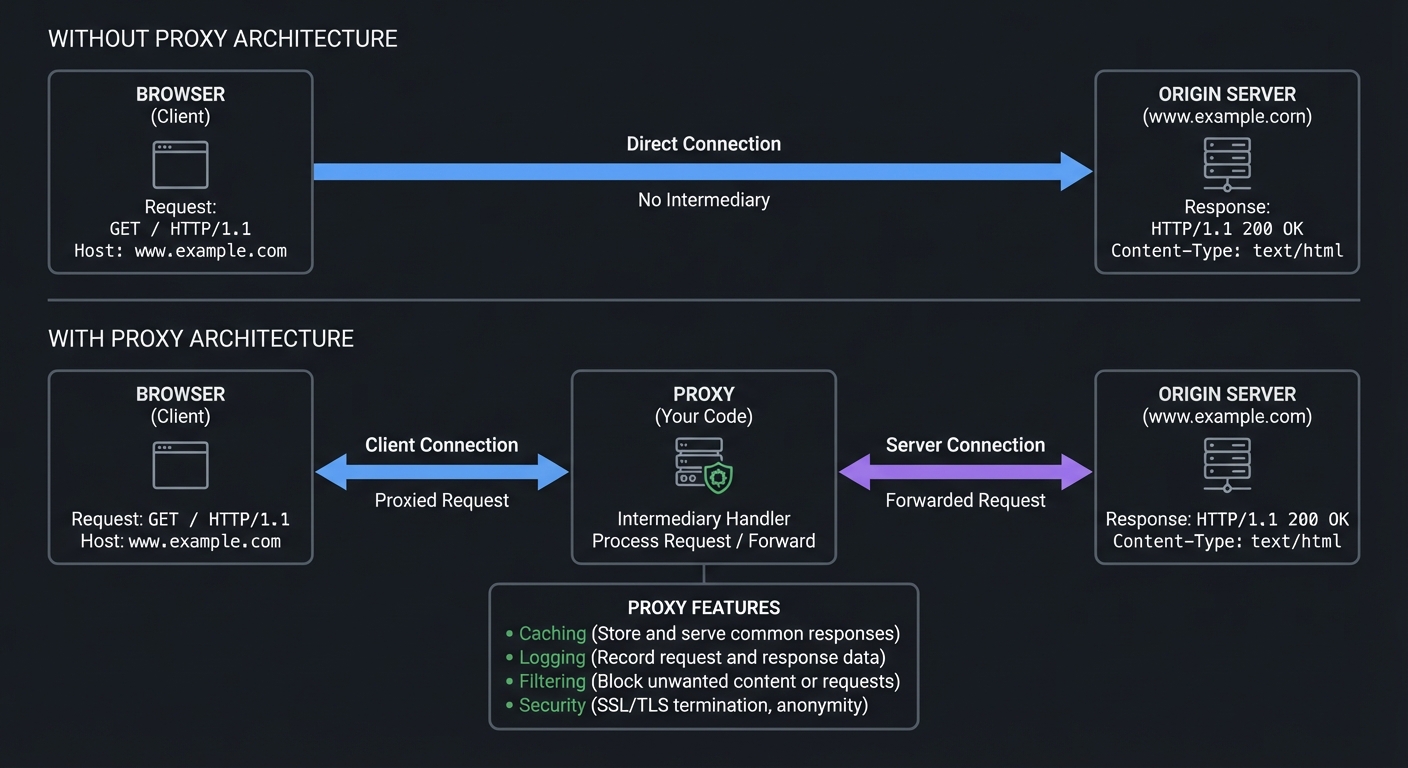
A proxy server acts as an intermediary between clients and servers:
┌────────────────────────────────────────────────────────────────────────┐
│                         PROXY ARCHITECTURE                              │
├────────────────────────────────────────────────────────────────────────┤
│                                                                         │
│    ┌──────────┐                              ┌──────────────────┐       │
│    │  Browser │ ─────────────────────────────▶│   Origin Server  │      │
│    │ (Client) │      Without Proxy            │  (www.example.com)│     │
│    └──────────┘                              └──────────────────┘       │
│                                                                         │
│    ───────────────────────────────────────────────────────────────      │
│                                                                         │
│    ┌──────────┐      ┌─────────────┐         ┌──────────────────┐       │
│    │  Browser │─────▶│    PROXY    │────────▶│   Origin Server  │       │
│    │ (Client) │◀─────│  (Your Code)│◀────────│  (www.example.com)│      │
│    └──────────┘      └─────────────┘         └──────────────────┘       │
│                             │                                           │
│                      ┌──────┴──────┐                                    │
│                      │   Features  │                                    │
│                      ├─────────────┤                                    │
│                      │ • Caching   │                                    │
│                      │ • Logging   │                                    │
│                      │ • Filtering │                                    │
│                      │ • Security  │                                    │
│                      └─────────────┘                                    │
│                                                                         │
└────────────────────────────────────────────────────────────────────────┘
How CS:APP Concepts Apply
Every chapter of CS:APP is relevant:
┌─────────────────────────────────────────────────────────────────────────┐
│                    CS:APP CONCEPT MAPPING TO PROXY                       │
├─────────────────────────────────────────────────────────────────────────┤
│                                                                          │
│  Chapter 2 (Data Representation):                                        │
│  ├─ HTTP headers: text parsing, integer conversion                       │
│  ├─ Content-Length: safe integer parsing, overflow prevention            │
│  └─ Binary protocols: byte ordering for future extensions                │
│                                                                          │
│  Chapter 3 (Machine-Level Programming):                                  │
│  ├─ Stack buffer overflow prevention                                     │
│  ├─ Understanding security vulnerabilities                               │
│  └─ Debugging with GDB at assembly level                                 │
│                                                                          │
│  Chapters 5-6 (Performance & Memory Hierarchy):                          │
│  ├─ Cache design: temporal and spatial locality                          │
│  ├─ Buffer sizing: minimize syscalls without wasting memory              │
│  └─ Data structure layout: cache-friendly organization                   │
│                                                                          │
│  Chapter 7 (Linking):                                                    │
│  ├─ Debug symbols for crash analysis                                     │
│  ├─ Library interposition for testing                                    │
│  └─ Understanding shared library dependencies                            │
│                                                                          │
│  Chapter 8 (Exceptional Control Flow):                                   │
│  ├─ Signal handling: SIGPIPE, SIGCHLD, SIGINT                            │
│  ├─ Process lifecycle for process-based concurrency                      │
│  └─ Reaping zombie children                                              │
│                                                                          │
│  Chapter 9 (Virtual Memory):                                             │
│  ├─ Memory-mapped caching (mmap)                                         │
│  ├─ Understanding RSS vs virtual size                                    │
│  └─ Guard pages for stack protection                                     │
│                                                                          │
│  Chapter 10 (Unix I/O):                                                  │
│  ├─ Robust read/write: handling EINTR, short counts                      │
│  ├─ Non-blocking I/O for multiplexing                                    │
│  └─ Buffered vs unbuffered I/O trade-offs                                │
│                                                                          │
│  Chapter 11 (Network Programming):                                       │
│  ├─ Socket creation, binding, listening, accepting                       │
│  ├─ DNS resolution: getaddrinfo                                          │
│  └─ Connection pooling for performance                                   │
│                                                                          │
│  Chapter 12 (Concurrency):                                               │
│  ├─ Process-per-connection vs thread-per-connection                      │
│  ├─ Thread pools with producer-consumer queues                           │
│  ├─ I/O multiplexing with select/poll/epoll                              │
│  └─ Synchronization: mutexes, condition variables                        │
│                                                                          │
└─────────────────────────────────────────────────────────────────────────┘
HTTP Protocol Essentials
Your proxy must understand HTTP:
HTTP Request Format:
┌─────────────────────────────────────────────────────────────────────────┐
│ GET /path/to/resource HTTP/1.1\r\n                   ← Request line     │
│ Host: www.example.com\r\n                            ← Required header  │
│ User-Agent: Mozilla/5.0\r\n                          ← Headers          │
│ Accept: text/html\r\n                                                   │
│ Connection: close\r\n                                                   │
│ \r\n                                                 ← Empty line       │
│ [optional body for POST/PUT]                                            │
└─────────────────────────────────────────────────────────────────────────┘

HTTP Response Format:
┌─────────────────────────────────────────────────────────────────────────┐
│ HTTP/1.1 200 OK\r\n                                  ← Status line      │
│ Content-Type: text/html\r\n                          ← Headers          │
│ Content-Length: 1234\r\n                                                │
│ \r\n                                                 ← Empty line       │
│ <html>...</html>                                     ← Body             │
└─────────────────────────────────────────────────────────────────────────┘
Concurrency Models Compared
┌────────────────────────────────────────────────────────────────────────┐
│                      CONCURRENCY MODEL COMPARISON                       │
├────────────────────────────────────────────────────────────────────────┤
│                                                                         │
│  ITERATIVE (Single-Threaded):                                           │
│  ├─ Simplest implementation                                             │
│  ├─ One request at a time                                               │
│  ├─ Good for debugging                                                  │
│  └─ Terrible throughput                                                 │
│                                                                         │
│  PROCESS-PER-CONNECTION:                                                │
│  ├─ fork() for each client                                              │
│  ├─ Excellent isolation (crashes don't affect other clients)            │
│  ├─ High overhead (process creation ~10-100ms)                          │
│  └─ Complex IPC for shared cache                                        │
│                                                                         │
│  THREAD-PER-CONNECTION:                                                 │
│  ├─ pthread_create() for each client                                    │
│  ├─ Lower overhead than processes                                       │
│  ├─ Shared address space (easy cache sharing)                           │
│  └─ Risk of thread exhaustion under load                                │
│                                                                         │
│  THREAD POOL:                                                           │
│  ├─ Fixed number of worker threads                                      │
│  ├─ Producer-consumer queue for requests                                │
│  ├─ Bounded resource usage                                              │
│  └─ Our recommended approach                                            │
│                                                                         │
│  I/O MULTIPLEXING (select/poll/epoll):                                  │
│  ├─ Single thread handles many connections                              │
│  ├─ Event-driven, non-blocking                                          │
│  ├─ Excellent scalability (C10K problem)                                │
│  └─ Complex state machine programming                                   │
│                                                                         │
└────────────────────────────────────────────────────────────────────────┘
Project Specification
Required Features
Core Proxy Functionality:
- Accept HTTP/1.0 and HTTP/1.1 requests from clients
- Forward requests to origin servers
- Return responses to clients
- Handle
GETrequests (at minimum) - Maintain correct headers (especially
Host:andConnection:)
Caching:
- Cache responses in memory
- Implement LRU eviction policy
- Respect
Cache-Controlheaders - Thread-safe cache operations
Concurrency:
- Support at least two concurrency models
- Implement thread pool with bounded queue
- Handle concurrent requests without race conditions
Robustness:
- Handle malformed HTTP requests gracefully
- Handle partial reads/writes correctly
- Handle server connection failures
- Timeout long-running connections
- Prevent buffer overflows
Observability:
- Structured logging with timestamps
- Request/response metrics
- Cache hit/miss statistics
- Connection pool statistics
Command-Line Interface
./proxy [-p port] [-c concurrency_model] [-t num_threads] [-m cache_size_mb] [-v]

Options:
  -p port             Listen port (default: 8080)
  -c model            Concurrency: "iterative", "fork", "thread", "pool", "epoll"
  -t num              Number of threads for pool (default: 4)
  -m size_mb          Max cache size in MB (default: 10)
  -v                  Verbose logging
Real World Outcome
When you complete this project, here is exactly what you will see when running your proxy:
Starting the Proxy
$ ./proxy -p 8080 -c pool -t 8 -m 50 -v
[2024-01-15T10:00:00.000Z] [INFO] [main] Proxy starting
[2024-01-15T10:00:00.001Z] [INFO] [main] Configuration:
    Port: 8080
    Concurrency: thread_pool
    Workers: 8
    Cache size: 50 MB
    Verbose: enabled
[2024-01-15T10:00:00.002Z] [INFO] [main] Listening on 0.0.0.0:8080
[2024-01-15T10:00:00.003Z] [INFO] [pool] Thread pool started with 8 workers
[2024-01-15T10:00:00.004Z] [INFO] [cache] LRU cache initialized (max 50 MB)
Handling Requests
# In another terminal, make a request through the proxy
$ curl -x localhost:8080 http://httpbin.org/get -v
*   Trying 127.0.0.1:8080...
* Connected to localhost (127.0.0.1) port 8080
> GET http://httpbin.org/get HTTP/1.1
> Host: httpbin.org
> User-Agent: curl/7.81.0
> Accept: */*
> Proxy-Connection: Keep-Alive
>
< HTTP/1.1 200 OK
< Content-Type: application/json
< Content-Length: 256
< X-Proxy-Cache: MISS
<
{
  "args": {},
  "headers": {
    "Host": "httpbin.org",
    ...
  },
  "url": "http://httpbin.org/get"
}

# Proxy logs show:
[2024-01-15T10:00:15.123Z] [INFO] [worker-3] request_start method=GET uri=http://httpbin.org/get client=127.0.0.1:54321
[2024-01-15T10:00:15.124Z] [DEBUG] [worker-3] cache_lookup key=httpbin.org/get result=MISS
[2024-01-15T10:00:15.125Z] [INFO] [worker-3] server_connect host=httpbin.org port=80
[2024-01-15T10:00:15.250Z] [INFO] [worker-3] server_response status=200 bytes=256
[2024-01-15T10:00:15.251Z] [DEBUG] [worker-3] cache_store key=httpbin.org/get size=256
[2024-01-15T10:00:15.252Z] [INFO] [worker-3] request_complete status=200 latency_ms=129 cache=MISS
Cache Hit
# Second request to same URL
$ curl -x localhost:8080 http://httpbin.org/get
{
  "args": {},
  ...
}

# Proxy logs show cache hit:
[2024-01-15T10:00:20.100Z] [INFO] [worker-5] request_start method=GET uri=http://httpbin.org/get client=127.0.0.1:54322
[2024-01-15T10:00:20.101Z] [DEBUG] [worker-5] cache_lookup key=httpbin.org/get result=HIT age_ms=4849
[2024-01-15T10:00:20.102Z] [INFO] [worker-5] request_complete status=200 latency_ms=2 cache=HIT
Stress Test Results
$ ab -n 10000 -c 100 -X localhost:8080 http://httpbin.org/get

Server Software:
Server Hostname:        httpbin.org
Server Port:            80

Document Path:          /get
Document Length:        256 bytes

Concurrency Level:      100
Time taken for tests:   12.345 seconds
Complete requests:      10000
Failed requests:        0
Total transferred:      2,560,000 bytes
HTML transferred:       2,560,000 bytes
Requests per second:    810.05 [#/sec] (mean)
Time per request:       123.45 [ms] (mean)
Time per request:       1.23 [ms] (mean, across all concurrent requests)
Transfer rate:          202.51 [Kbytes/sec] received

Connection Times (ms)
              min  mean[+/-sd] median   max
Connect:        0    1   0.5      1       5
Processing:    10  122  45.2    115     350
Waiting:       10  120  45.0    113     348
Total:         10  123  45.2    116     352

Percentage of requests served within a certain time (ms)
  50%    116
  66%    135
  75%    150
  80%    160
  90%    185
  95%    210
  98%    250
  99%    280
 100%    352 (longest request)
Metrics Dashboard
$ curl localhost:8080/_stats
{
  "uptime_seconds": 3600,
  "total_requests": 45678,
  "active_connections": 23,
  "cache": {
    "size_bytes": 15234567,
    "entry_count": 1234,
    "hits": 34567,
    "misses": 11111,
    "hit_rate": 0.757
  },
  "thread_pool": {
    "workers": 8,
    "active": 3,
    "queue_depth": 5,
    "max_queue_depth": 128
  },
  "latency_p50_ms": 15,
  "latency_p95_ms": 120,
  "latency_p99_ms": 250
}
Error Handling
# Connection to non-existent server
$ curl -x localhost:8080 http://nonexistent.invalid/
HTTP/1.1 502 Bad Gateway
Content-Type: text/html

<html><body><h1>502 Bad Gateway</h1>
<p>Could not connect to origin server: nonexistent.invalid</p>
</body></html>

# Proxy logs:
[2024-01-15T10:05:00.000Z] [WARN] [worker-2] server_connect_failed host=nonexistent.invalid error="Name or service not known"
[2024-01-15T10:05:00.001Z] [INFO] [worker-2] request_complete status=502 latency_ms=50 cache=BYPASS
Solution Architecture
High-Level Architecture
┌─────────────────────────────────────────────────────────────────────────┐
│                          PROXY ARCHITECTURE                              │
├─────────────────────────────────────────────────────────────────────────┤
│                                                                          │
│  ┌──────────────────────────────────────────────────────────────────┐   │
│  │                       MAIN THREAD                                  │   │
│  │  ┌─────────────┐                                                  │   │
│  │  │ Listener    │────▶ accept() ────┬─────────────────────────────│   │
│  │  │ Socket      │                   │                              │   │
│  │  └─────────────┘                   ▼                              │   │
│  │                          ┌─────────────────────┐                  │   │
│  │                          │   Request Queue     │                  │   │
│  │                          │  (Producer-Consumer) │                 │   │
│  │                          └─────────┬───────────┘                  │   │
│  └────────────────────────────────────┼──────────────────────────────┘   │
│                                       │                                   │
│  ┌────────────────────────────────────┼──────────────────────────────┐   │
│  │                      WORKER THREAD POOL                            │   │
│  │                                    │                               │   │
│  │  ┌────────────┐  ┌────────────┐   ▼   ┌────────────┐              │   │
│  │  │  Worker 1  │  │  Worker 2  │  ...  │  Worker N  │              │   │
│  │  └─────┬──────┘  └─────┬──────┘       └─────┬──────┘              │   │
│  │        │               │                    │                      │   │
│  │        └───────────────┼────────────────────┘                      │   │
│  │                        │                                           │   │
│  └────────────────────────┼───────────────────────────────────────────┘   │
│                           │                                               │
│  ┌────────────────────────┼───────────────────────────────────────────┐   │
│  │                        ▼                                            │   │
│  │              ┌─────────────────────┐                               │   │
│  │              │    Request Handler   │                              │   │
│  │              └──────────┬──────────┘                               │   │
│  │                         │                                           │   │
│  │        ┌────────────────┼────────────────┐                         │   │
│  │        ▼                ▼                ▼                         │   │
│  │  ┌──────────┐    ┌──────────────┐  ┌──────────────┐               │   │
│  │  │  Parser  │    │    Cache     │  │   Forwarder  │               │   │
│  │  │ (HTTP)   │    │   (LRU)      │  │  (to server) │               │   │
│  │  └──────────┘    └──────────────┘  └──────────────┘               │   │
│  │                                                                     │   │
│  └─────────────────────────────────────────────────────────────────────┘   │
│                                                                          │
└─────────────────────────────────────────────────────────────────────────┘
Module Breakdown
src/
├── main.c              # Entry point, argument parsing, server loop
├── config.h            # Configuration constants
├──
├── net/
│   ├── listener.c      # Socket setup, accept loop
│   ├── connection.c    # Connection management, timeouts
│   └── robust_io.c     # Wrapper functions for robust I/O
│
├── http/
│   ├── parser.c        # HTTP request/response parsing
│   ├── request.c       # Request data structures
│   ├── response.c      # Response data structures
│   └── headers.c       # Header manipulation
│
├── cache/
│   ├── cache.c         # LRU cache implementation
│   ├── cache_entry.c   # Cache entry lifecycle
│   └── hash.c          # Hash function for cache keys
│
├── concurrency/
│   ├── pool.c          # Thread pool implementation
│   ├── queue.c         # Bounded blocking queue
│   └── sync.c          # Synchronization primitives
│
├── handler/
│   ├── proxy.c         # Main proxy logic
│   ├── forward.c       # Server connection handling
│   └── error.c         # Error responses
│
├── logging/
│   ├── logger.c        # Structured logging
│   └── metrics.c       # Statistics collection
│
└── util/
    ├── string.c        # String utilities
    └── time.c          # Time handling
Implementation Guide
Phase 1: Iterative Proxy (Week 1-2)
Goal: Get a working proxy that handles one request at a time.
Steps:
- Create listening socket
- Accept client connection
- Read HTTP request
- Parse request line and headers
- Connect to origin server
- Forward request
- Read response
- Forward response to client
- Close connections
Key code patterns:
// Robust read wrapper (CS:APP style)
ssize_t rio_readn(int fd, void *buf, size_t n) {
    size_t nleft = n;
    ssize_t nread;
    char *bufp = buf;

    while (nleft > 0) {
        if ((nread = read(fd, bufp, nleft)) < 0) {
            if (errno == EINTR)
                nread = 0;      // Interrupted, retry
            else
                return -1;      // Error
        } else if (nread == 0) {
            break;              // EOF
        }
        nleft -= nread;
        bufp += nread;
    }
    return n - nleft;
}
Phase 2: Concurrent Proxy (Week 3-4)
Goal: Handle multiple clients simultaneously using thread pool.
Key components:
// Bounded blocking queue
typedef struct {
    int *buf;               // Buffer of client fds
    int capacity;           // Maximum queue size
    int count;              // Current count
    int head, tail;         // Ring buffer indices
    pthread_mutex_t lock;   // Mutex
    pthread_cond_t not_empty;
    pthread_cond_t not_full;
} blocking_queue_t;

void queue_put(blocking_queue_t *q, int item) {
    pthread_mutex_lock(&q->lock);
    while (q->count == q->capacity)
        pthread_cond_wait(&q->not_full, &q->lock);
    q->buf[q->tail] = item;
    q->tail = (q->tail + 1) % q->capacity;
    q->count++;
    pthread_cond_signal(&q->not_empty);
    pthread_mutex_unlock(&q->lock);
}
Phase 3: Caching (Week 5-6)
Goal: Cache responses to avoid redundant server requests.
Cache design considerations:
- Key: URL (or hash of URL + relevant headers)
- Value: Response headers + body
- Eviction: LRU based on total cache size
- Thread safety: Reader-writer lock
Phase 4: Robustness & Security (Week 7-8)
Goal: Handle edge cases and malicious input.
Critical checks:
- Content-Length overflow (integer overflow attack)
- Header line length limits (prevent buffer overflow)
- URL length limits
- Connection timeouts
- Graceful handling of broken pipes (SIGPIPE)
Phase 5: Observability & Polish (Week 9-10)
Goal: Make the proxy debuggable and measurable.
Logging format:
[2024-01-15T10:23:45.123Z] [INFO] [thread-3] request_start uri=/path client=192.168.1.1:54321
[2024-01-15T10:23:45.456Z] [INFO] [thread-3] cache_hit uri=/path age_ms=5000
[2024-01-15T10:23:45.457Z] [INFO] [thread-3] request_complete uri=/path status=200 latency_ms=334
Testing Strategy
Unit Tests
// Test HTTP parser
void test_parse_request() {
    const char *raw = "GET /path HTTP/1.1\r\nHost: example.com\r\n\r\n";
    http_request_t req;
    int result = http_parse_request(raw, strlen(raw), &req);
    assert(result == 0);
    assert(strcmp(req.method, "GET") == 0);
    assert(strcmp(req.path, "/path") == 0);
    assert(strcmp(req.host, "example.com") == 0);
}
Integration Tests
# Basic proxy test
curl -x localhost:8080 http://httpbin.org/get

# Cache test
curl -x localhost:8080 http://httpbin.org/cache/60
curl -x localhost:8080 http://httpbin.org/cache/60  # Should be cached

# Concurrency test
ab -n 1000 -c 100 -X localhost:8080 http://httpbin.org/delay/0.1
Stress Testing
# Siege for load testing
siege -c 100 -t 1M --proxy=localhost:8080 http://httpbin.org/get

# Slow client simulation
slowhttptest -c 1000 -H -g -o slow_test -i 10 -r 200 -t GET \
    -u http://localhost:8080/test -x 24 -p 3
Correctness Tools
# Memory errors
valgrind --leak-check=full --track-origins=yes ./proxy

# Thread safety
valgrind --tool=helgrind ./proxy

# Address sanitizer (compile with -fsanitize=address)
./proxy  # Will report buffer overflows at runtime

# Thread sanitizer (compile with -fsanitize=thread)
./proxy  # Will report data races at runtime
Common Pitfalls
Networking Pitfalls
| Pitfall | Problem | Solution |
|---|---|---|
| SIGPIPE crash | Writing to closed connection kills process | signal(SIGPIPE, SIG_IGN) or MSG_NOSIGNAL |
| Short reads | Assuming read() returns requested bytes | Use robust I/O wrappers |
| Blocking DNS | gethostbyname blocks all threads |
Use getaddrinfo with thread-safe resolver |
| Port exhaustion | Not closing sockets properly | Use SO_REUSEADDR, track connections |
Concurrency Pitfalls
| Pitfall | Problem | Solution |
|---|---|---|
| Race conditions | Shared data without synchronization | Mutex/rwlock all shared state |
| Deadlocks | Lock ordering violations | Always acquire locks in same order |
| Thread-local storage | Using global buffers in threads | Stack-allocate or use thread-local storage |
| Zombie threads | Not joining terminated threads | Detach or join all threads |
HTTP Pitfalls
| Pitfall | Problem | Solution |
|---|---|---|
| Missing Host header | HTTP/1.1 requires Host header | Parse and forward correctly |
| Connection header | HTTP/1.1 keep-alive confusion | Convert to HTTP/1.0 or handle properly |
| Chunked encoding | Body has no Content-Length | Parse Transfer-Encoding: chunked |
| Binary content | Assuming text data | Use Content-Length for body reading |
Extensions
HTTPS Support
Implement CONNECT method for HTTPS tunneling.
HTTP/2
Upgrade to HTTP/2 for multiplexed connections.
Connection Pooling
Maintain persistent connections to popular servers.
Load Balancing
Distribute requests across multiple origin servers.
Content Filtering
Block ads or malicious content.
Metrics Dashboard
Real-time visualization of proxy statistics.
Real-World Connections
Industry Proxies
| Proxy | Use Case | Architecture |
|---|---|---|
| Nginx | Reverse proxy, load balancer | Event-driven (epoll) |
| HAProxy | Load balancer | Single-threaded event loop |
| Squid | Caching proxy | Multi-process |
| Envoy | Service mesh | Thread pool + event loop |
Career Relevance
- Systems Engineer: Understanding of low-level networking
- Site Reliability Engineer: Debugging distributed systems
- Security Engineer: Understanding attack vectors
- Backend Developer: Building scalable services
Resources
CS:APP References
| Topic | Chapter | Relevance |
|---|---|---|
| Network programming | 11 | Socket API, protocols |
| Concurrency | 12 | Thread pools, synchronization |
| Robust I/O | 10 | Wrapper functions |
| Exceptional control flow | 8 | Signal handling |
| Virtual memory | 9 | Memory-mapped cache |
| Performance | 5-6 | Optimization |
Additional Reading
- “Unix Network Programming” by Stevens: Definitive socket programming reference
- “High Performance Browser Networking” by Grigorik: Modern web protocols
- HTTP/1.1 Specification (RFC 7230-7235): Protocol details
Self-Assessment Checklist
Core Functionality
- Proxy correctly forwards GET requests
- Handles HTTP/1.0 and HTTP/1.1
- Maintains correct headers
- Returns appropriate error responses
Concurrency
- Implements at least two concurrency models
- Thread pool handles bounded number of workers
- No race conditions under stress test
- No deadlocks under stress test
Caching
- Cache stores and retrieves responses
- LRU eviction works correctly
- Cache is thread-safe
- Cache-Control headers respected
Robustness
- Handles malformed requests gracefully
- Handles server connection failures
- Handles partial reads/writes
- No crashes under stress test
- Valgrind reports no memory errors
Observability
- Structured logging implemented
- Cache hit/miss metrics available
- Request latency tracked
- Can debug issues using logs
The Core Question You’re Answering
“How do I build software that is correct, fast, and robust when dealing with the inherent complexity of networks, concurrency, and untrusted input - and how do I prove these properties?”
This capstone forces you to confront the reality that systems programming is hard precisely because you’re dealing with:
- Partial failures: Networks drop, servers timeout, clients disconnect
- Concurrency: Shared state must be protected, but over-synchronization kills performance
- Adversarial input: Every byte from the network could be malicious
- Observable complexity: You must be able to diagnose problems in production
Concepts You Must Understand First
Before starting this project, ensure you have mastered these concepts:
| Concept | Where to Learn | Why Critical |
|---|---|---|
| Socket API | CS:APP 11.4 | Foundation of all networking |
| TCP connection lifecycle | CS:APP 11.4.3 | Understanding connect, accept, close |
| HTTP protocol basics | RFC 7230-7235 | What you’re proxying |
| Thread synchronization | CS:APP 12.4-12.5 | Race-free concurrent code |
| Producer-consumer pattern | CS:APP 12.5.4 | Thread pool implementation |
| Robust I/O | CS:APP 10.5 | Handling partial reads/writes |
| Signal handling | CS:APP 8.5 | SIGPIPE, SIGCHLD handling |
| Memory allocation | CS:APP 9.9 | Cache implementation |
| Buffer overflow | CS:APP 3.10 | Security hardening |
Questions to Guide Your Design
Work through these questions BEFORE writing code:
-
Connection Lifecycle: When do you create/destroy connections to origin servers? What happens if a server connection fails mid-transfer?
-
Thread Pool Sizing: How do you choose the number of worker threads? What happens if all workers are busy and new requests arrive?
-
Cache Key Design: Is the URL alone sufficient as a cache key? What about Vary headers? What about POST requests?
-
Memory Limits: How do you handle a response larger than your cache? What about a response larger than available memory?
-
Timeout Strategy: How long do you wait for a server to respond? What about a slow client to read the response?
-
Error Propagation: If parsing fails mid-header, what do you send to the client? How do you clean up resources?
-
Logging Performance: Can logging itself become a bottleneck? How do you log efficiently under high load?
-
Graceful Shutdown: How do you handle SIGTERM/SIGINT? What about in-flight requests?
Thinking Exercise
Before writing code, trace through this scenario by hand:
Scenario: Two clients request the same uncached URL simultaneously.
Time    Client A                  Proxy                          Origin Server
────────────────────────────────────────────────────────────────────────────────
t=0     GET /data HTTP/1.1 -->
t=1                               Check cache: MISS
t=2                               Lock cache entry for /data
t=3                               Connect to server -->
t=4     <-- 200 OK               Receive response           <-- 200 OK
t=5                    GET /data HTTP/1.1 -->
t=6                               ???? WHAT HAPPENS ????
t=7                               Store in cache
t=8                               Unlock cache entry
Questions:
- At t=6, should Client B wait for Client A’s request to complete? Or make a separate server request?
- If Client A’s server connection fails at t=4, what happens to Client B?
- How do you prevent both clients from making redundant server requests?
- What data structures and locks do you need to handle this correctly?
Hint: Research “cache stampede” or “thundering herd” problems.
Hints in Layers
Use these hints progressively if stuck:
Hint 1: Start Small
Build an echo server first. Then a simple forwarder (no parsing). Then add HTTP parsing. Don’t try to build everything at once.
Hint 2: Use Existing Infrastructure
For HTTP parsing, consider starting with a simple hand-written parser, but understand that production code might use libraries like http-parser or llhttp.
Hint 3: Debug One Thing at a Time
Test iterative mode until it’s bulletproof. Then add threading. Then add caching. Never add complexity to broken code.
Hint 4: Log Everything (Initially)
In development, log every system call’s return value. It’s the only way to understand what’s happening.
Hint 5: Use Valgrind From Day 1
Run under Valgrind from the start. Memory bugs compound; catching them early saves weeks.
The Interview Questions They’ll Ask
After completing this project, you’ll be ready for these questions:
- “Describe how you would design a caching proxy.”
- Cover: connection handling, thread pool, cache data structures, LRU eviction, thread safety
- “How do you handle a slow client that isn’t reading the response?”
- Expected: Timeouts, non-blocking I/O, dropping connection, buffering limits
- “What happens when you write to a socket whose peer has closed?”
- Expected: SIGPIPE (default: terminate), handling with SIG_IGN or MSG_NOSIGNAL
- “How do you prevent race conditions in a thread pool?”
- Expected: Bounded queue with mutex + condition variables, avoiding shared mutable state
- “What’s the difference between TCP and UDP? Why does HTTP use TCP?”
- Expected: Reliability, ordering, connection-oriented vs connectionless
- “How would you debug a proxy that occasionally corrupts responses?”
- Expected: Checksums, logging, Valgrind, reproducible test cases
- “How do you handle HTTP keep-alive connections?”
- Expected: Connection pooling, reuse, timeouts, Content-Length vs chunked encoding
Books That Will Help
| Topic | Book | Specific Chapters |
|---|---|---|
| Network programming fundamentals | CS:APP 3e | Chapter 11 (entire) |
| Concurrency and threads | CS:APP 3e | Chapter 12 (entire) |
| Robust I/O | CS:APP 3e | Chapter 10.5 |
| Signal handling | CS:APP 3e | Chapter 8.5 |
| Memory hierarchy for cache design | CS:APP 3e | Chapter 6.1-6.4 |
| Socket programming details | Stevens: Unix Network Programming Vol 1 | Chapters 1-8 |
| HTTP protocol | RFC 7230-7235 | Full specifications |
| High-performance servers | Stevens: Unix Network Programming Vol 1 | Chapter 30 (Client-Server Design) |
| Linux systems programming | Kerrisk: Linux Programming Interface | Chapters 56-63 |
| Thread programming | Butenhof: Programming with POSIX Threads | Chapters 1-7 |
This guide was expanded from CSAPP_3E_DEEP_LEARNING_PROJECTS.md. For the complete learning path, see the project index.
When you complete this project, you will have built something real - software that can handle actual browser traffic. This is the culmination of everything CS:APP teaches: you understand the full stack from bits to systems, and you can prove it with working code.