Project 7: Y86-64 CPU Simulator
Build a complete Y86-64 processor simulator that executes instructions both sequentially and through a pipelined model, producing detailed cycle-by-cycle traces that explain every stall, bubble, and forwarding decision.
Quick Reference
| Attribute | Value |
|---|---|
| Language | C (alt: Rust, Zig, C++) |
| Difficulty | Expert |
| Time | 1 month+ |
| Chapters | 4, 5 |
| Coolness | ★★★★★ Pure Magic |
| Portfolio Value | Resume Gold |
Table of Contents
- Learning Objectives
- Theoretical Foundation
- Project Specification
- Solution Architecture
- Implementation Guide
- Testing Strategy
- Common Pitfalls
- Extensions
- Real-World Connections
- Resources
- Self-Assessment Checklist
Learning Objectives
By completing this project, you will:
- Internalize ISA semantics: Understand exactly what each instruction does at the register/memory level
- Master datapath design: Know how data flows through fetch, decode, execute, memory, and writeback stages
- Understand pipeline hazards: Identify and classify RAW, WAR, and WAW dependencies
- Implement hazard mitigation: Build forwarding paths, stall logic, and bubble insertion
- Validate correctness rigorously: Prove that pipelined execution matches sequential semantics
- Think like hardware: Model time as discrete cycles, state as registers, and computation as combinational logic
- Debug at the cycle level: Trace execution and explain every micro-architectural decision
Theoretical Foundation
Y86-64 ISA Overview
Y86-64 is a teaching ISA designed by Bryant and O’Hallaron to illustrate processor design concepts. It’s a simplified subset of x86-64:
+-----------------------------------------------------------------------+
|                        Y86-64 vs x86-64                                |
+-----------------------------------------------------------------------+
| Feature           | Y86-64                | x86-64                    |
|-------------------|-----------------------|---------------------------|
| Registers         | 15 (no %r15)          | 16                        |
| Addressing Modes  | Register, Immediate,  | Many complex modes        |
|                   | Base+Displacement     |                           |
| Condition Codes   | ZF, SF, OF            | ZF, SF, OF, CF, PF, ...   |
| Instructions      | ~20 simple ones       | 1000+ with extensions     |
| Instruction Size  | 1-10 bytes            | 1-15 bytes                |
| Privilege Levels  | None                  | Ring 0-3                  |
+-----------------------------------------------------------------------+

The simplification makes pipeline design tractable while preserving
the essential concepts of real processor architecture.
Y86-64 Instruction Set
+-----------------------------------------------------------------------+
|                    Y86-64 INSTRUCTION SET                              |
+-----------------------------------------------------------------------+
| Category      | Instruction    | Description                          |
|---------------|----------------|--------------------------------------|
| Data Transfer | irmovq V, rB   | Immediate -> Register                |
|               | rrmovq rA, rB  | Register -> Register                 |
|               | mrmovq D(rB),rA| Memory -> Register                   |
|               | rmmovq rA,D(rB)| Register -> Memory                   |
|---------------|----------------|--------------------------------------|
| Arithmetic    | addq rA, rB    | rB = rB + rA (sets CC)               |
|               | subq rA, rB    | rB = rB - rA (sets CC)               |
|               | andq rA, rB    | rB = rB & rA (sets CC)               |
|               | xorq rA, rB    | rB = rB ^ rA (sets CC)               |
|---------------|----------------|--------------------------------------|
| Control Flow  | jmp Dest       | Unconditional jump                   |
|               | jle, jl, je,   | Conditional jumps based on CC        |
|               | jne, jge, jg   |                                      |
|               | call Dest      | Push return addr, jump               |
|               | ret            | Pop return addr, jump                |
|---------------|----------------|--------------------------------------|
| Stack         | pushq rA       | Decrement %rsp, store rA             |
|               | popq rA        | Load to rA, increment %rsp           |
|---------------|----------------|--------------------------------------|
| Conditional   | cmovle, cmovl, | Conditional move (if CC)             |
|               | cmove, cmovne, |                                      |
|               | cmovge, cmovg  |                                      |
|---------------|----------------|--------------------------------------|
| Special       | halt           | Stop execution                       |
|               | nop            | No operation                         |
+-----------------------------------------------------------------------+
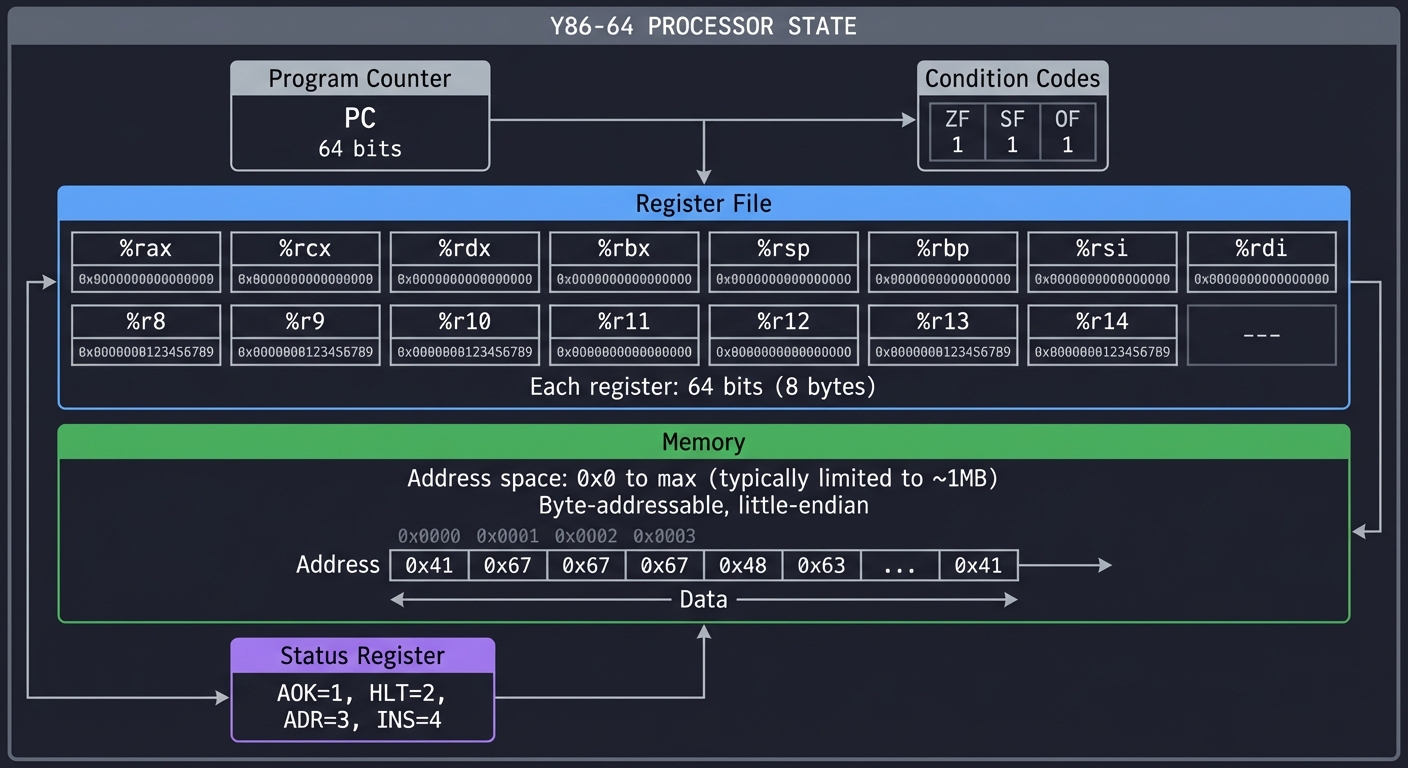
Processor State
+-----------------------------------------------------------------------+
|                     Y86-64 PROCESSOR STATE                             |
+-----------------------------------------------------------------------+
|                                                                        |
|  +------------------+     +------------------+                         |
|  | Program Counter  |     | Condition Codes  |                         |
|  |       PC         |     |   ZF  SF  OF     |                         |
|  |   64 bits        |     |    1   1   1     |                         |
|  +------------------+     +------------------+                         |
|                                                                        |
|  +----------------------------------------------------------+         |
|  |                   Register File                           |         |
|  |  +-----+-----+-----+-----+-----+-----+-----+-----+        |         |
|  |  | %rax| %rcx| %rdx| %rbx| %rsp| %rbp| %rsi| %rdi|        |         |
|  |  +-----+-----+-----+-----+-----+-----+-----+-----+        |         |
|  |  | %r8 | %r9 | %r10| %r11| %r12| %r13| %r14| --- |        |         |
|  |  +-----+-----+-----+-----+-----+-----+-----+-----+        |         |
|  |           Each register: 64 bits (8 bytes)                |         |
|  +----------------------------------------------------------+         |
|                                                                        |
|  +----------------------------------------------------------+         |
|  |                      Memory                               |         |
|  |   Address space: 0x0 to max (typically limited to ~1MB)   |         |
|  |   Byte-addressable, little-endian                         |         |
|  +----------------------------------------------------------+         |
|                                                                        |
|  +------------------+                                                  |
|  | Status Register  |                                                  |
|  | AOK=1, HLT=2,    |                                                  |
|  | ADR=3, INS=4     |                                                  |
|  +------------------+                                                  |
|                                                                        |
+-----------------------------------------------------------------------+
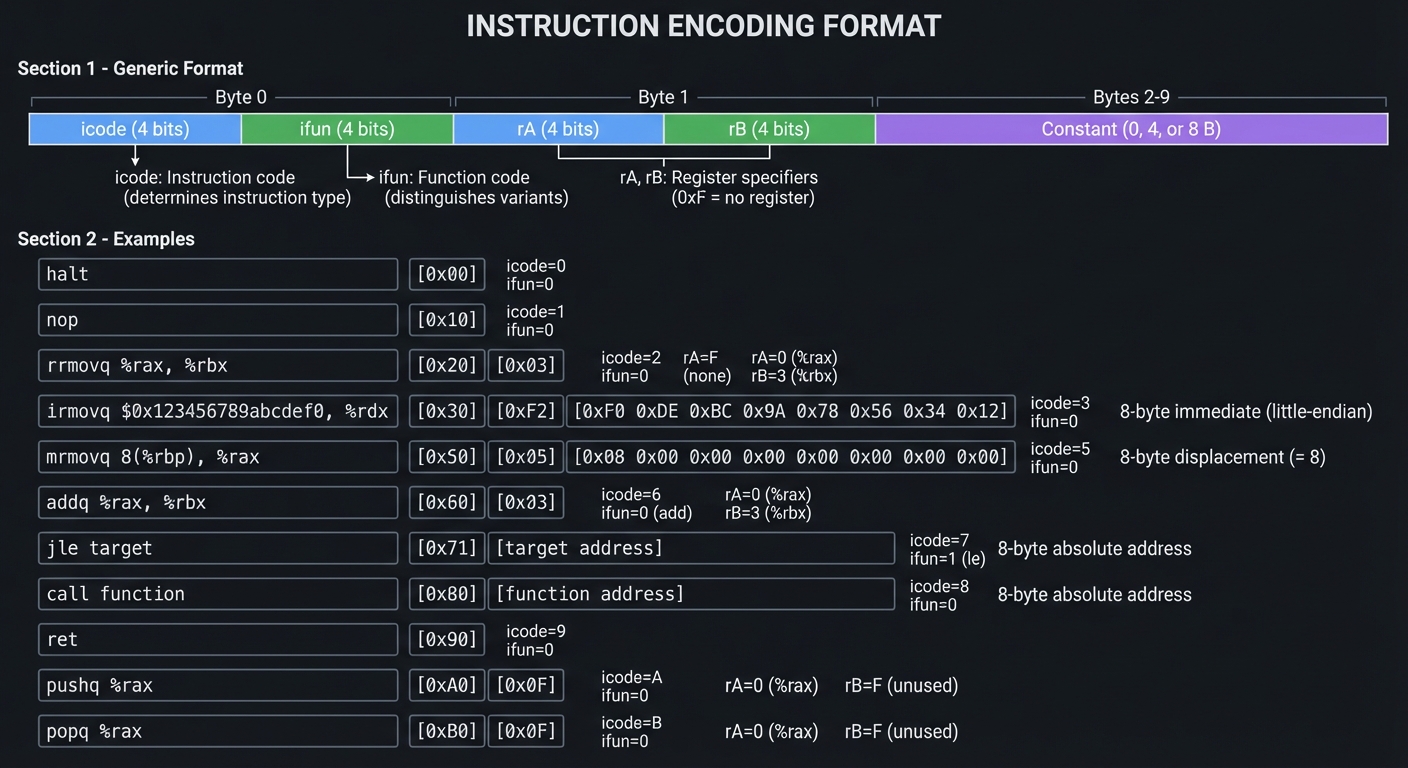
Instruction Encoding Format
Y86-64 uses variable-length instruction encoding (1-10 bytes):
+-----------------------------------------------------------------------+
|                    INSTRUCTION ENCODING FORMAT                         |
+-----------------------------------------------------------------------+
|                                                                        |
|  Generic format:                                                       |
|  +--------+--------+------------------+------------------+             |
|  | icode  | ifun   |  rA    |  rB    |      Constant    |             |
|  | 4 bits | 4 bits | 4 bits | 4 bits |   0, 4, or 8 B   |             |
|  +--------+--------+------------------+------------------+             |
|      Byte 0            Byte 1            Bytes 2-9                     |
|                                                                        |
|  icode: Instruction code (determines instruction type)                 |
|  ifun:  Function code (distinguishes variants)                         |
|  rA, rB: Register specifiers (0xF = no register)                       |
|                                                                        |
+-----------------------------------------------------------------------+
|                                                                        |
|  Examples:                                                             |
|                                                                        |
|  halt       [0x00]                         (1 byte)                    |
|                                                                        |
|  nop        [0x10]                         (1 byte)                    |
|                                                                        |
|  rrmovq %rax, %rbx                                                     |
|             [0x20] [0x03]                  (2 bytes)                   |
|              ^^^^   ^^^^                                               |
|              icode  rA=0, rB=3                                         |
|              ifun=0                                                    |
|                                                                        |
|  irmovq $0x123456789abcdef0, %rdx                                      |
|             [0x30] [0xF2] [0xF0 0xDE ... 0x12]  (10 bytes)             |
|              ^^^^   ^^^^   ^^^^^^^^^^^^^^^^                            |
|              icode  rA=F   8-byte immediate (little-endian)            |
|              ifun=0 rB=2                                               |
|                                                                        |
|  mrmovq 8(%rbp), %rax                                                  |
|             [0x50] [0x05] [0x08 0x00 ... 0x00]  (10 bytes)             |
|              ^^^^   ^^^^   ^^^^^^^^^^^^^^^^                            |
|              icode  rA=0   8-byte displacement (= 8)                   |
|                     rB=5                                               |
|                                                                        |
|  addq %rax, %rbx                                                       |
|             [0x60] [0x03]                  (2 bytes)                   |
|              ^^^^   ^^^^                                               |
|              icode  rA=0, rB=3                                         |
|              ifun=0                                                    |
|                                                                        |
|  jle target                                                            |
|             [0x71] [target address]        (9 bytes)                   |
|              ^^^^   ^^^^^^^^^^^^^^^                                    |
|              icode  8-byte absolute address                            |
|              ifun=1 (le)                                               |
|                                                                        |
|  call function                                                         |
|             [0x80] [function address]      (9 bytes)                   |
|                                                                        |
|  ret        [0x90]                         (1 byte)                    |
|                                                                        |
|  pushq %rax [0xA0] [0x0F]                  (2 bytes)                   |
|                     ^^^^                                               |
|                     rA=0, rB=F (unused)                                |
|                                                                        |
|  popq %rax  [0xB0] [0x0F]                  (2 bytes)                   |
|                                                                        |
+-----------------------------------------------------------------------+
Instruction Code Table
+-----------------------------------------------------------------------+
|                       ICODE / IFUN VALUES                              |
+-----------------------------------------------------------------------+
| icode | ifun | Instruction | Bytes | Description                      |
|-------|------|-------------|-------|----------------------------------|
|   0   |  0   | halt        |   1   | Stop execution                   |
|   1   |  0   | nop         |   1   | No operation                     |
|   2   |  0-6 | rrmovq/cmov |   2   | Register/conditional move        |
|   3   |  0   | irmovq      |  10   | Immediate to register            |
|   4   |  0   | rmmovq      |  10   | Register to memory               |
|   5   |  0   | mrmovq      |  10   | Memory to register               |
|   6   | 0-3  | OPq         |   2   | Arithmetic (add/sub/and/xor)     |
|   7   | 0-6  | jXX         |   9   | Conditional jump                 |
|   8   |  0   | call        |   9   | Call function                    |
|   9   |  0   | ret         |   1   | Return from function             |
|   A   |  0   | pushq       |   2   | Push register to stack           |
|   B   |  0   | popq        |   2   | Pop from stack to register       |
+-----------------------------------------------------------------------+

ifun values for conditional operations:
  0: unconditional (always)     1: le (<=)
  2: l (<)                      3: e (==)
  4: ne (!=)                    5: ge (>=)
  6: g (>)
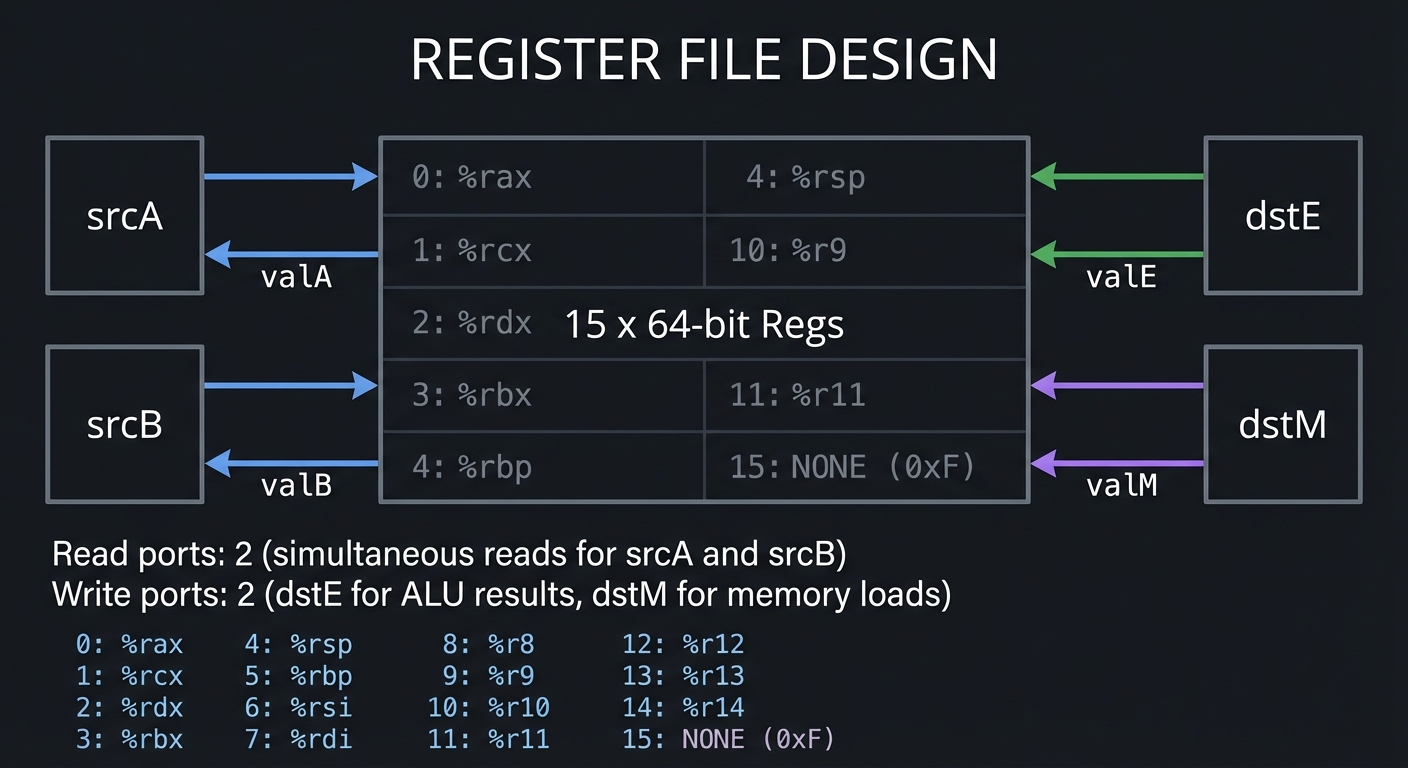
Register File Design
The register file is a key component that must support multiple reads and writes:
+-----------------------------------------------------------------------+
|                       REGISTER FILE DESIGN                             |
+-----------------------------------------------------------------------+
|                                                                        |
|                     +---------------------------+                      |
|                     |      15 x 64-bit Regs     |                      |
|                     +---------------------------+                      |
|                               |  |  |                                  |
|     Read Port A              |  |  |           Write Port              |
|     +-------+                |  |  |           +-------+               |
|     | srcA  |--------------->|  |  |<----------| dstE  |               |
|     +-------+     valA <-----|  |  |           +-------+               |
|                              |  |  |------> valE                       |
|     Read Port B              |  |  |                                   |
|     +-------+                |  |  |           +-------+               |
|     | srcB  |--------------->|  |  |<----------| dstM  |               |
|     +-------+     valB <-----|  |  |           +-------+               |
|                              |  |  |------> valM                       |
|                     +---------------------------+                      |
|                                                                        |
|   Read ports: 2 (simultaneous reads for srcA and srcB)                 |
|   Write ports: 2 (dstE for ALU results, dstM for memory loads)         |
|                                                                        |
|   Register IDs:                                                        |
|   0: %rax    4: %rsp    8: %r8     12: %r12                            |
|   1: %rcx    5: %rbp    9: %r9     13: %r13                            |
|   2: %rdx    6: %rsi   10: %r10    14: %r14                            |
|   3: %rbx    7: %rdi   11: %r11    15: NONE (0xF)                      |
|                                                                        |
+-----------------------------------------------------------------------+
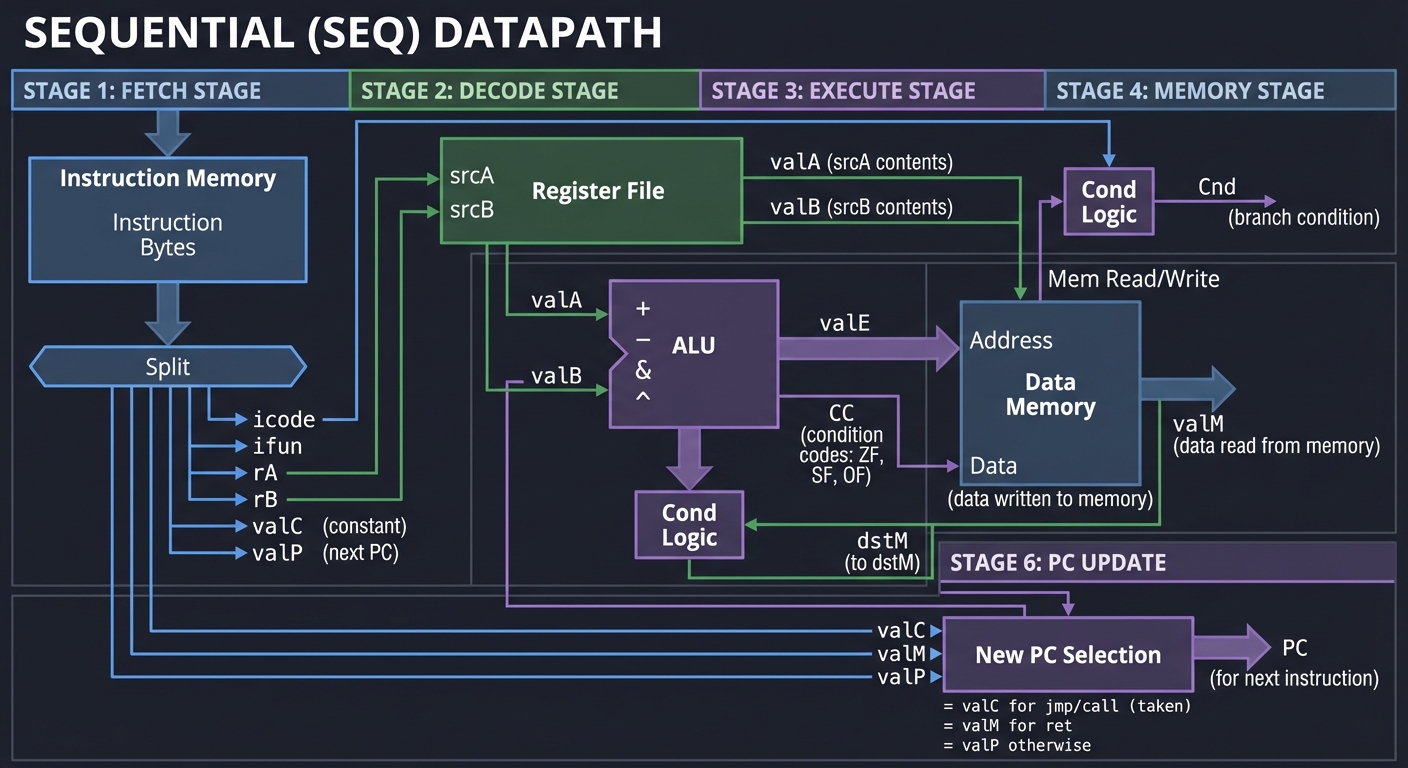
Sequential CPU Datapath
The sequential (SEQ) implementation executes one instruction per clock cycle:
+-----------------------------------------------------------------------+
|                    SEQUENTIAL (SEQ) DATAPATH                           |
+-----------------------------------------------------------------------+
|                                                                        |
|  +------------------------------------------------------------------+  |
|  |                         FETCH STAGE                               |  |
|  +------------------------------------------------------------------+  |
|           |                                                            |
|           v                                                            |
|    +-------------+                                                     |
|    | Instruction |     +--------+                                      |
|    |   Memory    |---->| Split  |---> icode, ifun                      |
|    +-------------+     +--------+---> rA, rB                           |
|           |                    |---> valC (constant)                   |
|           |                    |---> valP (next PC)                    |
|           v                                                            |
|  +------------------------------------------------------------------+  |
|  |                        DECODE STAGE                               |  |
|  +------------------------------------------------------------------+  |
|           |                                                            |
|           v                                                            |
|    +-------------+                                                     |
|    |  Register   |---> valA (srcA contents)                            |
|    |    File     |---> valB (srcB contents)                            |
|    +-------------+                                                     |
|           |                                                            |
|           v                                                            |
|  +------------------------------------------------------------------+  |
|  |                       EXECUTE STAGE                               |  |
|  +------------------------------------------------------------------+  |
|           |                                                            |
|           v                                                            |
|    +-------------+                                                     |
|    |    ALU      |---> valE (result)                                   |
|    +-------------+---> CC (condition codes: ZF, SF, OF)                |
|           |                                                            |
|           |         +------------+                                     |
|           |-------->| Cond Logic |---> Cnd (branch condition)          |
|           |         +------------+                                     |
|           v                                                            |
|  +------------------------------------------------------------------+  |
|  |                        MEMORY STAGE                               |  |
|  +------------------------------------------------------------------+  |
|           |                                                            |
|           v                                                            |
|    +-------------+                                                     |
|    |    Data     |---> valM (data read from memory)                    |
|    |   Memory    |<--- (data written to memory)                        |
|    +-------------+                                                     |
|           |                                                            |
|           v                                                            |
|  +------------------------------------------------------------------+  |
|  |                      WRITEBACK STAGE                              |  |
|  +------------------------------------------------------------------+  |
|           |                                                            |
|           v                                                            |
|    +-------------+                                                     |
|    |  Register   |<--- valE (to dstE)                                  |
|    |    File     |<--- valM (to dstM)                                  |
|    +-------------+                                                     |
|           |                                                            |
|           v                                                            |
|  +------------------------------------------------------------------+  |
|  |                        PC UPDATE                                  |  |
|  +------------------------------------------------------------------+  |
|           |                                                            |
|           v                                                            |
|    +-------------+                                                     |
|    |   New PC    |---> PC (for next instruction)                       |
|    |  Selection  |     = valC for jmp/call (taken)                     |
|    +-------------+     = valM for ret                                  |
|                        = valP otherwise                                |
|                                                                        |
+-----------------------------------------------------------------------+
Stage-by-Stage Details
+-----------------------------------------------------------------------+
|                     FETCH-DECODE-EXECUTE-MEMORY-WRITEBACK              |
+-----------------------------------------------------------------------+
|                                                                        |
|  FETCH:                                                                |
|    1. Read instruction bytes from memory[PC]                           |
|    2. Extract icode, ifun from first byte                              |
|    3. Determine instruction length                                     |
|    4. Extract rA, rB from register specifier byte (if present)         |
|    5. Extract valC (8-byte constant, if present)                       |
|    6. Compute valP = PC + instruction_length                           |
|    7. Check for invalid instruction (set status = INS)                 |
|                                                                        |
|  DECODE:                                                               |
|    1. Determine srcA, srcB based on icode                              |
|    2. Read valA = R[srcA] (if srcA != 0xF)                             |
|    3. Read valB = R[srcB] (if srcB != 0xF)                             |
|    4. For pushq/popq, handle %rsp specially                            |
|                                                                        |
|  EXECUTE:                                                              |
|    1. Select ALU inputs (valA, valB, valC, or constants)               |
|    2. Compute valE = ALU(aluA, aluB, operation)                        |
|    3. For OPq: set condition codes (ZF, SF, OF)                        |
|    4. For conditional: evaluate condition using CC                     |
|                                                                        |
|  MEMORY:                                                               |
|    1. For mrmovq/popq: valM = Memory[valE]                             |
|    2. For rmmovq/pushq: Memory[valE] = valA                            |
|    3. For call: Memory[valE] = valP (push return address)              |
|    4. For ret: valM = Memory[valA]                                     |
|    5. Check for invalid address (set status = ADR)                     |
|                                                                        |
|  WRITEBACK:                                                            |
|    1. Determine dstE, dstM based on icode                              |
|    2. For conditional move: dstE = 0xF if !Cnd (no write)              |
|    3. Write R[dstE] = valE (if dstE != 0xF)                            |
|    4. Write R[dstM] = valM (if dstM != 0xF)                            |
|                                                                        |
|  PC UPDATE:                                                            |
|    1. For call: PC = valC                                              |
|    2. For ret: PC = valM                                               |
|    3. For jXX (taken): PC = valC                                       |
|    4. Otherwise: PC = valP                                             |
|                                                                        |
+-----------------------------------------------------------------------+
Control Logic for SEQ
Each instruction needs specific control signals. Here’s a subset:
+-----------------------------------------------------------------------+
|                      SEQ CONTROL SIGNAL LOGIC                          |
+-----------------------------------------------------------------------+
|                                                                        |
|  srcA:                                                                 |
|    rrmovq, rmmovq, OPq, pushq: rA                                      |
|    popq, ret: %rsp                                                     |
|    otherwise: NONE (0xF)                                               |
|                                                                        |
|  srcB:                                                                 |
|    OPq, rmmovq, mrmovq: rB                                             |
|    pushq, popq, call, ret: %rsp                                        |
|    otherwise: NONE (0xF)                                               |
|                                                                        |
|  dstE:                                                                 |
|    rrmovq, irmovq, OPq: rB                                             |
|    pushq, popq, call, ret: %rsp                                        |
|    otherwise: NONE (0xF)                                               |
|                                                                        |
|  dstM:                                                                 |
|    mrmovq, popq: rA                                                    |
|    otherwise: NONE (0xF)                                               |
|                                                                        |
|  aluA:                                                                 |
|    rrmovq, OPq: valA                                                   |
|    irmovq, rmmovq, mrmovq: valC                                        |
|    call, pushq: -8                                                     |
|    ret, popq: 8                                                        |
|                                                                        |
|  aluB:                                                                 |
|    rrmovq, irmovq: 0                                                   |
|    OPq, rmmovq, mrmovq, pushq, popq, call, ret: valB                   |
|                                                                        |
|  aluFun:                                                               |
|    OPq: ifun (0=add, 1=sub, 2=and, 3=xor)                              |
|    otherwise: ADD (always add for address calculation)                 |
|                                                                        |
+-----------------------------------------------------------------------+
Pipelining Fundamentals
Pipelining overlaps instruction execution to improve throughput:
+-----------------------------------------------------------------------+
|                     WHY PIPELINE?                                      |
+-----------------------------------------------------------------------+
|                                                                        |
|  SEQUENTIAL (SEQ):                                                     |
|  +-------+-------+-------+-------+-------+                             |
|  | I1    | I2    | I3    | I4    | I5    |  ...                        |
|  | FDEMW | FDEMW | FDEMW | FDEMW | FDEMW |                             |
|  +-------+-------+-------+-------+-------+                             |
|  Cycle:  5      10      15      20      25                             |
|                                                                        |
|  Each instruction takes 5 cycles, throughput = 1 instr / 5 cycles      |
|                                                                        |
|  PIPELINED (PIPE):                                                     |
|  +---+---+---+---+---+---+---+---+---+                                  |
|  |I1F|I1D|I1E|I1M|I1W|   |   |   |   |                                  |
|  |   |I2F|I2D|I2E|I2M|I2W|   |   |   |                                  |
|  |   |   |I3F|I3D|I3E|I3M|I3W|   |   |                                  |
|  |   |   |   |I4F|I4D|I4E|I4M|I4W|   |                                  |
|  |   |   |   |   |I5F|I5D|I5E|I5M|I5W|                                  |
|  +---+---+---+---+---+---+---+---+---+                                  |
|  Cycle: 1   2   3   4   5   6   7   8   9                              |
|                                                                        |
|  5 instructions complete by cycle 9 (vs cycle 25)                      |
|  Throughput approaches 1 instr / cycle (5x improvement!)               |
|                                                                        |
+-----------------------------------------------------------------------+
|                                                                        |
|  PIPELINE REGISTERS (between stages):                                  |
|                                                                        |
|  +----+      +----+      +----+      +----+      +----+                 |
|  | F  |----->| D  |----->| E  |----->| M  |----->| W  |                 |
|  +----+  F/D +----+  D/E +----+  E/M +----+  M/W +----+                 |
|          reg        reg        reg        reg                          |
|                                                                        |
|  Each clock cycle:                                                     |
|  - All pipeline registers update simultaneously                        |
|  - Each stage processes its current values                             |
|  - Output flows into the next stage's register                         |
|                                                                        |
+-----------------------------------------------------------------------+
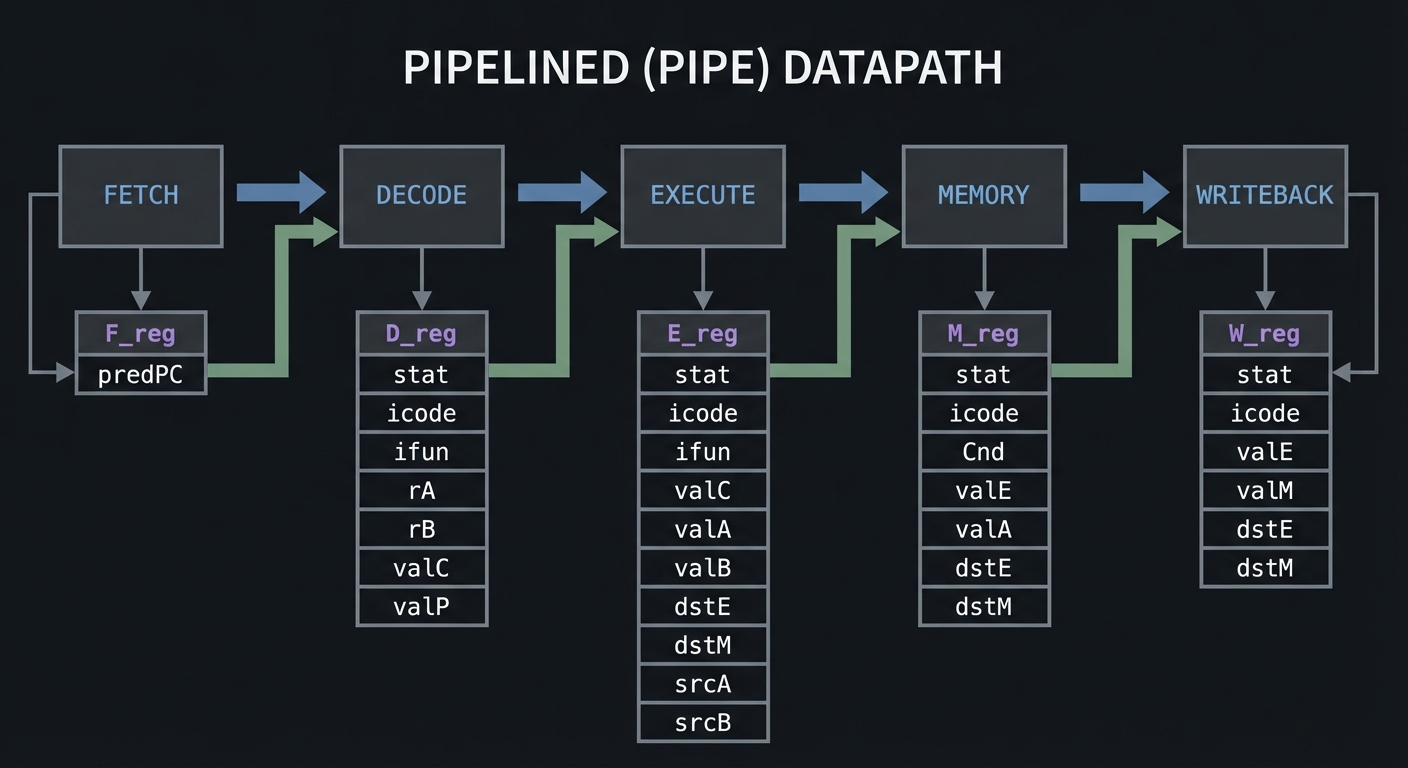
The PIPE Datapath
+-----------------------------------------------------------------------+
|                      PIPELINED (PIPE) DATAPATH                         |
+-----------------------------------------------------------------------+
|                                                                        |
|   +-------+    +--------+    +--------+    +--------+    +---------+   |
|   | FETCH |===>| DECODE |===>|EXECUTE |===>| MEMORY |===>|WRITEBACK|   |
|   +-------+    +--------+    +--------+    +--------+    +---------+   |
|       |            |            |              |              |        |
|       v            v            v              v              v        |
|   +-------+    +--------+    +--------+    +--------+                  |
|   | F_reg |    | D_reg  |    | E_reg  |    | M_reg  |                  |
|   +-------+    +--------+    +--------+    +--------+                  |
|   | predPC|    | stat   |    | stat   |    | stat   |                  |
|   |       |    | icode  |    | icode  |    | icode  |                  |
|   |       |    | ifun   |    | ifun   |    | Cnd    |                  |
|   |       |    | rA     |    | valC   |    | valE   |                  |
|   |       |    | rB     |    | valA   |    | valA   |                  |
|   |       |    | valC   |    | valB   |    | dstE   |                  |
|   |       |    | valP   |    | dstE   |    | dstM   |                  |
|   |       |    |        |    | dstM   |    |        |                  |
|   |       |    |        |    | srcA   |    |        |                  |
|   |       |    |        |    | srcB   |    |        |                  |
|   +-------+    +--------+    +--------+    +--------+                  |
|                                                                        |
|                              +--------+                                |
|                              | W_reg  |                                |
|                              +--------+                                |
|                              | stat   |                                |
|                              | icode  |                                |
|                              | valE   |                                |
|                              | valM   |                                |
|                              | dstE   |                                |
|                              | dstM   |                                |
|                              +--------+                                |
|                                                                        |
+-----------------------------------------------------------------------+
Data Hazards
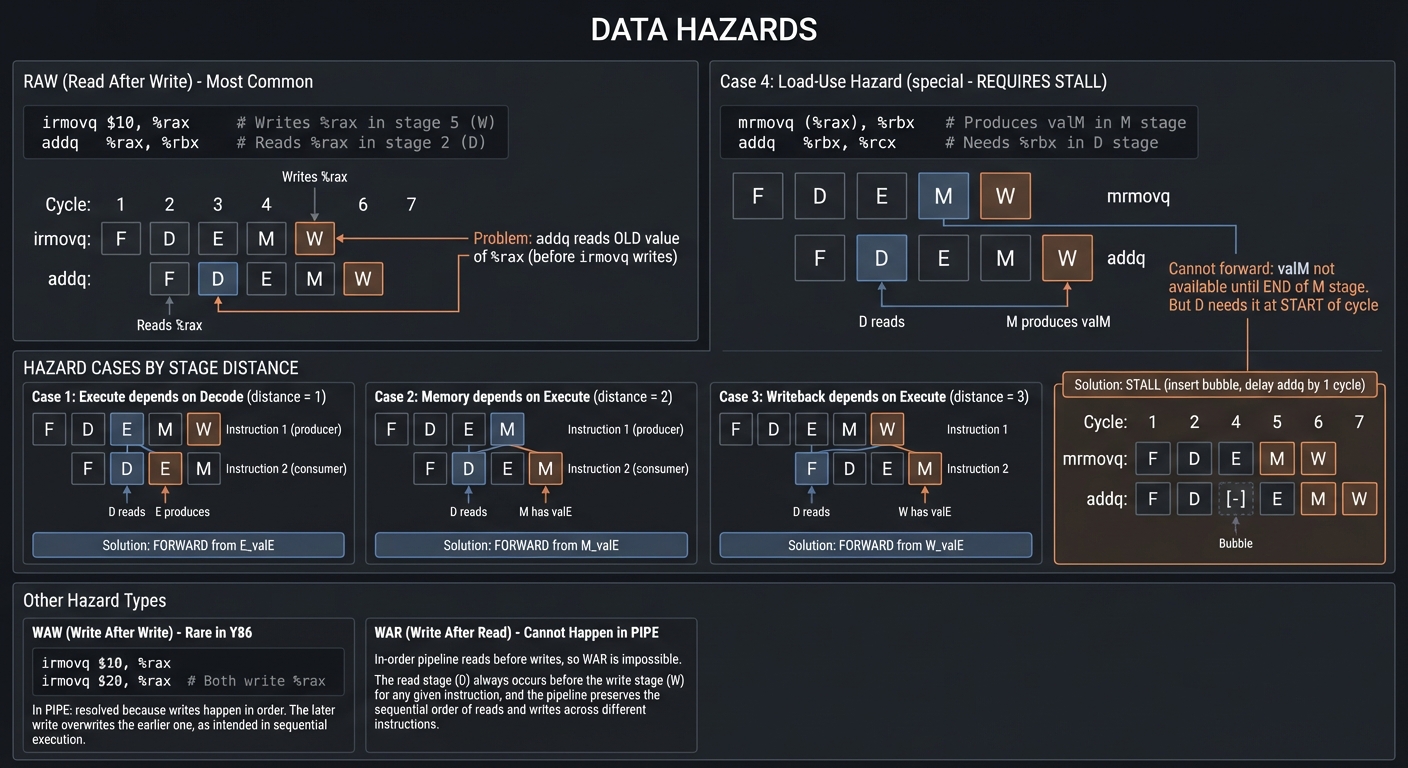
Data hazards occur when instructions depend on results not yet available:
+-----------------------------------------------------------------------+
|                         DATA HAZARDS                                   |
+-----------------------------------------------------------------------+
|                                                                        |
|  RAW (Read After Write) - Most Common:                                 |
|  -------------------------------------                                 |
|    irmovq $10, %rax       # Writes %rax in stage 5 (W)                 |
|    addq %rax, %rbx        # Reads %rax in stage 2 (D)                  |
|                                                                        |
|    Cycle:  1   2   3   4   5   6   7                                   |
|    irmovq: F   D   E   M   W                                           |
|    addq:       F   D   E   M   W                                       |
|                    ^           ^                                       |
|                    |           |                                       |
|                  Reads %rax  Writes %rax                               |
|                                                                        |
|    Problem: addq reads OLD value of %rax (before irmovq writes)        |
|                                                                        |
|  WAW (Write After Write) - Rare in Y86:                                |
|  --------------------------------------                                |
|    irmovq $10, %rax                                                    |
|    irmovq $20, %rax       # Both write %rax                            |
|                                                                        |
|    In PIPE: resolved because writes happen in order                    |
|                                                                        |
|  WAR (Write After Read) - Cannot Happen in PIPE:                       |
|  -----------------------------------------------                       |
|    In-order pipeline reads before writes, so WAR is impossible         |
|                                                                        |
+-----------------------------------------------------------------------+
|                                                                        |
|  HAZARD CASES BY STAGE DISTANCE:                                       |
|  --------------------------------                                      |
|                                                                        |
|  Case 1: Execute depends on Decode (distance = 1)                      |
|    +---+---+---+---+---+                                               |
|    | F | D | E | M | W |  Instruction 1 (producer)                     |
|    |   | F | D | E | M |  Instruction 2 (consumer)                     |
|    +---+---+---+---+---+                                               |
|            ^       ^                                                   |
|          D reads  E produces                                           |
|                                                                        |
|    valE not ready when I2 needs it in D stage                          |
|    Solution: FORWARD from E_valE                                       |
|                                                                        |
|  Case 2: Memory depends on Execute (distance = 2)                      |
|    +---+---+---+---+---+---+                                           |
|    | F | D | E | M | W |   |  Instruction 1 (producer)                 |
|    |   |   | F | D | E | M |  Instruction 2 (consumer)                 |
|    +---+---+---+---+---+---+                                           |
|                ^       ^                                               |
|              D reads  M has valE                                       |
|                                                                        |
|    valE ready by M, forward from M_valE                                |
|    Solution: FORWARD from M_valE                                       |
|                                                                        |
|  Case 3: Writeback depends on Execute (distance = 3)                   |
|    +---+---+---+---+---+---+---+                                       |
|    | F | D | E | M | W |   |   |  Instruction 1                        |
|    |   |   |   | F | D | E | M |  Instruction 2                        |
|    +---+---+---+---+---+---+---+                                       |
|                    ^       ^                                           |
|                  D reads  W has valE                                   |
|                                                                        |
|    Solution: FORWARD from W_valE                                       |
|                                                                        |
|  Case 4: Load-Use Hazard (special - REQUIRES STALL)                    |
|    mrmovq (%rax), %rbx    # Produces valM in M stage                   |
|    addq %rbx, %rcx        # Needs %rbx in D stage                      |
|                                                                        |
|    +---+---+---+---+---+---+                                           |
|    | F | D | E | M | W |   |  mrmovq                                   |
|    |   | F | D | E | M | W |  addq                                     |
|    +---+---+---+---+---+---+                                           |
|            ^       ^                                                   |
|          D reads  M produces valM                                      |
|                                                                        |
|    Cannot forward: valM not available until END of M stage             |
|    But D needs it at START of cycle                                    |
|    Solution: STALL (insert bubble, delay addq by 1 cycle)              |
|                                                                        |
+-----------------------------------------------------------------------+
Control Hazards
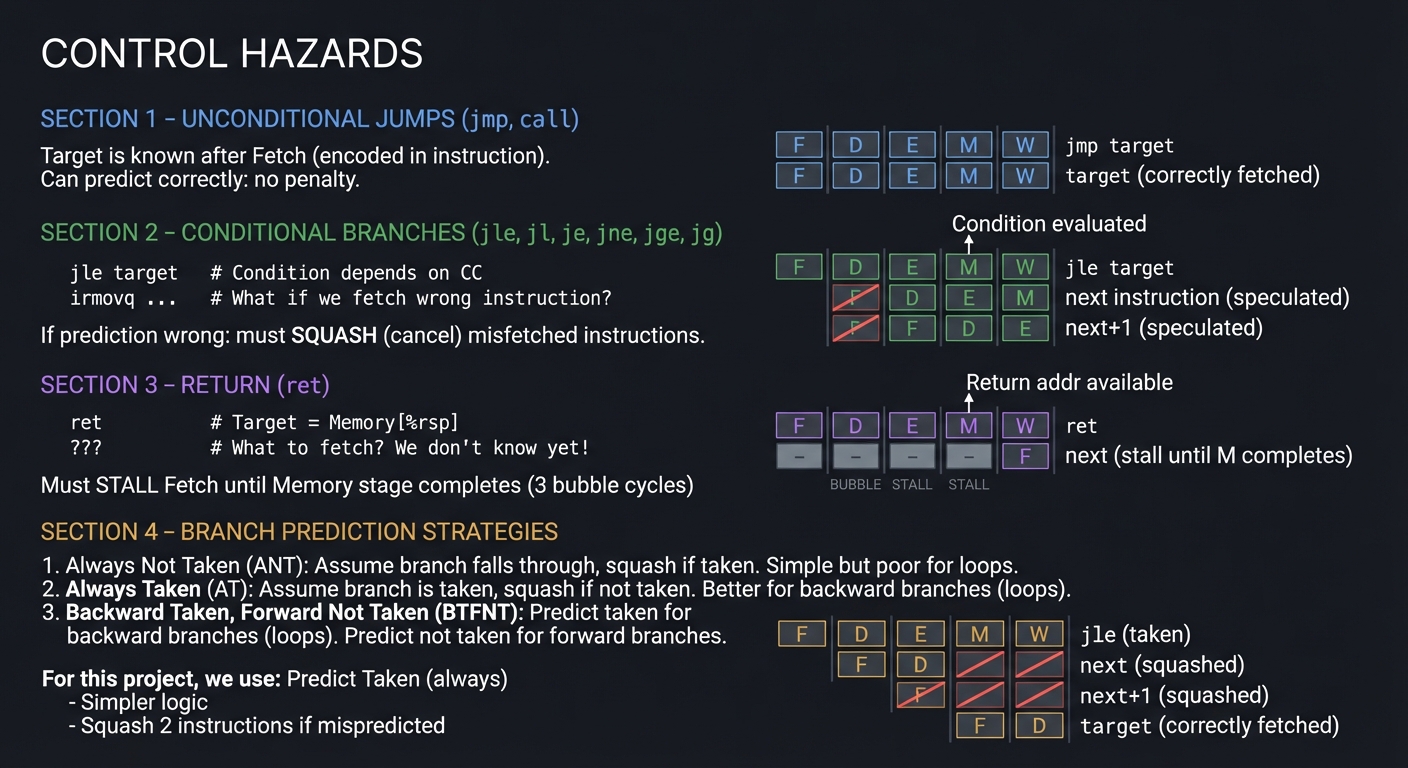
Control hazards arise from branches and jumps where the next PC is uncertain:
+-----------------------------------------------------------------------+
|                        CONTROL HAZARDS                                 |
+-----------------------------------------------------------------------+
|                                                                        |
|  UNCONDITIONAL JUMPS (jmp, call):                                      |
|  ---------------------------------                                     |
|    Target is known after Fetch (encoded in instruction)                |
|    Can predict correctly: no penalty                                   |
|                                                                        |
|  CONDITIONAL BRANCHES (jle, jl, je, jne, jge, jg):                     |
|  --------------------------------------------------                    |
|    Target known after Fetch, but condition known after Execute         |
|                                                                        |
|    jle target     # Condition depends on CC                            |
|    irmovq ...     # What if we fetch wrong instruction?                |
|                                                                        |
|    +---+---+---+---+---+                                               |
|    | F | D | E | M | W |  jle                                          |
|    |   | F | D | E | M |  next instruction (speculated)                |
|    |   |   | F | D | E |  next+1 (speculated)                          |
|    +---+---+---+---+---+                                               |
|                ^                                                       |
|              Condition                                                 |
|              evaluated                                                 |
|                                                                        |
|    If prediction wrong: must SQUASH (cancel) misfetched instructions   |
|                                                                        |
|  RETURN (ret):                                                         |
|  --------------                                                        |
|    Target comes from stack - unknown until Memory stage!               |
|                                                                        |
|    ret            # Target = Memory[%rsp]                              |
|    ???            # What to fetch? We don't know yet!                  |
|                                                                        |
|    +---+---+---+---+---+                                               |
|    | F | D | E | M | W |  ret                                          |
|    |   | - | - | - | F |  next (stall until M completes)               |
|    +---+---+---+---+---+                                               |
|                    ^                                                   |
|                  Return addr                                           |
|                  available                                             |
|                                                                        |
|    Must STALL Fetch until Memory stage completes (3 bubble cycles)     |
|                                                                        |
+-----------------------------------------------------------------------+
|                                                                        |
|  BRANCH PREDICTION STRATEGIES:                                         |
|  ------------------------------                                        |
|                                                                        |
|  1. Always Not Taken (ANT):                                            |
|     Assume branch falls through, squash if taken                       |
|     Simple but poor for loops                                          |
|                                                                        |
|  2. Always Taken (AT):                                                 |
|     Assume branch is taken, squash if not taken                        |
|     Better for backward branches (loops)                               |
|                                                                        |
|  3. Backward Taken, Forward Not Taken (BTFNT):                         |
|     Predict taken for backward branches (loops)                        |
|     Predict not taken for forward branches                             |
|                                                                        |
|  For this project, we use: Predict Taken (always)                      |
|    - Simpler logic                                                     |
|    - Squash 2 instructions if mispredicted                             |
|                                                                        |
+-----------------------------------------------------------------------+
Hazard Detection and Forwarding
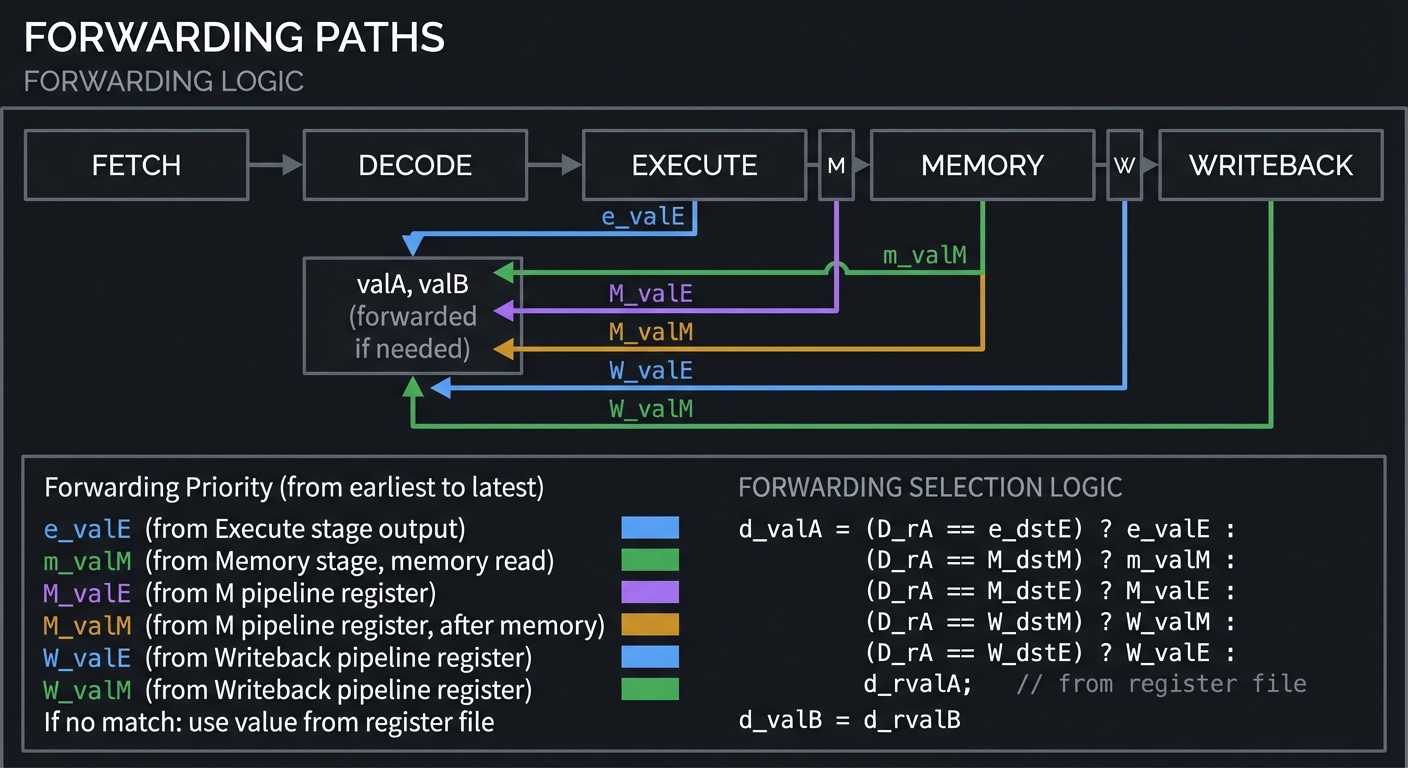
Forwarding bypasses the register file to supply values directly:
+-----------------------------------------------------------------------+
|                    FORWARDING PATHS                                    |
+-----------------------------------------------------------------------+
|                                                                        |
|                         FORWARDING LOGIC                               |
|                                                                        |
|  +--------+    +--------+    +--------+    +--------+    +---------+   |
|  | FETCH  |    | DECODE |    |EXECUTE |    | MEMORY |    |WRITEBACK|   |
|  +--------+    +--------+    +--------+    +--------+    +---------+   |
|                   |  ^           |              |              |       |
|                   |  |    +------+              |              |       |
|                   |  |    |                     |              |       |
|                   |  +----+---e_valE------------+              |       |
|                   |  |    |                                    |       |
|                   |  +----+---------m_valM---------------------+       |
|                   |  |                                         |       |
|                   |  +--------------M_valE---------------------+       |
|                   |  |                                         |       |
|                   |  +--------------M_valM---------------------+       |
|                   |  |                                                 |
|                   |  +----------------------------------W_valE---------+
|                   |  |                                                 |
|                   |  +----------------------------------W_valM---------+
|                   |                                                    |
|                 valA, valB                                             |
|               (forwarded if needed)                                    |
|                                                                        |
|  Forwarding Priority (from earliest to latest):                        |
|    1. e_valE (from Execute stage output)                               |
|    2. m_valM (from Memory stage, memory read)                          |
|    3. M_valE (from M pipeline register)                                |
|    4. M_valM (from M pipeline register, after memory)                  |
|    5. W_valE (from Writeback pipeline register)                        |
|    6. W_valM (from Writeback pipeline register)                        |
|                                                                        |
|  If no match: use value from register file                             |
|                                                                        |
+-----------------------------------------------------------------------+
|                                                                        |
|  FORWARDING SELECTION LOGIC (pseudocode):                              |
|                                                                        |
|  d_valA = (D_rA == e_dstE) ? e_valE :                                  |
|           (D_rA == M_dstM) ? m_valM :                                  |
|           (D_rA == M_dstE) ? M_valE :                                  |
|           (D_rA == W_dstM) ? W_valM :                                  |
|           (D_rA == W_dstE) ? W_valE :                                  |
|           d_rvalA;  // from register file                              |
|                                                                        |
|  Similarly for d_valB                                                  |
|                                                                        |
+-----------------------------------------------------------------------+
Stalling and Bubbling
When forwarding is insufficient, we must stall or insert bubbles:
+-----------------------------------------------------------------------+
|                   STALLING AND BUBBLING                                |
+-----------------------------------------------------------------------+
|                                                                        |
|  STALL: Hold a stage's inputs constant (don't advance)                 |
|  BUBBLE: Insert a nop-like instruction (clear the stage)               |
|                                                                        |
|  +------------------------------------------------------------------+  |
|  |                      PIPELINE CONTROL SIGNALS                    |  |
|  +------------------------------------------------------------------+  |
|  |                                                                   |  |
|  |  For each pipeline register:                                      |  |
|  |    NORMAL:  load new values from previous stage                   |  |
|  |    STALL:   keep current values (don't update)                    |  |
|  |    BUBBLE:  load bubble/nop values (clear state)                  |  |
|  |                                                                   |  |
|  +------------------------------------------------------------------+  |
|                                                                        |
|  LOAD-USE HAZARD (requires stall):                                     |
|                                                                        |
|    Cycle:    1    2    3    4    5    6    7                           |
|    mrmovq:  [F]  [D]  [E]  [M]  [W]                                     |
|    addq:         [F]  [D]  [D]  [E]  [M]  [W]   <- D repeats!          |
|    next:              [F]  [F]  [D]  [E]  [M]   <- F repeats!          |
|                                                                        |
|                   ^    ^                                               |
|                   |    |                                               |
|               Bubble  Stall                                            |
|               in E    F and D                                          |
|                                                                        |
|    Actions:                                                            |
|    - F_stall = 1 (hold PC)                                             |
|    - D_stall = 1 (hold D register)                                     |
|    - E_bubble = 1 (insert nop into Execute)                            |
|                                                                        |
|  MISPREDICTED BRANCH:                                                  |
|                                                                        |
|    Cycle:    1    2    3    4    5    6    7                           |
|    jne:     [F]  [D]  [E]  [M]  [W]                                     |
|    wrongI1:      [F]  [D]   X                   <- cancelled!          |
|    wrongI2:           [F]   X                   <- cancelled!          |
|    correct:                [F]  [D]  [E]  [M]   <- fetch after E       |
|                                                                        |
|                       ^                                                |
|                    Branch                                              |
|                    resolved                                            |
|                                                                        |
|    Actions (at cycle 4):                                               |
|    - D_bubble = 1 (cancel wrongI1)                                     |
|    - E_bubble = 1 (cancel wrongI2)                                     |
|    - Correct PC fed to Fetch                                           |
|                                                                        |
|  RETURN INSTRUCTION:                                                   |
|                                                                        |
|    Cycle:    1    2    3    4    5    6    7                           |
|    ret:     [F]  [D]  [E]  [M]  [W]                                     |
|    bubble:       [B]  [B]  [B]                  <- 3 bubbles           |
|    target:                     [F]  [D]  [E]    <- after M completes   |
|                                                                        |
|    Actions:                                                            |
|    - While ret in D, E, or M: D_bubble = 1                             |
|    - F_stall until return address available                            |
|                                                                        |
+-----------------------------------------------------------------------+
Complete Pipeline Control Logic
+-----------------------------------------------------------------------+
|                    PIPELINE CONTROL CONDITIONS                         |
+-----------------------------------------------------------------------+
|                                                                        |
|  CONDITION DEFINITIONS:                                                |
|                                                                        |
|  load_use_hazard = (                                                   |
|      E_icode in {IMRMOVQ, IPOPQ} &&                                    |
|      E_dstM in {d_srcA, d_srcB}                                        |
|  )                                                                     |
|                                                                        |
|  mispredicted_branch = (                                               |
|      E_icode == IJXX && !e_Cnd    // branch in E, not taken            |
|  )                                                                     |
|                                                                        |
|  ret_hazard = (                                                        |
|      IRET in {D_icode, E_icode, M_icode}                               |
|  )                                                                     |
|                                                                        |
+-----------------------------------------------------------------------+
|                                                                        |
|  CONTROL ACTIONS:                                                      |
|                                                                        |
|  Condition            | F_stall | D_stall | D_bubble | E_bubble |     |
|  ---------------------|---------|---------|----------|----------|     |
|  load_use_hazard      |    1    |    1    |    0     |    1     |     |
|  mispredicted_branch  |    0    |    0    |    1     |    1     |     |
|  ret_hazard           |    1    |    0    |    1     |    0     |     |
|  normal               |    0    |    0    |    0     |    0     |     |
|                                                                        |
|  Special case: load_use + ret simultaneously:                          |
|    Prioritize load_use (stall), don't bubble D                         |
|                                                                        |
+-----------------------------------------------------------------------+
Pipeline Registers
Each pipeline register holds state passed between stages:
+-----------------------------------------------------------------------+
|                    PIPELINE REGISTER CONTENTS                          |
+-----------------------------------------------------------------------+
|                                                                        |
|  F Register (minimal - just predicted PC):                             |
|  +------------------------------------------+                          |
|  | predPC | Predicted next PC               |                          |
|  +------------------------------------------+                          |
|                                                                        |
|  D Register (after Fetch, before Decode):                              |
|  +------------------------------------------+                          |
|  | stat   | Status (AOK, HLT, ADR, INS)     |                          |
|  | icode  | Instruction code                |                          |
|  | ifun   | Instruction function            |                          |
|  | rA     | Register A specifier            |                          |
|  | rB     | Register B specifier            |                          |
|  | valC   | Constant (immediate/disp)       |                          |
|  | valP   | PC of next instruction          |                          |
|  +------------------------------------------+                          |
|                                                                        |
|  E Register (after Decode, before Execute):                            |
|  +------------------------------------------+                          |
|  | stat   | Status                          |                          |
|  | icode  | Instruction code                |                          |
|  | ifun   | Instruction function            |                          |
|  | valC   | Constant                        |                          |
|  | valA   | Value read from srcA            |                          |
|  | valB   | Value read from srcB            |                          |
|  | dstE   | Destination register (ALU)      |                          |
|  | dstM   | Destination register (Memory)   |                          |
|  | srcA   | Source A (for forwarding)       |                          |
|  | srcB   | Source B (for forwarding)       |                          |
|  +------------------------------------------+                          |
|                                                                        |
|  M Register (after Execute, before Memory):                            |
|  +------------------------------------------+                          |
|  | stat   | Status                          |                          |
|  | icode  | Instruction code                |                          |
|  | Cnd    | Condition result (for cmov/jmp) |                          |
|  | valE   | ALU result                      |                          |
|  | valA   | Passthrough (for rmmovq/pushq)  |                          |
|  | dstE   | Destination register (ALU)      |                          |
|  | dstM   | Destination register (Memory)   |                          |
|  +------------------------------------------+                          |
|                                                                        |
|  W Register (after Memory, before Writeback):                          |
|  +------------------------------------------+                          |
|  | stat   | Status                          |                          |
|  | icode  | Instruction code                |                          |
|  | valE   | ALU result                      |                          |
|  | valM   | Memory result                   |                          |
|  | dstE   | Destination register (ALU)      |                          |
|  | dstM   | Destination register (Memory)   |                          |
|  +------------------------------------------+                          |
|                                                                        |
+-----------------------------------------------------------------------+
Project Specification
What You Will Build
A command-line Y86-64 simulator with two execution modes:
- Sequential Simulator (SEQ): Execute one instruction per cycle, producing final state
- Pipelined Simulator (PIPE): Execute with 5-stage pipeline, producing per-cycle traces
Functional Requirements
- Object File Loading:
- Parse Y86-64 object files (YO format)
- Load code and data into simulated memory
- Validate memory addresses
- Sequential Execution:
- Implement all Y86-64 instructions
- Track register and memory state
- Report final state (registers, CC, status)
- Pipelined Execution:
- Implement 5-stage pipeline with registers
- Detect and handle all hazards (data, control)
- Produce cycle-by-cycle trace output
- Trace Output:
- Show pipeline stage contents each cycle
- Indicate stalls, bubbles, and forwards
- Explain hazard reasons
Example Trace Output
$ ./y86sim -p trace.yo

=== Y86-64 PIPELINED SIMULATOR ===
Program: trace.yo
Mode: Pipelined with trace

Cycle 1:
+-------+------------+------------+------------+------------+------------+
| Stage |   icode    |    valE    |    valM    |   srcA/B   |   dstE/M   |
+-------+------------+------------+------------+------------+------------+
|   F   | irmovq     |     -      |     -      |     -      |     -      |
|   D   | nop        |     -      |     -      |   -/-      |   -/-      |
|   E   | nop        |     -      |     -      |     -      |   -/-      |
|   M   | nop        |     -      |     -      |     -      |   -/-      |
|   W   | nop        |     -      |     -      |     -      |   -/-      |
+-------+------------+------------+------------+------------+------------+
  PC = 0x000, Status = AOK

Cycle 2:
+-------+------------+------------+------------+------------+------------+
| Stage |   icode    |    valE    |    valM    |   srcA/B   |   dstE/M   |
+-------+------------+------------+------------+------------+------------+
|   F   | mrmovq     |     -      |     -      |     -      |     -      |
|   D   | irmovq     |     -      |     -      |   -/-      |   -/%rax   |
|   E   | nop        |     -      |     -      |     -      |   -/-      |
|   M   | nop        |     -      |     -      |     -      |   -/-      |
|   W   | nop        |     -      |     -      |     -      |   -/-      |
+-------+------------+------------+------------+------------+------------+
  PC = 0x00a, Status = AOK

Cycle 3:
+-------+------------+------------+------------+------------+------------+
| Stage |   icode    |    valE    |    valM    |   srcA/B   |   dstE/M   |
+-------+------------+------------+------------+------------+------------+
|   F   | addq       |     -      |     -      |     -      |     -      |
|   D   | mrmovq     |     -      |     -      | -/%rax     | %rbx/-     |
|   E   | irmovq     | 0x0000064  |     -      |     -      | %rax/-     |
|   M   | nop        |     -      |     -      |     -      |   -/-      |
|   W   | nop        |     -      |     -      |     -      |   -/-      |
+-------+------------+------------+------------+------------+------------+
  PC = 0x014, Status = AOK
  FORWARD: D_valB <- E_valE (0x0000064)  [%rax from irmovq]

Cycle 4:
+-------+------------+------------+------------+------------+------------+
| Stage |   icode    |    valE    |    valM    |   srcA/B   |   dstE/M   |
+-------+------------+------------+------------+------------+------------+
|   F   | addq       |     -      |     -      |     -      |     -      |
|   D   | addq       |     -      |     -      |%rbx/%rcx   |   -/%rcx   |
|   E   | bubble     |     -      |     -      |     -      |   -/-      |
|   M   | irmovq     | 0x0000064  |     -      |     -      | %rax/-     |
|   W   | nop        |     -      |     -      |     -      |   -/-      |
+-------+------------+------------+------------+------------+------------+
  PC = 0x014, Status = AOK
  STALL: Load-use hazard (%rbx from mrmovq)
  Action: F stall, D stall, E bubble

Cycle 5:
+-------+------------+------------+------------+------------+------------+
| Stage |   icode    |    valE    |    valM    |   srcA/B   |   dstE/M   |
+-------+------------+------------+------------+------------+------------+
|   F   | halt       |     -      |     -      |     -      |     -      |
|   D   | addq       |     -      |     -      |%rbx/%rcx   |   -/%rcx   |
|   E   | mrmovq     | 0x0000064  |     -      |     -      | %rbx/-     |
|   M   | bubble     |     -      |     -      |     -      |   -/-      |
|   W   | irmovq     | 0x0000064  |     -      |     -      | %rax/-     |
+-------+------------+------------+------------+------------+------------+
  PC = 0x016, Status = AOK
  FORWARD: D_valA <- m_valM (pending)  [%rbx from mrmovq]

...

=== FINAL STATE ===
Cycles: 12
Instructions: 8
CPI: 1.50

Registers:
  %rax = 0x0000000000000064
  %rbx = 0x0000000000000005
  %rcx = 0x0000000000000069
  ...

Condition Codes: ZF=0 SF=0 OF=0
Status: HLT

Hazard Statistics:
  Load-use stalls:      1
  Branch mispredicts:   0
  Return stalls:        0
  Data forwards:        3
Non-Functional Requirements
- Correctness: Pipelined execution must produce identical final state to sequential
- Completeness: All Y86-64 instructions implemented
- Traceability: Every pipeline event must be explainable
- Performance: Handle programs up to 10,000 instructions
Real World Outcome
When you complete this project, here is exactly what you will see when running your Y86-64 simulator:
$ cd y86sim
$ make
gcc -O2 -Wall -g -c src/main.c -o build/main.o
gcc -O2 -Wall -g -c src/seq_sim.c -o build/seq_sim.o
gcc -O2 -Wall -g -c src/pipe_sim.c -o build/pipe_sim.o
...
gcc -o y86sim build/*.o

$ cat tests/sum.yo
                            | # Sum array program
0x000: 30f40002000000000000  | irmovq $0x200, %rsp
0x00a: 30f10001000000000000  | irmovq array, %rcx
0x014: 30f20500000000000000  | irmovq $5, %rdx
0x01e: 6300                  | xorq %rax, %rax
0x020: 6266                  | andq %rsi, %rsi
0x022:                       | loop:
0x022: 50610000000000000000  |   mrmovq (%rcx), %rsi
0x02c: 6060                  |   addq %rsi, %rax
0x02e: 30f70800000000000000  |   irmovq $8, %rdi
0x038: 6071                  |   addq %rdi, %rcx
0x03a: 30f70100000000000000  |   irmovq $1, %rdi
0x044: 6172                  |   subq %rdi, %rdx
0x046: 742200000000000000    |   jne loop
0x04f: 00                    |   halt
0x100:                       | array:
0x100: 0100000000000000      |   .quad 1
0x108: 0200000000000000      |   .quad 2
...

$ ./y86sim --mode seq tests/sum.yo
=== Y86-64 SEQUENTIAL SIMULATOR ===
Program: tests/sum.yo
Mode: Sequential

Executing...
Instructions: 37
Status: HLT

=== FINAL STATE ===
Registers:
  %rax = 0x000000000000000f    (15 = 1+2+3+4+5)
  %rcx = 0x0000000000000128
  %rdx = 0x0000000000000000
  %rsp = 0x0000000000000200
  ...

Condition Codes: ZF=1 SF=0 OF=0
Status: HLT (Halted)

$ ./y86sim --mode pipe --trace tests/sum.yo
=== Y86-64 PIPELINED SIMULATOR ===
Program: tests/sum.yo
Mode: Pipelined with trace

Cycle 1:
+-------+------------+--------+--------+----------+----------+
| Stage |   icode    |  valE  |  valM  | src A/B  | dst E/M  |
+-------+------------+--------+--------+----------+----------+
|   F   | irmovq     |   -    |   -    |   -/-    |   -/-    |
|   D   | bubble     |   -    |   -    |   -/-    |   -/-    |
|   E   | bubble     |   -    |   -    |   -/-    |   -/-    |
|   M   | bubble     |   -    |   -    |   -/-    |   -/-    |
|   W   | bubble     |   -    |   -    |   -/-    |   -/-    |
+-------+------------+--------+--------+----------+----------+
PC = 0x000, Status = AOK

Cycle 2:
+-------+------------+--------+--------+----------+----------+
| Stage |   icode    |  valE  |  valM  | src A/B  | dst E/M  |
+-------+------------+--------+--------+----------+----------+
|   F   | irmovq     |   -    |   -    |   -/-    |   -/-    |
|   D   | irmovq     |   -    |   -    |   -/F    |  %rsp/-  |
|   E   | bubble     |   -    |   -    |   -/-    |   -/-    |
|   M   | bubble     |   -    |   -    |   -/-    |   -/-    |
|   W   | bubble     |   -    |   -    |   -/-    |   -/-    |
+-------+------------+--------+--------+----------+----------+
PC = 0x00a, Status = AOK

...

Cycle 15:
  FORWARD: D_valA <- M_valE (0x0000000000000108) [%rcx from addq]
  STALL: Load-use hazard (%rsi from mrmovq)
  Action: F stall, D stall, E bubble

...

=== FINAL STATE ===
Cycles: 52
Instructions: 37
CPI: 1.41

Registers:
  %rax = 0x000000000000000f

Hazard Statistics:
  Load-use stalls:      5
  Branch mispredicts:   0
  Return stalls:        0
  Data forwards:       23

$ ./y86sim --mode both tests/sum.yo
=== EQUIVALENCE CHECK ===
SEQ final state matches PIPE final state: PASS
  SEQ instructions: 37
  PIPE cycles: 52
  CPI: 1.41
Solution Architecture
High-Level Design
+-----------------------------------------------------------------------+
|                        Y86-64 SIMULATOR                                |
+-----------------------------------------------------------------------+
|                                                                        |
|  +------------------+                                                  |
|  |    Main Driver   |                                                  |
|  | - Parse args     |                                                  |
|  | - Load program   |                                                  |
|  | - Select mode    |                                                  |
|  +--------+---------+                                                  |
|           |                                                            |
|           +--------------------+--------------------+                  |
|           |                    |                    |                  |
|           v                    v                    v                  |
|  +------------------+  +------------------+  +------------------+      |
|  |   Object Loader  |  |  SEQ Simulator   |  |  PIPE Simulator  |      |
|  | - Parse .yo file |  | - Fetch          |  | - Pipeline regs  |      |
|  | - Load memory    |  | - Decode         |  | - Hazard detect  |      |
|  | - Symbol table   |  | - Execute        |  | - Forwarding     |      |
|  +--------+---------+  | - Memory         |  | - Stall/Bubble   |      |
|           |            | - Writeback      |  | - Trace output   |      |
|           v            | - PC update      |  +--------+---------+      |
|  +------------------+  +--------+---------+           |                |
|  |  Memory Model    |           |                     |                |
|  | - Read/Write     |           +----------+----------+                |
|  | - Bounds check   |                      |                           |
|  +------------------+                      v                           |
|           ^            +------------------+                            |
|           |            |  Register File   |                            |
|           +------------| - 15 registers   |                            |
|                        | - Read ports     |                            |
|                        | - Write ports    |                            |
|                        +------------------+                            |
|                                                                        |
+-----------------------------------------------------------------------+
Key Data Structures
/* Instruction codes */
typedef enum {
    I_HALT   = 0x0,
    I_NOP    = 0x1,
    I_RRMOVQ = 0x2,  /* Also cmovXX */
    I_IRMOVQ = 0x3,
    I_RMMOVQ = 0x4,
    I_MRMOVQ = 0x5,
    I_OPQ    = 0x6,
    I_JXX    = 0x7,
    I_CALL   = 0x8,
    I_RET    = 0x9,
    I_PUSHQ  = 0xA,
    I_POPQ   = 0xB
} icode_t;

/* Function codes */
typedef enum {
    F_NONE = 0,
    /* OPq functions */
    A_ADD = 0, A_SUB = 1, A_AND = 2, A_XOR = 3,
    /* Jump/cmov conditions */
    C_YES = 0, C_LE = 1, C_L = 2, C_E = 3,
    C_NE = 4, C_GE = 5, C_G = 6
} ifun_t;

/* Processor status */
typedef enum {
    STAT_AOK = 1,  /* Normal operation */
    STAT_HLT = 2,  /* halt instruction */
    STAT_ADR = 3,  /* Invalid address */
    STAT_INS = 4   /* Invalid instruction */
} stat_t;

/* Register identifiers */
typedef enum {
    R_RAX = 0, R_RCX = 1, R_RDX = 2, R_RBX = 3,
    R_RSP = 4, R_RBP = 5, R_RSI = 6, R_RDI = 7,
    R_R8  = 8, R_R9  = 9, R_R10 = 10, R_R11 = 11,
    R_R12 = 12, R_R13 = 13, R_R14 = 14,
    R_NONE = 0xF
} reg_t;

/* Condition codes */
typedef struct {
    bool ZF;  /* Zero flag */
    bool SF;  /* Sign flag */
    bool OF;  /* Overflow flag */
} cc_t;

/* Processor state (for SEQ) */
typedef struct {
    uint64_t PC;
    uint64_t regs[15];
    cc_t CC;
    stat_t status;
    uint8_t *memory;
    size_t mem_size;
} cpu_state_t;

/* Pipeline register contents */
typedef struct {
    stat_t stat;
    icode_t icode;
    ifun_t ifun;
    reg_t rA, rB;
    int64_t valC;
    uint64_t valP;
} f_register_t;

typedef struct {
    stat_t stat;
    icode_t icode;
    ifun_t ifun;
    int64_t valC;
    int64_t valA, valB;
    reg_t dstE, dstM;
    reg_t srcA, srcB;
} e_register_t;

typedef struct {
    stat_t stat;
    icode_t icode;
    bool Cnd;
    int64_t valE;
    int64_t valA;
    reg_t dstE, dstM;
} m_register_t;

typedef struct {
    stat_t stat;
    icode_t icode;
    int64_t valE, valM;
    reg_t dstE, dstM;
} w_register_t;

/* Pipeline state */
typedef struct {
    uint64_t predPC;
    f_register_t F;  /* Fetch output / Decode input */
    e_register_t D;  /* Decode output / Execute input */
    m_register_t E;  /* Execute output / Memory input */
    w_register_t M;  /* Memory output / Writeback input */

    /* Forwarding values */
    int64_t e_valE;  /* ALU output this cycle */
    int64_t m_valM;  /* Memory read this cycle */

    /* Control signals */
    bool F_stall, D_stall;
    bool D_bubble, E_bubble;

    /* Statistics */
    uint64_t cycles;
    uint64_t instructions;
    uint64_t load_use_stalls;
    uint64_t branch_mispredicts;
    uint64_t ret_stalls;
    uint64_t forwards;
} pipe_state_t;
Module Structure
y86sim/
|-- src/
|   |-- main.c              # Entry point, argument parsing
|   |-- loader.c            # Object file loading
|   |-- memory.c            # Memory model
|   |-- registers.c         # Register file operations
|   |-- seq_sim.c           # Sequential simulator
|   |-- pipe_sim.c          # Pipelined simulator
|   |-- stages/
|   |   |-- fetch.c         # Fetch stage logic
|   |   |-- decode.c        # Decode stage logic
|   |   |-- execute.c       # Execute stage logic
|   |   |-- memory.c        # Memory stage logic
|   |   |-- writeback.c     # Writeback stage logic
|   |-- hazard.c            # Hazard detection
|   |-- forward.c           # Forwarding logic
|   |-- trace.c             # Trace output formatting
|   |-- alu.c               # ALU operations
|   |-- condition.c         # Condition code logic
|-- include/
|   |-- y86.h               # Type definitions
|   |-- stages.h            # Stage function declarations
|   |-- hazard.h            # Hazard detection interface
|-- tests/
|   |-- simple/             # Basic instruction tests
|   |-- hazards/            # Hazard test cases
|   |-- programs/           # Full programs
|-- Makefile
|-- README.md
Implementation Guide
Phase 1: Foundation (Days 1-5)
Goals:
- Set up project structure
- Implement memory model
- Implement object file loader
- Implement register file
Tasks:
- Memory Model: ```c typedef struct { uint8_t *data; size_t size; } memory_t;
memory_t *memory_create(size_t size); void memory_destroy(memory_t *mem); uint64_t memory_read_quad(memory_t *mem, uint64_t addr, stat_t *status); void memory_write_quad(memory_t *mem, uint64_t addr, uint64_t val, stat_t *status); uint8_t memory_read_byte(memory_t *mem, uint64_t addr, stat_t *status);
2. **Object Loader**:
   Parse .yo file format:
0x000: 30f40002000000000000 | irmovq $0x200, %rsp 0x00a: 30f10100000000000000 | irmovq $1, %rcx
3. **Register File**:
```c
uint64_t reg_read(cpu_state_t *cpu, reg_t r);
void reg_write(cpu_state_t *cpu, reg_t r, uint64_t val);
Checkpoint: Can load a .yo file and display memory contents.
Phase 2: Sequential Simulator (Days 6-14)
Goals:
- Implement all instruction semantics
- Complete the SEQ datapath
- Pass basic instruction tests
Tasks:
- Instruction Fetch: ```c typedef struct { icode_t icode; ifun_t ifun; reg_t rA, rB; int64_t valC; uint64_t valP; stat_t status; } fetch_result_t;
fetch_result_t seq_fetch(cpu_state_t *cpu);
2. **Decode Stage**:
```c
typedef struct {
    int64_t valA, valB;
    reg_t srcA, srcB;
} decode_result_t;

decode_result_t seq_decode(cpu_state_t *cpu, fetch_result_t *f);
- Execute Stage: ```c typedef struct { int64_t valE; bool Cnd; cc_t new_cc; } execute_result_t;
execute_result_t seq_execute(cpu_state_t *cpu, fetch_result_t *f, decode_result_t *d);
4. **Memory Stage**:
```c
typedef struct {
    int64_t valM;
    stat_t status;
} memory_result_t;

memory_result_t seq_memory(cpu_state_t *cpu, fetch_result_t *f,
                           decode_result_t *d, execute_result_t *e);
- Writeback Stage:
void seq_writeback(cpu_state_t *cpu, fetch_result_t *f, execute_result_t *e, memory_result_t *m); - PC Update:
uint64_t seq_pc_update(cpu_state_t *cpu, fetch_result_t *f,
                    execute_result_t *e, memory_result_t *m);
Instruction Implementation Template:
/* Example: addq rA, rB */
case I_OPQ:
    switch (ifun) {
    case A_ADD:
        valE = valA + valB;
        break;
    case A_SUB:
        valE = valB - valA;
        break;
    case A_AND:
        valE = valA & valB;
        break;
    case A_XOR:
        valE = valA ^ valB;
        break;
    }
    /* Set condition codes */
    new_cc.ZF = (valE == 0);
    new_cc.SF = ((int64_t)valE < 0);
    new_cc.OF = /* overflow detection */;
    break;
Checkpoint: Sequential simulator passes all instruction tests.
Phase 3: Pipeline Registers (Days 15-20)
Goals:
- Implement pipeline register structures
- Create register update logic
- Handle bubble injection
Tasks:
- Pipeline Register Operations:
void pipe_init(pipe_state_t *pipe); void pipe_update_F(pipe_state_t *pipe, bool stall, uint64_t new_predPC); void pipe_update_D(pipe_state_t *pipe, bool stall, bool bubble, f_register_t *new_D); void pipe_update_E(pipe_state_t *pipe, bool bubble, e_register_t *new_E); void pipe_update_M(pipe_state_t *pipe, m_register_t *new_M); void pipe_update_W(pipe_state_t *pipe, w_register_t *new_W); - Bubble Values:
e_register_t bubble_E = { .stat = STAT_AOK, .icode = I_NOP, .ifun = F_NONE, .valC = 0, .valA = 0, .valB = 0, .dstE = R_NONE, .dstM = R_NONE, .srcA = R_NONE, .srcB = R_NONE }; - Clock Cycle Logic:
void pipe_cycle(pipe_state_t *pipe, cpu_state_t *cpu) {
 /* Compute new values for each stage (combinational) */
 w_register_t new_W = compute_W(pipe);
 m_register_t new_M = compute_M(pipe, cpu);
 e_register_t new_E = compute_E(pipe, cpu);
 f_register_t new_D = compute_D(pipe, cpu);
 uint64_t new_predPC = compute_F(pipe, cpu);

 /* Compute control signals */
 compute_control(pipe);

 /* Update all registers simultaneously */
 pipe_update_W(pipe, &new_W);
 pipe_update_M(pipe, &new_M);
 pipe_update_E(pipe, pipe->E_bubble, &new_E);
 pipe_update_D(pipe, pipe->D_stall, pipe->D_bubble, &new_D);
 pipe_update_F(pipe, pipe->F_stall, new_predPC);
}
Checkpoint: Pipeline advances correctly with nop instructions.
Phase 4: Hazard Detection (Days 21-25)
Goals:
- Implement forwarding logic
- Implement stall detection
- Handle all hazard cases
Tasks:
- Forwarding Logic:
int64_t forward_valA(pipe_state_t *pipe, reg_t srcA, int64_t rvalA) { if (srcA == R_NONE) return 0; /* Priority: most recent first */ if (srcA == pipe->E.dstE) return pipe->e_valE; if (srcA == pipe->M.dstM) return pipe->m_valM; if (srcA == pipe->M.dstE) return pipe->M.valE; if (srcA == pipe->W.dstM) return pipe->W.valM; if (srcA == pipe->W.dstE) return pipe->W.valE; return rvalA; /* From register file */ } - Load-Use Detection:
bool detect_load_use(pipe_state_t *pipe) { bool E_is_load = (pipe->E.icode == I_MRMOVQ || pipe->E.icode == I_POPQ); if (!E_is_load) return false; return (pipe->E.dstM == pipe->D.srcA || pipe->E.dstM == pipe->D.srcB); } - Branch Misprediction Detection:
bool detect_mispredict(pipe_state_t *pipe) { return (pipe->E.icode == I_JXX && !pipe->e_Cnd); } - Return Detection:
bool detect_ret(pipe_state_t *pipe) { return (pipe->D.icode == I_RET || pipe->E.icode == I_RET || pipe->M.icode == I_RET); } - Control Signal Generation:
void compute_control(pipe_state_t *pipe) {
 bool load_use = detect_load_use(pipe);
 bool mispredict = detect_mispredict(pipe);
 bool ret_hazard = detect_ret(pipe);

 pipe->F_stall = load_use || ret_hazard;
 pipe->D_stall = load_use;
 pipe->D_bubble = mispredict || (ret_hazard && !load_use);
 pipe->E_bubble = load_use || mispredict;
}
Checkpoint: All hazard test cases pass.
Phase 5: Integration and Validation (Days 26-30)
Goals:
- Integrate all components
- Validate against SEQ
- Comprehensive testing
Tasks:
- Equivalence Testing:
bool validate_equivalence(const char *program) { cpu_state_t seq_cpu, pipe_cpu; load_program(&seq_cpu, program); load_program(&pipe_cpu, program); /* Run SEQ to completion */ seq_run(&seq_cpu); /* Run PIPE to completion */ pipe_run(&pipe_cpu); /* Compare final states */ return compare_states(&seq_cpu, &pipe_cpu); } - Trace Output:
void trace_cycle(pipe_state_t *pipe) {
 printf("Cycle %lu:\n", pipe->cycles);
 print_stage("F", pipe->F);
 print_stage("D", pipe->D);
 print_stage("E", pipe->E);
 print_stage("M", pipe->M);
 print_stage("W", pipe->W);

 if (pipe->F_stall || pipe->D_stall)
     printf("  STALL: %s\n", stall_reason(pipe));
 if (pipe->D_bubble || pipe->E_bubble)
     printf("  BUBBLE: %s\n", bubble_reason(pipe));

 print_forwards(pipe);
}
Checkpoint: All test programs produce identical results in SEQ and PIPE modes.
Testing Strategy
Test Categories
| Category | Purpose | Examples |
|---|---|---|
| Unit Tests | Test individual instructions | addq, mrmovq, jle |
| Hazard Tests | Test specific hazards | Load-use, branch mispredict |
| Integration | Full programs | Factorial, sum array |
| Equivalence | SEQ vs PIPE matching | All programs |
Hazard Test Cases
Load-Use Hazard:
# Test: mrmovq followed by immediate use
    irmovq $0x100, %rax
    irmovq $5, %rbx
    rmmovq %rbx, (%rax)
    mrmovq (%rax), %rcx    # Loads value
    addq %rcx, %rdx        # Uses %rcx - LOAD-USE HAZARD!
    halt
RAW Hazard (No Stall - Forwarding):
# Test: irmovq followed by use (should forward)
    irmovq $10, %rax       # Produces %rax
    addq %rax, %rbx        # Needs %rax - FORWARD from E
    halt
Branch Misprediction:
# Test: conditional branch not taken
    irmovq $5, %rax
    irmovq $10, %rbx
    subq %rax, %rbx        # Sets CC (ZF=0, SF=0)
    je target              # Not taken! (ZF=0)
    irmovq $1, %rcx        # Should execute
    halt
target:
    irmovq $2, %rcx        # Should NOT execute
    halt
Return Hazard:
# Test: ret instruction
    irmovq stack, %rsp
    call func
    halt

func:
    irmovq $42, %rax
    ret                    # Needs 3 bubble cycles

    .pos 0x200
stack:
Full Program Tests
Factorial:
# Compute factorial(5) = 120
    irmovq $5, %rdi
    call factorial
    halt

factorial:
    irmovq $1, %rax        # Base case result
    andq %rdi, %rdi
    je done
    pushq %rdi
    irmovq $1, %rsi
    subq %rsi, %rdi
    call factorial
    popq %rdi
    mulq %rdi, %rax        # (Note: mulq not in Y86, use repeated add)
done:
    ret
Sum Array:
# Sum array of 5 elements
    irmovq array, %rdi
    irmovq $5, %rsi
    call sum
    halt

sum:
    xorq %rax, %rax
    andq %rsi, %rsi
    je sum_done
sum_loop:
    mrmovq (%rdi), %r8
    addq %r8, %rax
    irmovq $8, %r9
    addq %r9, %rdi
    irmovq $1, %r9
    subq %r9, %rsi
    jne sum_loop
sum_done:
    ret

    .align 8
array:
    .quad 1
    .quad 2
    .quad 3
    .quad 4
    .quad 5
Validation Matrix
+-----------------------------------------------------------------------+
|                      VALIDATION MATRIX                                 |
+-----------------------------------------------------------------------+
| Test Type            | SEQ Correct | PIPE Correct | SEQ == PIPE      |
|----------------------|-------------|--------------|------------------|
| Basic Instructions   |     [ ]     |     [ ]      |       [ ]        |
| Arithmetic (OPq)     |     [ ]     |     [ ]      |       [ ]        |
| Memory Access        |     [ ]     |     [ ]      |       [ ]        |
| Branches (taken)     |     [ ]     |     [ ]      |       [ ]        |
| Branches (not taken) |     [ ]     |     [ ]      |       [ ]        |
| Call/Return          |     [ ]     |     [ ]      |       [ ]        |
| Push/Pop             |     [ ]     |     [ ]      |       [ ]        |
| Load-Use Hazard      |     N/A     |     [ ]      |       [ ]        |
| Data Forward (E)     |     N/A     |     [ ]      |       [ ]        |
| Data Forward (M)     |     N/A     |     [ ]      |       [ ]        |
| Data Forward (W)     |     N/A     |     [ ]      |       [ ]        |
| Branch Mispredict    |     N/A     |     [ ]      |       [ ]        |
| Return Stall         |     N/A     |     [ ]      |       [ ]        |
| Factorial Program    |     [ ]     |     [ ]      |       [ ]        |
| Sum Array Program    |     [ ]     |     [ ]      |       [ ]        |
+-----------------------------------------------------------------------+
Common Pitfalls
Frequent Mistakes
| Pitfall | Symptom | Solution |
|---|---|---|
| Wrong instruction length | PC points to wrong place | Create length table, verify against YAS |
| Sign extension errors | Wrong values for negative immediates | Use signed types, careful casting |
| Forgetting %rsp update | Stack corruption | Handle pushq/popq/call/ret specially |
| Wrong forwarding priority | Stale values used | Forward from most recent first |
| Missing hazard case | Incorrect execution | Systematic testing of all combinations |
| Off-by-one in cycles | Wrong pipeline timing | Draw timing diagrams carefully |
| Bubble vs Stall confusion | Instructions lost or duplicated | Bubble clears, Stall preserves |
| CC set at wrong time | Wrong branch decisions | Only OPq sets CC, only in Execute |
Debugging Strategies
- Single-Step Mode: Execute one cycle at a time, examine all state
- Comparison Testing: Run same program in SEQ and PIPE, compare at each step
- Known Programs: Use programs with known outputs (factorial, sum)
- Minimal Reproduction: Reduce failing case to minimum instructions
- Pipeline Diagrams: Draw actual vs expected pipeline timing
Tricky Edge Cases
Consecutive Memory Operations:
mrmovq (%rax), %rbx
mrmovq (%rbx), %rcx    # Uses %rbx - load-use!
Self-Modifying Code (don’t support, but detect):
irmovq target, %rax
irmovq $0x00, %rbx
rmmovq %rbx, (%rax)    # Writes to code section!
target:
    addq ...            # Modified instruction
Stack Pointer as Source and Dest:
pushq %rsp             # What value gets pushed?
popq %rsp              # What value gets popped?
Answer: For pushq %rsp, push the old (pre-decrement) value of %rsp.
Extensions
Beginner Extensions
- Interactive Mode: Step through execution, inspect state
- Disassembler: Convert binary back to assembly
- Memory Dump: Formatted hex dump of memory regions
Intermediate Extensions
- Branch Prediction: Implement BTFNT or 2-bit saturating counter
- Branch Target Buffer: Cache branch targets for faster prediction
- Performance Counters: Track IPC, cache hits (simulated), etc.
- Visualization: GUI showing pipeline state over time
Advanced Extensions
- Out-of-Order Execution: Implement Tomasulo’s algorithm
- Speculative Execution: Execute past branches, rollback on mispredict
- Superscalar: Issue multiple instructions per cycle
- Cache Simulation: Add L1 instruction and data caches
- SMT (Hyperthreading): Multiple hardware threads
Research Extensions
- Power Modeling: Estimate power based on pipeline activity
- Timing Attacks: Demonstrate speculative execution vulnerabilities
- Custom ISA Extensions: Add new instructions (multiply, divide)
Real-World Connections
Modern Processor Design
Your Y86-64 simulator models concepts found in real CPUs:
+-----------------------------------------------------------------------+
|              Y86-64 CONCEPTS IN MODERN PROCESSORS                      |
+-----------------------------------------------------------------------+
|                                                                        |
|  Y86-64 Feature        Modern Equivalent                              |
|  ------------------    --------------------------------------------    |
|  5-stage pipeline      10-20+ stage pipelines (Intel, AMD)             |
|  Simple forwarding     Complex bypass networks                         |
|  Predict taken         Sophisticated branch predictors (TAGE)          |
|  In-order execution    Out-of-order with reorder buffer               |
|  Single issue          4-8 wide superscalar                            |
|  Unified memory        Separate I/D caches, TLBs, prefetchers         |
|                                                                        |
|  Concepts that scale directly:                                         |
|  - Pipeline hazards (still fundamental)                                |
|  - Forwarding networks (more complex but same idea)                    |
|  - Branch misprediction penalties (larger with deeper pipelines)       |
|  - Memory latency hiding (critical in modern designs)                  |
|                                                                        |
+-----------------------------------------------------------------------+
Industry Applications
- CPU Verification: Simulators validate hardware before fabrication
- Compiler Development: Understand how code maps to microarchitecture
- Performance Analysis: Profile software at the microarchitecture level
- Security Research: Analyze timing channels and speculative vulnerabilities
- Education: Foundation for computer architecture courses
Related Technologies
- gem5: Open-source full-system simulator
- QEMU: Emulator for full system emulation
- Spike: RISC-V ISA simulator
- Intel SDE: Software Development Emulator for x86
- LLVM: Uses similar concepts for instruction scheduling
Interview Relevance
This project prepares you for questions like:
- “Explain how a CPU pipeline works”
- “What are data hazards and how are they resolved?”
- “Why does branch misprediction hurt performance?”
- “How does out-of-order execution work?”
- “Explain forwarding in a pipelined processor”
Resources
Essential Reading
- CS:APP Chapter 4: “Processor Architecture” - Complete coverage of Y86-64 and PIPE
- CS:APP Chapter 5: “Optimizing Program Performance” - Why pipeline details matter
- Patterson & Hennessy: “Computer Organization and Design” - Alternative perspective
Y86-64 Tools
- YAS: Y86-64 assembler (assembles .ys to .yo)
- YIS: Y86-64 sequential simulator (reference implementation)
- SSIM: Student simulator framework
Available at: http://csapp.cs.cmu.edu/3e/labs.html
Video Resources
- CMU 15-213 lectures on processor architecture
- MIT 6.004 computational structures
- David Patterson’s “Computer Architecture” MOOC
Reference Documentation
- Y86-64 Programmer’s Manual: Detailed ISA specification
- HCL Description: Hardware Control Language for pipeline description
- PIPE Implementation Notes: Stage-by-stage implementation details
Related Projects in This Series
- Previous: P6 (Attack Lab Workflow) - Understanding x86-64 calling conventions
- Next: P8 (Performance Clinic) - Applying pipeline knowledge to optimization
- Related: P9 (Cache Lab) - Memory hierarchy understanding
Self-Assessment Checklist
Understanding
- I can explain each stage of the 5-stage pipeline
- I can identify RAW, WAR, and WAW hazards in code
- I understand why forwarding works and when it doesn’t (load-use)
- I can explain branch prediction and misprediction penalties
- I understand the difference between stall and bubble
- I can trace pipeline execution on paper for small programs
Implementation
- Sequential simulator executes all instructions correctly
- Pipeline registers update correctly each cycle
- Forwarding paths cover all cases
- Load-use hazard detection works
- Branch misprediction recovery works
- Return instruction stalls correctly
- All test programs produce correct results
Validation
- SEQ and PIPE produce identical final states
- Cycle counts match expected values
- Trace output explains all hazard events
- Edge cases are handled (consecutive hazards, etc.)
Growth
- I can predict CPI for simple programs
- I understand performance implications of code ordering
- I can explain modern CPU concepts in terms of what I learned
- I debugged at least one subtle hazard bug
Submission / Completion Criteria
Minimum Viable Completion:
- Sequential simulator passes all instruction tests
- Pipelined simulator produces correct final state
- Basic trace output showing pipeline stages
Full Completion:
- All hazard cases handled correctly
- Detailed trace output with hazard explanations
- Equivalence testing passes for all programs
- Statistics output (CPI, hazard counts)
Excellence (Going Above & Beyond):
- Branch prediction with accuracy tracking
- Interactive debugging mode
- Visualization of pipeline state
- Performance comparison with real processors
- Extension to handle additional instructions
The Core Question You’re Answering
“How does a CPU execute instructions, and what are the fundamental trade-offs between simplicity and performance that led to pipelining - including all the complexity required to make pipelining correct?”
This question is central to understanding computer architecture. You’re learning:
- How an ISA specification translates into hardware behavior
- Why pipelining improves throughput but creates hazards
- How forwarding and stalling maintain correctness while preserving performance
- The concept of “time as a discrete resource” - thinking in cycles
Concepts You Must Understand First
Before starting this project, ensure you understand these concepts:
| Concept | Where to Learn | Why It’s Needed |
|---|---|---|
| Sequential Logic | CS:APP 4.2 | Understand clock cycles and state transitions |
| Combinational Logic | CS:APP 4.2 | Know how values propagate through gates in zero time |
| Instruction Encoding | CS:APP 4.1.3 | Decode Y86-64 instruction bytes |
| Register File Operation | CS:APP 4.2.5 | Implement multi-port read/write |
| ALU Operations | CS:APP 4.2.3 | Understand arithmetic and condition code setting |
| Pipeline Stages | CS:APP 4.4 | Know what happens in F, D, E, M, W |
| Data Dependencies | CS:APP 4.5.5 | Identify RAW, WAR, WAW hazards |
| Control Dependencies | CS:APP 4.5.8 | Understand branch and return handling |
Questions to Guide Your Design
As you implement the simulator, ask yourself:
- What state must I track? Registers, memory, PC, condition codes, status - what else?
- How do I decode instructions? Given bytes, how do I extract icode, ifun, registers, constants?
- What happens in each stage? For each instruction type, what does Fetch/Decode/Execute/Memory/Writeback do?
- When is state updated? At the clock edge - how do I model simultaneous updates?
- What creates a hazard? When does an instruction need a value not yet available?
- How do I detect hazards? Compare source registers with destination registers in later stages
- What is the correct action? Stall, bubble, or forward - and when?
Thinking Exercise
Before you start coding, trace through this instruction sequence by hand:
0x000: irmovq $100, %rax     # I1
0x00a: irmovq $200, %rbx     # I2
0x014: addq %rax, %rbx       # I3 - needs %rax and %rbx
0x016: mrmovq 0(%rbx), %rcx  # I4 - needs %rbx
0x020: addq %rcx, %rax       # I5 - needs %rcx (LOAD-USE!)
0x022: halt                  # I6
Fill in this pipeline diagram:
Cycle:   1    2    3    4    5    6    7    8    9   10   11
I1:     [F]  [D]  [E]  [M]  [W]
I2:          [F]  [D]  [E]  [M]  [W]
I3:               [?]  [?]  [?]  [?]  [?]
I4:                    [?]  [?]  [?]  [?]  [?]
I5:                         [?]  [?]  [?]  [?]  [?]  [?]
I6:                                   [?]  [?]  [?]  [?]  [?]
Questions to answer:
- When I3 is in Decode (cycle 3), where are %rax and %rbx? Are they available?
- What forwarding is needed for I3?
- When I4 needs %rbx, where is that value?
- When I5 needs %rcx from I4’s load, can we forward it? Why or why not?
- How many stall cycles are needed? When?
Expected answers:
- I3 in D at cycle 3: %rax is being written by I1 (W stage), %rbx is in I2 (E stage, result available as e_valE)
- Forward %rax from W_valE, forward %rbx from e_valE
- %rbx is in M stage (M_valE) when I4 decodes - forward from M_valE
- NO - I4 produces valM at end of M stage, I5 needs it at start of D stage. Must STALL for 1 cycle.
- 1 stall cycle when I5 reaches D and I4 is in E (load-use hazard)
Hints in Layers
If you get stuck, reveal hints one at a time. Try each level before moving to the next.
Hint 1 - Start with SEQ
Build the sequential simulator FIRST. Get every instruction working correctly before attempting pipelining. SEQ is your correctness reference.
Hint 2 - Pipeline Registers as Structs
Model each pipeline register (F, D, E, M, W) as a struct holding all values passed between stages. Update ALL registers simultaneously at the end of each cycle.
Hint 3 - Forwarding Priority
When checking for forwarding, priority matters: check Execute stage first (most recent), then Memory, then Writeback. First match wins.
Hint 4 - Hazard Detection Logic
Three conditions to check every cycle:
- Load-use: Is E stage a load AND does D stage need E’s dstM?
- Misprediction: Is E stage a conditional jump AND was prediction wrong?
- Return: Is there a RET in D, E, or M stages?
The Interview Questions They’ll Ask
After completing this project, you should be able to answer these interview questions:
- “Explain the 5 stages of a classic RISC pipeline.”
- Fetch: Read instruction from memory, increment PC
- Decode: Read registers, determine operation
- Execute: Perform ALU operation or address calculation
- Memory: Read/write data memory
- Writeback: Write results back to register file
- “What are the three types of pipeline hazards?”
- Structural: Two instructions need same hardware (rare in simple pipelines)
- Data: Instruction needs result from previous instruction not yet available (RAW most common)
- Control: Branch/jump target unknown, wrong instructions may be in pipeline
- “What is forwarding (bypassing) and why does it help?”
- Forwarding sends computed value directly to where it’s needed
- Avoids waiting for writeback stage
- Reduces stalls from 2-3 cycles to 0 for most RAW hazards
- “Why can’t we always avoid stalls with forwarding?”
- Load-use hazard: Memory read value (valM) not available until end of Memory stage
- But Decode stage needs it at the beginning of the cycle
- Must stall 1 cycle to let load complete
- “How do you handle branch misprediction in a pipeline?”
- Speculate: predict branch outcome, fetch predicted path
- Verify: check prediction when branch executes (E stage for conditional)
- Squash: if wrong, insert bubbles (cancel instructions) and fetch correct path
- “What is the CPI (Cycles Per Instruction) for an ideal pipeline? Why is real CPI higher?”
- Ideal CPI = 1.0 (one instruction completes per cycle)
- Real CPI > 1 due to: load-use stalls, branch mispredictions, return stalls
- Typical CPI: 1.2-1.5 for well-designed code
Books That Will Help
| Topic | Book | Chapter/Section |
|---|---|---|
| Y86-64 ISA Specification | CS:APP 3e | Section 4.1 |
| Sequential Implementation | CS:APP 3e | Section 4.3 |
| Pipeline Implementation | CS:APP 3e | Section 4.4-4.5 |
| Hazards and Forwarding | CS:APP 3e | Section 4.5.5-4.5.8 |
| Alternative Pipeline View | Patterson & Hennessy | Appendix C |
| Advanced Pipelining | Hennessy & Patterson (CAQA) | Chapter 3 |
| Digital Logic Background | CS:APP 3e | Section 4.2 |
| HCL Reference | CS:APP 3e | Section 4.2.5 |
This guide was expanded from CSAPP_3E_DEEP_LEARNING_PROJECTS.md. For the complete learning path, see the project index.
When you complete this project, you will have built a working computer inside a computer. Every modern processor, from smartphones to supercomputers, uses the concepts you’ve implemented. The pipeline, hazard detection, and forwarding logic you write are direct analogs of what runs in silicon.